

Restored Nagasaki bell rings in 80 years since US atomic bombing

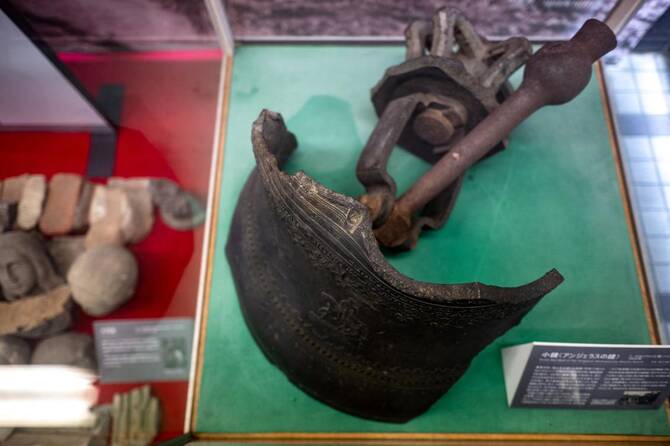
Above, a part of the tower bell (bell of the Angelus), which was destroyed by the atomic bomb, at the atomic bomb relics exhibition room of Urakami Cathedral in Nagasaki city. (AFP)
Short Url
Updated 09 August 2025
Follow

Restored Nagasaki bell rings in 80 years since US atomic bombing

  • On Aug. 9, 1945, at 11:02 a.m., three days after a nuclear attack on Hiroshima, the US dropped an atomic bomb on Nagasaki
  • About 74,000 people were killed in the southwestern port city, on top of the 140,000 killed in Hiroshima

NAGASAKI, Japan: Twin cathedral bells rang in unison Saturday in Japan’s Nagasaki for the first time since the atomic bombing of the city 80 years ago, commemorating the moment the atrocity took place.

On Aug. 9, 1945, at 11:02 a.m., three days after a nuclear attack on Hiroshima, the United States dropped an atomic bomb on Nagasaki.

After heavy downpours Saturday morning, the rain stopped shortly before a moment of silence and ceremony in which Nagasaki mayor Shiro Suzuki urged the world to “stop armed conflicts immediately.”

“Eighty years have passed, and who could have imagined that the world would become like this?

“A crisis that could threaten the survival of humanity, such as a nuclear war, is looming over each and every one of us living on this planet.”

About 74,000 people were killed in the southwestern port city, on top of the 140,000 killed in Hiroshima.

Days later, on Aug. 15, 1945, Japan surrendered, marking the end of World War II.

Historians have debated whether the bombings ultimately saved lives by bringing an end to the conflict and averting a ground invasion.

But those calculations meant little to survivors, many of whom battled decades of physical and psychological trauma, as well as the stigma that often came with being a hibakusha.

Ninety-three-year-old survivor Hiroshi Nishioka, who was just three kilometers from the spot where the bomb exploded, told ceremony attendees of the horror he witnessed as a young teenager.

“Even the lucky ones (who were not severely injured) gradually began to bleed from their gums and lose their hair, and one after another they died,” he recalled.

“Even though the war was over, the atomic bomb brought invisible terror.”

Nagasaki resident Atsuko Higuchi said it “made her happy” that everyone would remember the city’s victims.

“Instead of thinking that these events belong to the past, we must remember that these are real events that took place,” the 50-year-old said.

On Saturday, the two bells of Nagasaki’s Immaculate Conception Cathedral rang together for the first time since 1945.

The imposing red-brick cathedral, with its twin bell towers atop a hill, was rebuilt in 1959 after it was almost completely destroyed in the monstrous explosion just a few hundred meters away.

Only one of its two bells was recovered from the rubble, leaving the northern tower silent.

With funds from US churchgoers, a new bell was constructed and restored to the tower, and chimed Saturday at the exact moment the bomb was dropped.

The cathedral’s chief priest, Kenichi Yamamura, said the bell’s restoration “shows the greatness of humanity.”

“It’s not about forgetting the wounds of the past but recognizing them and taking action to repair and rebuild, and in doing so, working together for peace,” Yamamura said.

He also sees the chimes as a message to the world, shaken by multiple conflicts and caught in a frantic new arms race.

“We should not respond to violence with violence, but rather demonstrate through our way of living, praying, how senseless it is to take another’s life,” he said.

Nearly 100 countries were set to participate in this year’s commemorations, including Russia, which has not been invited since its 2022 invasion of Ukraine.

Israel, whose ambassador was not invited last year over the war in Gaza, was in attendance.

An American university professor, whose grandfather participated in the Manhattan Project, which developed the first nuclear weapons, spearheaded the bell project.

During his research in Nagasaki, a Japanese Christian told him he would like to hear the two bells of the cathedral ring together in his lifetime.

Inspired by the idea, James Nolan, a sociology professor at Williams College in Massachusetts, embarked on a year-long series of lectures about the atomic bomb across the United States, primarily in churches.

He managed to raise $125,000 from American Catholics to fund the new bell.

When it was unveiled in Nagasaki in the spring, “the reactions were magnificent. There were people literally in tears,” said Nolan.

Many American Catholics he met were also unaware of the painful history of Nagasaki’s Christians, who, converted in the 16th century by the first European missionaries and then persecuted by Japanese shoguns, kept their faith alive clandestinely for over 250 years.

This story was told in the novel “Silence” by Shusaku Endo, and adapted into a film by Martin Scorsese in 2016.

He explains that American Catholics also showed “compassion and sadness” upon hearing about the perseverance of Nagasaki’s Christians after the atomic bomb, which killed 8,500 of the parish’s 12,000 faithful.

They were inspired by the “willingness to forgive and rebuild.”


Australia to toughen gun laws as it mourns deadly Bondi attack

Updated 16 December 2025
Follow

Australia to toughen gun laws as it mourns deadly Bondi attack

  • Footage showed one man, identified by local media as fruit seller Ahmed al Ahmed, grabbing one of the gunmen as he fired
  • Prime Minister Anthony Albanese convened a meeting of leaders of Australia’s states and territories in response on Monday, agreeing with them “to strengthen gun laws across the nation”

SYDNEY: Australia’s leaders have agreed to toughen gun laws after attackers killed 15 people at a Jewish festival on Bondi Beach, the worst mass shooting in decades decried as antisemitic “terrorism” by authorities.
Dozens fled in panic as a father and son fired into crowds packing the Sydney beach for the start of Hanukkah on Sunday evening.
A 10-year-old girl, a Holocaust survivor and a local rabbi were among those killed, while 42 others were rushed to hospital with gunshot wounds and other injuries.
Prime Minister Anthony Albanese convened a meeting of leaders of Australia’s states and territories in response on Monday, agreeing with them “to strengthen gun laws across the nation.”
Albanese’s office said they agreed to explore ways to improve background checks for firearm owners, bar non-nationals from obtaining gun licenses and limit the types of weapons that are legal.
Mass shootings have been rare in Australia since a lone gunman killed 35 people in the town of Port Arthur in 1996, which led to sweeping reforms long seen as a gold standard worldwide.
Those included a gun buyback scheme, a national firearms register and a crackdown on ownership of semi-automatic weapons.
But Sunday’s shooting has raised fresh questions about how the two suspects — who public broadcaster ABC reported had possible links to the Daesh group — obtained the guns.

- ‘An act of pure evil’ -

Police are still unraveling what drove Sunday’s attack, although authorities have said it targeted Jews.
Albanese called it “an act of pure evil, an act of antisemitism, an act of terrorism on our shores.”
A string of antisemitic attacks has spread fear among Australia’s Jewish communities after the October 7, 2023, Hamas assault on Israel and the ensuing war in Gaza.
The Australian government this year accused Iran of orchestrating a recent wave of antisemitic attacks and expelled Tehran’s ambassador nearly four months ago.
But Israeli Prime Minister Benjamin Netanyahu accused Australia’s government of “pouring oil on the fire of antisemitism” in the months before the shooting, referring to Canberra’s announcement that it would recognize Palestinian statehood in August.
Other world leaders expressed revulsion, with US President Donald Trump condemning the “antisemitic attack.”
The gunmen opened fire on an annual celebration that drew more than 1,000 people to the beach to mark Hanukkah.
They took aim from a raised boardwalk at a beach packed with swimmers cooling off on the steamy summer evening.
Witness Beatrice was celebrating her birthday and had just blown out the candles when the shooting started.
“We thought it was fireworks,” she told AFP. “We’re just feeling lucky we’re all safe.”
Carrying long-barrelled guns, they peppered the beach with bullets for 10 minutes before police shot and killed the 50-year-old father.
The 24-year-old son was arrested and remains under guard in hospital with serious injuries.
Australian media named the suspects as Sajid Akram and his son Naveed Akram.
Tony Burke, the home affairs minister, said the father arrived in Australia on a student visa in 1998 and had become a permanent resident. The son was an Australia-born citizen.
Hours after the shooting, police found a homemade bomb in a car parked close to the beach, saying the “improvised explosive device” had likely been planted by the pair.
Rabbi Mendel Kastel said his brother-in-law was among the dead.
“We need to hold strong. This is not the Australia that we know. This is not the Australia that we want.”
Wary of reprisals, police have so far avoided questions about the attackers’ religion or ideological motivations.
Misinformation spread quickly online after the attacks, some of it targeting immigrants and the Muslim community.
Police said they responded to reports on Monday of several pig heads left at a Muslim cemetery in southwestern Sydney.

- Panic and bravery -

A brave few dashed toward the beach as the shooting unfolded, wading through fleeing crowds to rescue children, treat the injured and confront the gunmen.
Footage showed one man, identified by local media as fruit seller Ahmed al Ahmed, grabbing one of the gunmen as he fired.
The 43-year-old wrestled the gun out of the attacker’s hands, before pointing the weapon at him as he backed away.
A team of off-duty lifeguards sprinted across the sand to drag children to safety.
“The team ran out under fire to try and clear children from the playground while the gunmen were firing,” said Steven Pearce from Surf Life Saving New South Wales.
Bleeding victims were carried across the beach atop surfboards turned into makeshift stretchers.
On Monday evening, a flower memorial next to Bondi Beach swelled in size as mourners gathered.
Hundreds, including members of the Jewish community, sang songs, clapped and held each other.
Leading a ceremony to light a menorah candle, a rabbi told the crowd: “The only strength we have is if we bring light into the world.”