

ICC unseals Libya war crimes warrant for militia officer

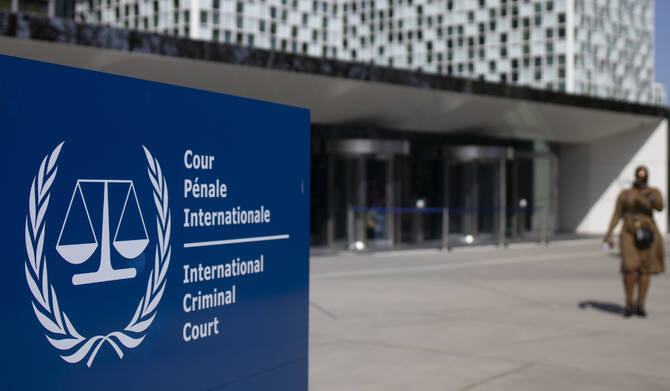
A view of the exterior view of the International Criminal Court in The Hague, Netherlands, Wednesday, March 31, 2021. (AP file photo)
Short Url
Updated 09 August 2025
Follow

ICC unseals Libya war crimes warrant for militia officer

  • The crimes were allegedly committed in Benghazi or surrounding areas, in Libya, on or before June 3, 2016 until on or about July 17, 2017

THE HAGUE: The International Criminal Court on Friday unsealed an arrest warrant for a Libyan militia member accused of war crimes including murder and torture between 2016 and 2017.
The court said there were “reasonable grounds to believe” that Saif Suleiman Sneidel was responsible for war crimes of murder, torture and “outrages upon personal dignity.”
The November 2020 warrant found “reasonable grounds to believe that Mr.Sneidel participated in three executions where a total of 23 people were murdered,” the ICC’s prosecutor’s office said in a statement.
The crimes were allegedly committed in Benghazi or surrounding areas, in Libya, on or before June 3, 2016 until on or about July 17, 2017.
The prosecutor’s office said Sneidel’s arrest warrant had been issued under seal to “maximize arrest opportunities” and to minimize risks to the criminal investigation.
“For this reason, no details of the application or warrant could be provided until this stage,” it said.
The decision to make it public followed a second application by the prosecutor’s office to “increase prospects for arrest.”
“We hope to create the momentum for Mr.Sneidel’s arrest and surrender,” said deputy prosecutor Nazhat Shameem Khan said.
“The Court can now discuss issues related to possible arrest with States, the UN Security Council, and the international community at large, fostering support and cooperation.”

Sneidel is believed to have been serving in Group 50, a sub-unit of the Al-Saiqa Brigade led by the the late Libyan commander, Mahmoud Mustafa Busayf Al-Werfalli.
Prior to his death, Al-Werfalli was the subject of two ICC arrest warrants for eight executions in Benghazi, three of which the prosecution alleges Sneidel took part in.
“The prosecution alleges that Mr.Sneidel was a close associate of Mr.Al-Werfalli, and had an important leadership role alongside him in the Al-Saiqa Brigade,” the statement said.
The ICC has been investigating atrocities in Libya since 2011, following a referral from the United Nations Security Council.
The ICC also confirmed that another Libyan suspect, Khaled Mohamed Ali El Hishri, had been arrested by German authorities on July 16, 2025 for war crimes and crimes against humanity.
He remains in custody in Germany pending legal proceedings.
Libya has faced years of instability, militia violence and fractured government since Qaddafi was overthrown and killed in 2011 near his hometown of Sirte during the Arab Spring uprising.


Ireland moves to buy military radar system from France

Updated 6 sec ago
Follow

Ireland moves to buy military radar system from France

  • The EU member “will now immediately commence detailed negotiations with France on a potential agreement“
  • Media reports estimate the cost of the new MRP system at $350-$585 million

DUBLIN: Ireland said Wednesday it plans to buy a multi-million euro military radar system from France as it prepares to host the rotating EU presidency next year amid concerns over its defense capability.
The EU member “will now immediately commence detailed negotiations with France on a potential agreement” following cabinet approval, said a statement on the government website.
A government-level approach with one country was “the only feasible way for Ireland to develop the required radar capabilities,” it said.
“This approach guarantees the use of the experience and knowledge of a trusted partner country which cannot be provided through any other option,” it said.
Media reports estimate the cost of the new “Military Radar Programme” (MRP) system at between 300 and 500 million euros ($350-$585 million).
The move comes after several unidentified drones blamed on pro-Russian actors were spotted off the Irish coast near Dublin around the time Ukrainian President Volodymyr Zelensky arrived in the Irish capital for a one-day visit earlier this month.
The incident emerged in a local media report only after Zelensky had left Ireland, sparking doubts over its defense capability.
The militarily neutral country which will host EU leaders summit meetings when it takes over the six-month bloc presidency in July next year maintains a small army and has no combat air force or large naval fleet.
The government is also “in final negotiations to conclude a contract before the end of the year” to provide counter-drone technology in advance of the EU presidency, Defense Minister Helen McEntee said in a statement on Wednesday.
“My department will work with the (Irish) Defense Forces to ensure that they have the capacity to identify and neutralize threats posed by drones,” she said.