

Officials estimate losses after fires gut factory, damage four other plants in Pakistan’s Karachi

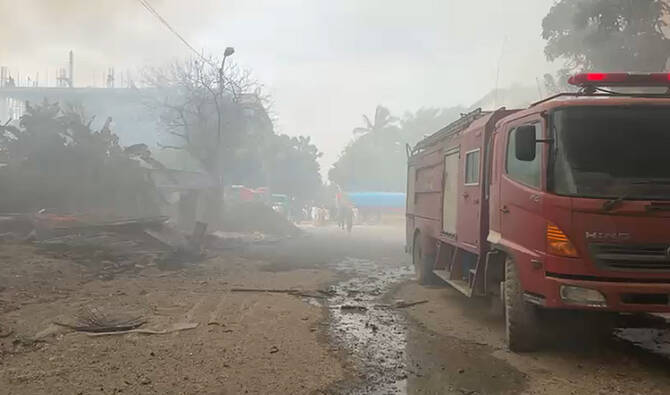
A Fire truck is seen parked at the site in Karachi where a fire broke out in the garment factory on August 7, 2025. (Rescue 1122)
Short Url
Updated 08 August 2025
Follow

Officials estimate losses after fires gut factory, damage four other plants in Pakistan’s Karachi

  • Factory fires are common in Karachi, where industrial zones often suffer from poor safety standards and inadequate enforcement of regulations
  • In Nov., a blaze killed around a dozen people at a shopping mall, while more than 250 people were killed in the deadliest such incident in 2012

KARACHI: Officials were assessing damages after two fires gutted a garments factory and damaged four other manufacturing plants in Pakistan’s commercial capital of Karachi, they said on Friday.

In the first incident, a blaze broke out at the MashaAllah Factory, which processes imported second-hand clothing, and led to the total collapse of the building, according to Hasaan Khan, a spokesperson of Sindh Rescue 1122 service.

At least seven people were injured who were shifted to hospital, while the blaze later engulfed three nearby plants located within the Landhi Export Processing Zone.

“During the cooling-off period, another factory, named Home Furnishings, caught fire at around 11:30pm on Thursday,” Khan told Arab News.

“Our teams were present close to the site and immediately doused the blaze.”

The official said they were estimating losses and ascertaining the causes of the fires.

Factory fires are common in Karachi, a city of over 20 million, where industrial zones often suffer from poor safety standards, lack of fire exits, and inadequate enforcement of regulations.

In Nov. last year, a blaze at a shopping mall killed around a dozen people and injured several others. In April 2023, four firefighters died and nearly a dozen others were injured after a blaze erupted at a garment factory, while 10 people were killed in a massive fire at a chemical factory in the city in August 2021.

In the deadliest such incident, 260 people were killed in 2012 after being trapped inside a garment factory when a fire broke out.

Despite frequent incidents, industrial safety remains a persistent concern in the city, putting thousands of laborers and residents at ongoing risk.


Pakistan transporters call off five-day strike after successful talks with Punjab government

Updated 5 sec ago
Follow

Pakistan transporters call off five-day strike after successful talks with Punjab government

  • Transporters went on strike against heavy fines, penalties imposed by Punjab over traffic violations
  • Punjab government sets up committee to resolve transporters issues, confirms provincial minister

ISLAMABAD: Pakistani goods transporters called off their five-day-long nationwide strike on Friday after successful talks with the Punjab government, officials and transporters confirmed, as the business community warned of an impending economic crisis if the dispute stayed unresolved. 

Transporters went on a nationwide strike on Dec. 8 against stringent traffic rules and heavy fines imposed by the Punjab government over traffic violations. These penalties were included in the Motor Vehicle Ordinance 2025 last month. 

The ordinance details hefty fines ranging from Rs2000 [$7] to Rs50,000 [$178] and mentions prison sentences going up to six months for various offenses committed by drivers, such as driving on the wrong side of the road or driving in vehicles with tinted windows. 

“Yes, the strike has been called off after our meeting with Senior Minister of Punjab Marriyum Aurangzeb,” Nabeel Tariq, president of the All Pakistan Goods Transport Association (APGTA), told Arab News. 

Tariq said fines ranging from Rs1000 ($3.6) to Rs1500 ($5.4) for traffic violations have been increased to around Rs20,000 ($71.3) as per the new rules. 

He said the APGTA has agreed to accept a 100 percent or even 200 percent hike in fines. However, he said an increase of 2000 percent was not “logical.”

“Our urgent demands have been accepted and a committee has been formed to review the ordinance and come up with recommendations,” Tariq said. 

Speaking to Arab News, Aurangzeb confirmed the strike had been called off after talks with the Punjab government and that a committee has been formed to resolve the transporters’ issues. 

The committee will be headed by Aurangzeb and will include representatives of goods transporters, a statement issued by her office said. 

“The government wants to protect human lives and make things better for all citizens,” the statement said. “We will resolve the issues (with transporters) amicably.” 

‘UNPRECEDENTED CRISIS’

Pakistan’s business and industrial community, meanwhile, warned of an impending crisis if the disputed was not resolved. 

The All Pakistan Textile Mills Association (APTMA) and the Karachi Chamber of Commerce and Industry (KCCI) have both appealed for immediate government intervention.

Imdad Hussain Naqvi, president of the Grand Transport Alliance Pakistan (GTAP), told Arab News that over 400,000 goods carriers had been stranded across Pakistan due to the strike, affecting supplies to millions of consumers.

Earlier, in a letter to Punjab Chief Minister Maryam Nawaz, APTMA Chairman Kamran Arshad said the strike has “critically impacted import and export operations which are backbone of the country’s economy.”

He said hundreds of cargo vehicles remain stranded across Punjab, creating “abnormal delays” in goods movement and triggering heavy demurrage, detention charges, missed vessels and production shutdowns due to the non-availability of raw materials.

Arshad warned the disruption poses “a serious risk of order cancelation of export orders by international buyers, which would have far-reaching consequences for Pakistan’s foreign exchange earnings.”

Meanwhile in Pakistan’s commercial hub Karachi, KCCI President Rehan Hanif issued an even stronger warning, saying the nationwide strike threatens to paralyze Pakistan’s economic lifeline. 

“The complete suspension of cargo movement is pushing Pakistan toward an unprecedented trade and industrial crisis,” Hanif said in a statement. 

He added that import and export consignments are now stranded at the city’s ports, highways and industrial zones.