Lebanon takes first steps toward arms reform as Hezbollah pushes back

1 / 2
Lebanese President Joseph Aoun, Lebanese Prime Minister Nawaf Salam and members of the Lebanese cabinet meet to discuss efforts to bring all weapons in the country under the control of the state, at the Presidential Palace in Baabda, Aug. 5, 2025. (Reuters)
2 / 2
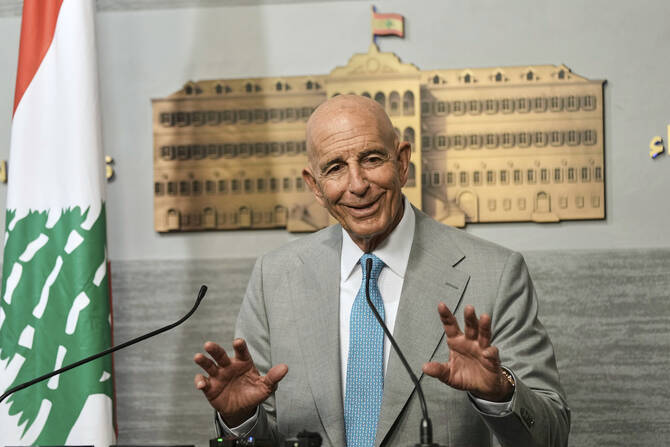
US envoy Tom Barrack said on Thursday Lebanon's government had taken a "historic" decision this week by moving to disarm Iran-backed group Hezbollah, which Washington has pushed for. (AP/File)
Short Url
Updated 09 August 2025
Follow

Lebanon takes first steps toward arms reform as Hezbollah pushes back

  • Cabinet convenes to approve US proposal on state weapons monopoly
  • Hezbollah, Amal ministers walk out in protest as demonstrations take place in key strongholds

BEIRUT: Lebanon entered a new phase on Thursday evening after approving the restriction of all weapons to state control, including those held by Hezbollah and other militias, and endorsing the objectives outlined in the US-brokered executive mechanism.

President Joseph Aoun underscored this shift on Friday, stressing the importance of “linking Lebanon to its regional environment,” adding that though reform is underway, “no one can deny that the road ahead will be difficult.”

Following Tuesday’s marathon session, the Lebanese Cabinet reconvened on Thursday evening to continue discussing US Special Envoy Thomas Barrack’s proposal to “ensure that the possession of weapons is restricted solely to the state.”

All ministers were present, including representatives of Hezbollah and the Amal Movement.

The Cabinet ultimately approved the proposal’s objectives after four ministers aligned with Amal and Hezbollah left in protest, claiming the government had “insisted on approving this section” without granting them ”the opportunity to review it.”

The walkout was followed by protests on Thursday night in Beirut’s southern suburbs, as well as in the Bekaa and southern regions, with Hezbollah and Amal supporters taking to the streets on motorcycles, chanting slogans against the decision.

The protests persisted until nearly midnight, remaining contained and not extending into the capital, amid security measures taken by the Lebanese Armed Forces.

Social media platforms were flooded with activist posts denouncing the surrender of Hezbollah’s weapons.

Overnight, Hezbollah and the Amal Movement, through their sources, leaked to the media the announcement that “the withdrawal of our four ministers from the Cabinet session will not lead to a resignation.

“The decisions taken are clearly aimed at pushing us into a confrontation with the army, and that will not happen,” they said. “We are committed to: no surrender of weapons, no clashes in the streets, no confrontation with the army, and no resignation from the government. The weapons issue requires thorough and comprehensive discussion, with Lebanon’s national interest as the top priority, and this is being addressed in coordination with the Lebanese army through agreement on a national strategy.”

A political source who attended Thursday night’s Cabinet session told Arab News: “The Shiite ministers’ actions were merely a way to register their objection, nothing beyond that.

“The Lebanese Army Command has been tasked with preparing a plan to enforce the state’s exclusive control over weapons, which will be presented to the Cabinet at the end of this month, followed by detailed discussions.”

The source added that the decision is final, with a clear implementation deadline set for the end of the year.

Information Minister Paul Morcos said that, during its Thursday evening session, the Cabinet “approved the objectives outlined in the introduction of the US paper aimed at consolidating the cessation of hostilities agreement,” but that final decisions will be made once the Army Command submits its executive plan.

Morcos explained that Aoun had hoped the four ministers would remain and take part in the session, but they opted to walk out to avoid being present when the decision was finalized.

The Cabinet approved the preamble to the US paper without delving into its detailed provisions.

The proposal’s key objectives include establishing the state’s exclusive control over all arms, extending state sovereignty across all Lebanese territory, ensuring the durability of the cessation of hostilities, and ending the armed presence of all non-governmental actors, including Hezbollah, throughout the country.

It also includes securing Israel’s withdrawal from the five disputed points in southern Lebanon, resolving border and prisoner issues diplomatically through indirect negotiations, enabling the return of civilians to border villages and towns, completing border demarcation, and convening an economic conference to support Lebanon’s economy and reconstruction efforts.

Hezbollah, however, considers “the US paper to be a substitute for the ceasefire agreement reached in November 2024” and has repeatedly rejected it. The party insists that “Israel must first implement the terms of that agreement before any discussion can take place regarding the withdrawal of Hezbollah’s weapons.”

Former MP Fares Souaid, a leader of the Cedar Revolution that emerged after the assassination of former Prime Minister Rafik Hariri, stated: “The Cabinet’s decision closes a chapter that began with the 1969 Cairo Agreement, followed by successive resistance movements on Lebanese soil and culminating in the Islamic Resistance. This is the moment marking the end of resistance movements and the dawn of a new era for the entire region.”

Souaid described the protests by ministers and activists as “calculated moves and predictable reactions.” He said that while Hezbollah may continue to protest, it will be unable to alter the course of events, calling Thursday’s demonstrations “a protest with no prospects”.

He continued: “Hezbollah has lost its existential purpose. It cannot engage in politics dressed in camouflage, and even if it removes the uniform, the reality remains unchanged. Its continued existence is meaningless, a mere illusion. We may soon witness the rise of a new, alternative party to fill the void.”

Academic and political writer Hareth Sleiman dismissed the protests and the withdrawal of the ministers as “a storm in a teacup that blew over the very next day.”

He explained: “Given its mobilization, ideology, and rhetoric, Hezbollah cannot openly tell its supporters that it will surrender its weapons. Instead, it seeks to frame the decision as something imposed upon it, while portraying itself as acting to preserve civil peace in the country.”

Hezbollah, represented by Parliament Speaker Nabih Berri, played a key role in negotiating and approving the ceasefire deal with Israel. Although the party has started to follow through on the agreement, dissent within its ranks has since emerged. Still, the move toward consolidating all arms under state control is now underway.

“Hezbollah may accept defeat in the face of Israel, but it cannot afford to appear defeated before its own supporters,” continued Sleiman. “Notably, many of the activists protesting on social media are not defending the party’s weapons, but rather their own salaries.”

Sleiman stressed that the majority of the Shia community in Lebanon does not support the continuation of the current reality.

“What is gained by holding onto the weapons? The south is devastated, Israel continues to kill, assassinate, and violate sovereignty, and there is no longer any possibility of rearming or transferring Iranian weapons through Syria. Waiting for the cards to be reshuffled only means prolonging the catastrophe,” he said.

“Today, the Lebanese state is working to erase Hezbollah’s past sins, save the south and its people, and put the country on the road to recovery, while those protesting do so shamelessly. The Shiites of Lebanon refuse to see their fate become that of the people of Gaza. Enough.”


Morocco aims to boost legal cannabis farming and tap a global boom

Updated 4 sec ago
Follow

Morocco aims to boost legal cannabis farming and tap a global boom

BAB BERRED: Since he started growing cannabis at 14, Mohamed Makhlouf has lived in the shadows, losing sleep while bracing for a knock on his door from authorities that could mean prison or his entire harvest confiscated.
But after decades of operating in secret, Makhlouf finally has gained peace of mind as Morocco expands legal cultivation and works to integrate veteran growers like him into the formal economy.
On his farmland deep in the Rif Mountains, stalks of a government-approved cannabis strain rise from the earth in dense clusters. He notices when police pass on a nearby road. But where the crop’s aroma once meant danger, today there is no cause for concern. They know he sells to a local cooperative.
“Legalization is freedom,” Makhlouf said. “If you want your work to be clean, you work with the companies and within the law.”
The 70-year-old Makhlouf’s story mirrors the experience of a small but growing number of farmers who started in Morocco’s vast black market but now sell legally to cooperatives producing cannabis for medicinal and industrial use.
New market begins to sprout
Morocco is the world’s biggest producer of cannabis and top supplier of the resin used to make hashish. For years, authorities have oscillated between looking the other way and cracking down, even as the economy directly or indirectly supports hundreds of thousands of people in the Rif Mountains, according to United Nations reports and government data.
Abdelsalam Amraji, another cannabis farmer who joined the legal industry, said the crop is crucial to keeping the community afloat.
“Local farmers have tried cultivating wheat, nuts, apples, and other crops, but none have yielded viable results,” he said.
The region is known as an epicenter of anti-government sentiment and growers have lived for years with arrest warrants hanging over them. They avoided cities and towns. Many saw their fields burned in government campaigns targeting cultivation.
Though cannabis can fetch higher prices on the black market, the decreased risk is worth it, Amraji said.
“Making money in the illegal field brings fear and problems,” he said. “When everything is legal, none of that happens.”
Market remains under tight regulation
The change began in 2021 when Morocco became the first major illegal cannabis producer, and the first Muslim-majority country, to pass a law legalizing certain forms of cultivation.
Officials heralded the move as a way to lift small-scale farmers like Makhlouf and Amraji out of poverty and integrate cannabis-growing regions into the economy after decades of marginalization.
In 2024, King Mohammed VI pardoned more than 4,800 farmers serving prison sentences to allow longtime growers “to integrate into the new strategy,” the justice ministry said at the time.
Since legalization was enacted in 2022, Morocco has tightly regulated every step of production and sale from seeds and pesticides to farming licenses and distribution. Though certain cultivation is authorized, officials have shown no sign of moving toward legalization or reforms targeting recreational consumers.
“We have two contradictory missions that are really to allow the same project to succeed in the same environment,” said Mohammed El Guerrouj, director-general of Morocco’s cannabis regulatory agency. “Our mission as policemen is to enforce regulations. But our mission is also to support farmers and operators so they succeed in their projects.”
Licensing and cooperatives are part of new ecosystem
The agency issued licenses last year to more than 3,371 growers across the Rif and recorded nearly 4,200 tons of legal cannabis produced.
Near the town of Bab Berred, the Biocannat cooperative buys cannabis from roughly 200 small farmers during harvest season. The raw plant is transformed into neat vials of CBD oil, jars of lotion and chocolates that have spread across Morocco’s pharmacy shelves.
Some batches are milled into industrial hemp for textiles. For medicinal use and export, some of the product is refined into products with less than 1 percent THC, the psychoactive compound that gives cannabis its high.
Aziz Makhlouf, the cooperative’s director, said legalization created a whole ecosystem that employed more than just farmers.
“There are those who handle packaging, those who handle transport, those who handle irrigation — all of it made possible through legalization,” said Makhlouf, a Bab Berred native whose family has long been involved in cannabis farming.
Legalization has brought licenses, formal cooperatives and the hope of steady income without fear of arrest. But the shift also has exposed the limits of reform. The legal market remains too small to absorb the hundreds of thousands who depend on the illicit trade and the new rules have introduced more pressures, farmers and experts say.
Protests erupted in parts of nearby Taounate in August after cooperatives there failed to pay growers for their crop. Farmers waved banners reading “No legalization without rights” and “Enough procrastination,” furious that payments they were promised for working legally at the government’s urging never came, local media reported.
Illegal cultivation persists
The government insists the transformation is only beginning and challenges can be overcome.
But black market demand remains high. Today, cannabis is grown legally on 14,300 acres (5,800 hectares) in the Rif, while more than 67,000 acres (27,100 hectares) are used for illegal growing, according to government data. The number of farmers entering the legal system remains tiny compared with the number thought to be tied to the illicit market.
An April report from the Global Institute Against Transnational Organized Crime characterized the industry as “more one of coexistence of both markets than a decisive transition from one to the other.”
“A substantial proportion of the population continue to rely on illicit cannabis networks for income generation, perpetuating the dynamics that the state is trying to reform,” the report said.
For now, Morocco’s two cannabis economies exist side by side — one regulated and one outlawed — as the country tries to coax a centuries-old trade out of the shadows without leaving its farmers behind.
“Cannabis is legal now, just like mint,” Amraji said. “I never imagined I’d one day be authorized to grow it. I’m shocked.”