

Lebanon cabinet meeting again on Hezbollah disarmament

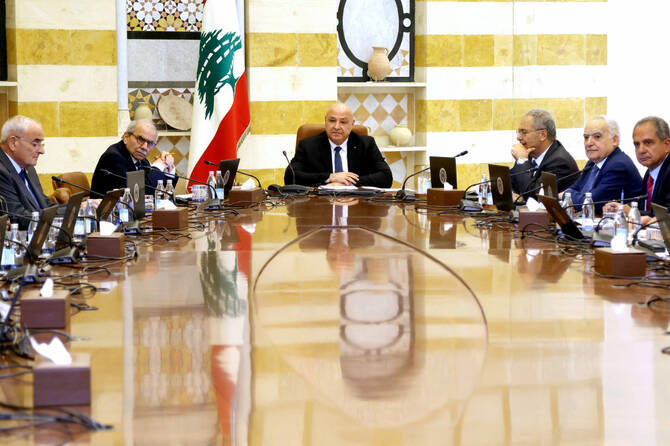
Lebanon's President Joseph Aoun (C) chairing a cabinet session to discuss the issue of disarming Hezbollah at the presidential palace of Baabda east of Beirut. (File/AFP)
Short Url
Updated 07 August 2025
Follow

Lebanon cabinet meeting again on Hezbollah disarmament

  • Amid fears Israel could expand its strikes in Lebanon, Prime Minister Nawaf Salam tasked the army with developing a plan to restrict weapons to government forces by the end of 2025

BEIRUT: Lebanon’s cabinet is set to meet again on Thursday to discuss the thorny task of disarming Hezbollah, a day after the Iran-backed group rejected the government’s decision to take away its weapons.

With Washington pressing Lebanon to take action on the matter, US envoy Tom Barrack has made several visits to Beirut in recent weeks, presenting officials with a proposal that includes a timetable for Hezbollah’s disarmament.

Amid the US pressure and fears Israel could expand its strikes in Lebanon, Prime Minister Nawaf Salam said Tuesday that the government had tasked the army with developing a plan to restrict weapons to government forces by the end of 2025.

The decision is unprecedented since the end of Lebanon’s civil war more than three decades ago, when the country’s armed factions — with the exception of Hezbollah — agreed to surrender their weapons.

The government said the new disarmament push was part of implementing a November ceasefire that sought to end more than a year of hostilities between Israel and Hezbollah.

That conflict culminated last year in two months of full-blown war that left the group badly weakened, both politically and militarily.

Hezbollah said on Wednesday that it would treat the government’s decision to disarm it “as if it did not exist,” accusing the cabinet of committing a “grave sin.”

It added that the move “undermines Lebanon’s sovereignty and gives Israel a free hand to tamper with its security, geography, politics and future existence.”

The Amal movement, Hezbollah’s main ally headed by parliament speaker Nabih Berri, also criticized the move and called Thursday’s cabinet meeting “an opportunity for correction.”

Iran, Hezbollah’s military and financial backer, said on Wednesday that any decision on disarmament “will ultimately rest with Hezbollah itself.”

“We support it from afar, but we do not intervene in its decisions,” Foreign Minister Abbas Araghchi added, saying the group had “rebuilt itself” after the war with Israel.

Two ministers affiliated with Hezbollah and the Amal movement walked out of Tuesday’s meeting on disarmament in protest.

Hezbollah described the walkout as a rejection of the government’s “decision to subject Lebanon to American tutelage and Israeli occupation.”

Citing “political sources” with knowledge of the matter, pro-Hezbollah newspaper Al Akhbar said the group and its Amal allies could choose to withdraw their four ministers from the government or trigger a no-confidence vote in parliament by the Shiite bloc, which comprises 27 of Lebanon’s 128 lawmakers.

Israel — which routinely carries out air strikes in Lebanon despite the ceasefire, saying it is targeting Hezbollah fighters and infrastructure — has already signalled it would not hesitate to launch destructive military operations if Beirut failed to disarm the group.

Israeli strikes in south Lebanon killed two people on Wednesday, according to the Lebanese health ministry.


UN, aid groups warn Gaza operations at risk from Israel impediments

Updated 18 December 2025
Follow

UN, aid groups warn Gaza operations at risk from Israel impediments

  • Dozens of international aid groups face de-registration by December 31, which then means they have to close operations within 60 days

UNITED NATIONS: The United Nations and aid groups warned on Wednesday that humanitarian operations in the Palestinian territories, particularly Gaza, were at risk of collapse if Israel does not lift impediments that include a “vague, arbitrary, and highly politicized” registration process.
Dozens of international aid groups face de-registration by December 31, which then means they have to close operations within 60 days, said the UN and more than 200 local and international aid groups in a joint statement.
“The deregistration of INGOs (international aid groups) in Gaza will have a catastrophic impact on access to essential and basic services,” the statement read.
“INGOs run or support the majority of field hospitals, primary health care centers, emergency shelter responses, water and sanitation services, nutrition stabilization centers for children with acute malnutrition, and critical mine action activities,” it said.

SUPPLIES LEFT OUT OF REACH: GROUPS
While some international aid groups have been registered under the system that was introduced in March, “the ongoing re-registration process and other arbitrary hindrances to humanitarian operations have left millions of dollars’ worth of essential supplies — including food, medical items, hygiene materials, and shelter assistance — stuck outside of Gaza and unable to reach people in need,” the statement read.
Israel’s mission to the United Nations in New York did not immediately respond to a request for comment on the statement. Under the first phase of US President Donald Trump’s Gaza plan, a fragile ceasefire in the two-year-old war between Israel and Palestinian militants Hamas began on October 10. Hamas released hostages, Israel freed detained Palestinians and more aid began flowing into the enclave where a global hunger monitor said in August famine had taken hold.
However, Hamas says fewer aid trucks are entering Gaza than was agreed. Aid agencies say there is far less aid than required, and that Israel is blocking many necessary items from coming in. Israel denies that and says it is abiding by its obligations under the truce.
“The UN will not be able to compensate for the collapse of INGOs’ operations if they are de-registered, and the humanitarian response cannot be replaced by alternative actors operating outside established humanitarian principles,” the statement by the UN and aid groups said.
The statement stressed “humanitarian access is not optional, conditional or political,” adding: “Lifesaving assistance must be allowed to reach Palestinians without further delay.”