

EXPLAINER: Can Lebanon disarm Hezbollah?

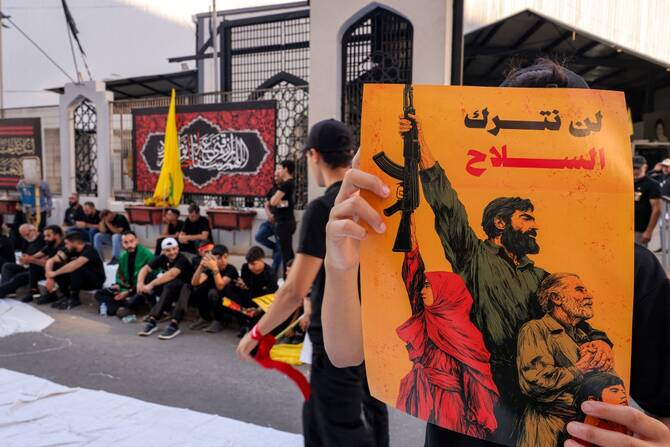
A person holds a sign with the Arabic slogan “we will not relinquish arms” as Lebanese Shiite Hezbollah supporters take part in a ceremony during the peak of Ashura in Beirut's southern suburbs, July 6, 2025. (AFP)
Short Url
Updated 06 August 2025
Follow

EXPLAINER: Can Lebanon disarm Hezbollah?

  • US envoy proposed a roadmap to Lebanese officials to fully disarm Hezbollah in exchange for Israel halting strikes and withdrawing troops
  • Lebanese army has a deadline to submit a disarmament plan of Hezbollah to the government by the end of August

Lebanon’s cabinet has told the army to draw up a plan to establish a state monopoly on arms in a challenge to the Iran-backed Shiite Muslim group Hezbollah, which rejects calls to disarm.

WHY IS THERE A PUSH TO DISARM HEZBOLLAH NOW?
Israel pummelled Hezbollah last year in a war sparked by the conflict in Gaza, killing many of its top brass and 5,000 of its fighters before a November truce brokered by the United States.
That deal committed Lebanon to restricting arms to six specific state security forces, and further stipulated that it should confiscate unauthorized weapons and prevent rearmament by non-state groups.
In the months since, a new Lebanese government vowed to confine arms across the country to state control, Hezbollah’s main arms route was cut when its Syrian ally Bashar Assad was ousted in December and Israel attacked its sponsor Iran in June.
The government is facing pressure from Washington and Hezbollah’s domestic rivals to act swiftly amid fears that Israel could intensify air strikes on Lebanon.
Despite November’s ceasefire, Israel has continued to carry out strikes on what it says are Hezbollah arms depots and fighters, mostly in southern Lebanon.

HOW IS THE UNITED STATES INVOLVED?
In June, US envoy Thomas Barrack proposed a roadmap to Lebanese officials to fully disarm Hezbollah in exchange for Israel halting its strikes on Lebanon and withdrawing its troops from five points they still occupy in southern Lebanon.
But Hezbollah and its main Shiite ally the Amal Movement, led by Parliament Speaker Nabih Berri, say the sequencing should be reversed, with Israel withdrawing and halting strikes before any talks on Hezbollah’s arms.
Washington has grown impatient, demanding the Beirut government make the first move with a formal commitment to disarm Hezbollah.

WHY IS HEZBOLLAH SO WELL-ARMED?
After Lebanon’s 15-year civil war ended in 1990 Hezbollah, founded by Iran’s Revolutionary Guards in 1982, was the only group allowed to keep its weapons on the grounds that it was fighting Israel’s occupation of the country’s south.
After Israel withdrew in 2000 the group did not give up its arms, arguing its ability to fight was still a critical element of national defense against future Israeli aggression.
A ceasefire agreement after a war between Hezbollah and Israel in 2006 was backed by a UN resolution demanding the disarmament of all militant groups — but Hezbollah again kept its weapons, accusing Israel of having violated other parts of the truce deal, which Israel denies.
Hezbollah took over parts of Beirut in fighting in 2008, underscoring its dominance. The group exercised decisive sway over state affairs in the following years as its power grew.

WHAT DOES HEZBOLLAH SAY AND COULD THERE BE CIVIL STRIFE?
Hezbollah has called the government’s decision to ask the army to draw up plans to disarm it a “grave sin” that “fully serves Israel’s interest.”
Hezbollah chief Naim Qassem rejected each clause in Barrack’s roadmap and when he spoke on Tuesday, dozens of motorcycles with men carrying Hezbollah flags drove around the group’s stronghold in Beirut’s southern suburbs — a show of its enduring strength.
Hovering over any attempt to force Hezbollah to disarm is the spectre of previous bouts of civil unrest, including the 2008 fighting, triggered by the government’s attempt to shut down the group’s military telecoms network — an important facility for the group, but still less central than its arms.

WHAT ARE THE POLITICAL COMPLICATIONS?
Lebanon’s power-sharing system apportions public sector posts — including in parliament, the cabinet and other roles — to different religious sects according to quotas.
The system is meant to ensure no sect is cut out of decision making, but critics say it leads to political paralysis.
Shiite representation in both parliament and cabinet is dominated by Hezbollah and its political ally Amal.
Two Shiite ministers were traveling during Tuesday’s cabinet session, and the other two walked out in the final moments as the decision was being taken. Qassem has said any government decision would require a national consensus and may challenge the legitimacy of cabinet decisions taken without Shiites.

WHAT HAPPENS NEXT?
The cabinet decision gave the army a deadline to submit a disarmament plan to the government by the end of August. Another session scheduled for Thursday will discuss Barrack’s proposal.
Some Lebanese parties may keep trying to find a workaround that avoids a confrontation between Hezbollah and the state while warding off heavier Israeli strikes.


US military launches strikes in Syria against Daesh fighters after American deaths

Updated 20 December 2025
Follow

US military launches strikes in Syria against Daesh fighters after American deaths

  • “This is not the beginning of a war — it is a declaration of vengeance,” Defense Secretary Pete Hegseth says
  • President Trump earlier pledged “very serious retaliation” but stressed that Syria was fighting alongside US troops

WASHINGTON: The Trump administration launched military strikes Friday in Syria to “eliminate” Daesh group fighters and weapons sites in retaliation for an ambush attack that killed two US troops and an American interpreter almost a week ago.
A US official described it as “a large-scale” strike that hit 70 targets in areas across central Syria that had Daesh (also known as Islamic State or IS) infrastructure and weapons. Another US official, who also spoke on condition of anonymity to discuss sensitive operations, said more strikes should be expected.
The attack was conducted using F-15 Eagle jets, A-10 Thunderbolt ground attack aircraft and AH-64 Apache helicopters, the officials said. F-16 fighter jets from Jordan and HIMARS rocket artillery also were used, one official said.
“This is not the beginning of a war — it is a declaration of vengeance. The United States of America, under President Trump’s leadership, will never hesitate and never relent to defend our people,” Defense Secretary Pete Hegseth said on social media.


President Donald Trump had pledged “very serious retaliation” after the shooting in the Syrian desert, for which he blamed Daesh. The troops were among hundreds of US troops deployed in eastern Syria as part of a coalition fighting the terrorist group.
Trump in a social media post said the strikes were targeting Daesh “strongholds.” He reiterated his support for Syrian President Ahmad Al-Sharaa, who he said was “fully in support” of the US effort to target the militant group.
Trump also offered an all-caps threat, warning the group against attacking US personnel again.
“All terrorists who are evil enough to attack Americans are hereby warned — YOU WILL BE HIT HARDER THAN YOU HAVE EVER BEEN HIT BEFORE IF YOU, IN ANY WAY, ATTACK OR THREATEN THE USA.,” the president added.
The attack was a major test for the warming ties between the United States and Syria since the ouster of autocratic leader Bashar Assad a year ago. Trump has stressed that Syria was fighting alongside US troops and said Al-Sharaa was “extremely angry and disturbed by this attack,” which came as the US military is expanding its cooperation with Syrian security forces.
Syria’s foreign ministry in a statement on X following the launch of US strikes said that last week’s attack “underscores the urgent necessity of strengthening international cooperation to combat terrorism in all its forms” and that Syria is committed “to fighting Daesh and ensuring that it has no safe havens on Syrian territory and will continue to intensify military operations against it wherever it poses a threat.”


Daesh has not claimed responsibility for the attack on the US service members, but the group has claimed responsibility for two attacks on Syrian security forces since, one of which killed four Syrian soldiers in Idlib province. The group in its statements described Al-Sharaa’s government and army as “apostates.” While Al-Sharaa once led a group affiliated with Al-Qaeda, he has had a long-running enmity with Daesh.
Syrian state television reported that the US strikes hit targets in rural areas of Deir ez-Zor and Raqqa provinces and in the Jabal Al-Amour area near Palmyra. It said they targeted “weapons storage sites and headquarters used by Daesh as launching points for its operations in the region.”

Trump this week met privately with the families of the slain Americans at Dover Air Force Base in Delaware before he joined top military officials and other dignitaries on the tarmac for the dignified transfer, a solemn and largely silent ritual honoring US service members killed in action.

President Donald Trump, from left, Defense Secretary Pete Hegseth and Chairman of the Joint Chiefs Air Force Gen. Dan Caine attend a casualty return ceremony at Dover Air Force Base, Delaware, on Dec. 17, 2025,of soldiers who were killed in an attack in Syria last week. (AP)

The guardsmen killed in Syria last Saturday were Sgt. Edgar Brian Torres-Tovar, 25, of Des Moines, and Sgt. William Nathaniel Howard, 29, of Marshalltown, according to the US Army. Ayad Mansoor Sakat, of Macomb, Michigan, a US civilian working as an interpreter, was also killed.
The shooting nearly a week ago near the historic city of Palmyra also wounded three other US troops as well as members of Syria’s security forces, and the gunman was killed. The assailant had joined Syria’s internal security forces as a base security guard two months ago and recently was reassigned because of suspicions that he might be affiliated with Daesh, Interior Ministry spokesperson Nour Al-Din Al-Baba has said.
The man stormed a meeting between US and Syrian security officials who were having lunch together and opened fire after clashing with Syrian guards.
When asked for further information, the Pentagon referred AP to Hegseth’s social media post.