OIC blames Kashmir dispute for latest India-Pakistan standoff, urges peaceful resolution

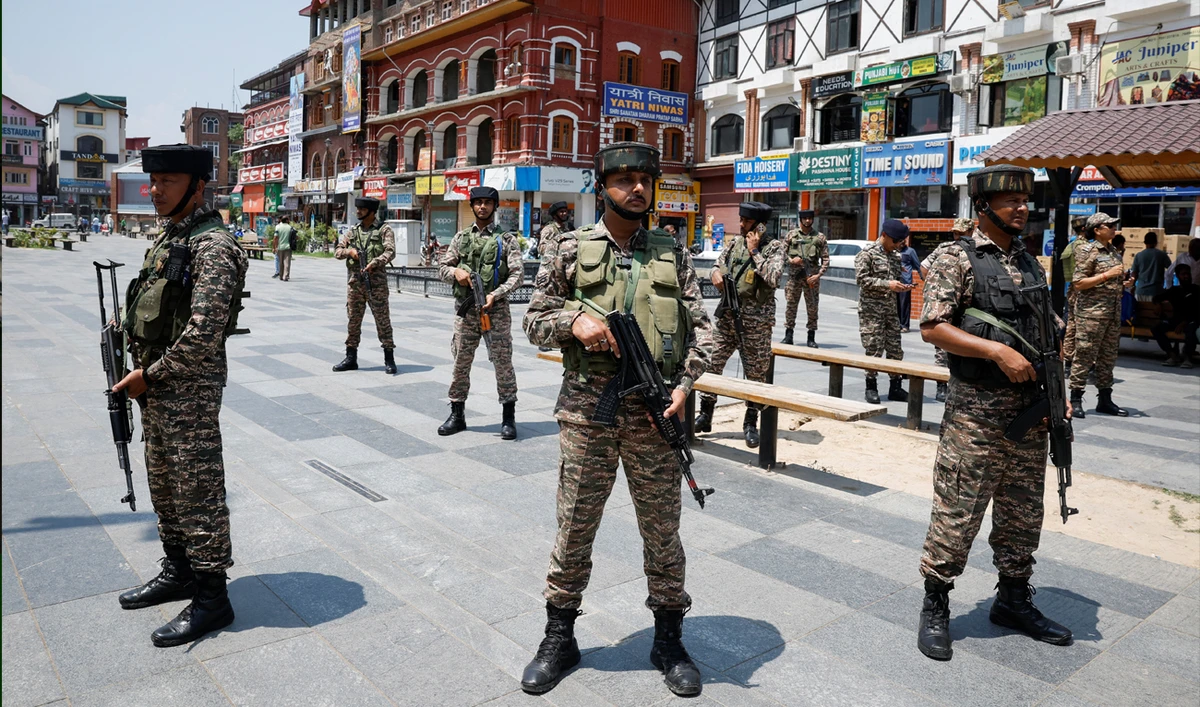
Indian security personnel stand guard on a street during the sixth anniversary of the revocation of Jammu and Kashmir’s partial autonomy, splitting the state into the two federally administered territories of Jammu and Kashmir and Ladakh, in Srinagar, Indian-administered Kashmir on August 5, 2025. (REUTERS)
Short Url
Updated 07 August 2025
Follow

OIC blames Kashmir dispute for latest India-Pakistan standoff, urges peaceful resolution

  • OIC criticizes India’s 2019 revocation of Kashmir’s special status, demographic changes in the disputed region
  • It urges adherence to agreements like the Indus Waters Treaty, calls for dialogue between the two neighbors

ISLAMABAD: The Organization of Islamic Cooperation (OIC) on Wednesday said the recent standoff between India and Pakistan was rooted in the unresolved Kashmir dispute, urging the global community to press New Delhi for a “peaceful and expeditious” settlement to ensure regional stability.

The remarks came during an event marking the sixth anniversary of India’s 2019 decision to revoke the special constitutional status of Jammu and Kashmir and integrate the Muslim-majority Himalayan region into the rest of the Indian union. The move triggered a sharp response from Pakistan, which downgraded diplomatic ties, a situation that remains unresolved. Both countries claim Kashmir in full but control only parts of it.

Speaking at the United Nations, OIC Permanent Observer Ambassador Hameed Opeloyeru linked the latest military escalation to the decades-old territorial conflict.

Earlier this year, India and Pakistan engaged in a brief but intense four-day exchange of drone strikes, missiles and artillery fire in May, following a gun attack on tourists in the Indian-administered town of Pahalgam. New Delhi blamed Islamabad for the attack, while Pakistan denied any involvement and demanded an independent probe.

“The OIC has continued to renew its call on the global community to lean on the Government of India to allow an expeditious but peaceful resolution of the Jammu Kashmir dispute, in line with the UN Charter and the basic principles of international law,” Opeloyeru said. “Without doubt, the people of Jammu Kashmir do enjoy the inalienable rights to self-determination as established under international law, including the UN Charter.”

“It is evident that the unresolved Kashmir dispute is the root cause of the recent hostilities in West Asia,” he added. “To this end, the OIC promptly expressed its concern on the Pahalgam attack on Azad Jammu and Kashmir on 22 April 2025 and later welcomed the ceasefire, which was established on 10 May 2025 and which continues to hold.”

The OIC also criticized India’s decision to suspend the 1960 Indus Waters Treaty, a World Bank-brokered agreement governing river water distribution with Pakistan, in the aftermath of the Pahalgam attack. Islamabad has already described such a move as “an act of war,” though the OIC has urged both sides to adhere to bilateral agreements and resume dialogue.

At the same event, the OIC reiterated its rejection of India’s 2019 revocation of Kashmir’s special status and what it described as efforts to alter the region’s demography. The group reaffirmed its support for the Kashmiri people’s “legitimate struggle” for self-determination, citing resolutions adopted at its ministerial session in Istanbul in June 2025.


Pakistan’s Mahnoor Omer named among TIME’s ‘Women of the Year’ for 2026

Updated 01 March 2026
Follow

Pakistan’s Mahnoor Omer named among TIME’s ‘Women of the Year’ for 2026

  • Omer moved a Pakistani court against the so-called ‘period tax’ in Sept. 2025 which has since sparked a national debate
  • Taxes on sanitary pads in Pakistan can add up to 40 percent to retail price, UNICEF says only around 12 percent women use such products

ISLAMABAD: Pakistani women’s rights activist Mahnoor Omer, who fought against taxes on menstrual products, has been named among the TIME magazine’s ‘Women of the Year’ for 2026.

Omer’s efforts have been recognized alongside 16 activists, artists, athletes and businesswomen in the TIME’s Women of the Year 2026 list, including Olympic gold medalist Sydney McLaughlin-Levrone and Oscar-nominated filmmaker Chloe Zhao.

Dissatisfied with the efforts to educate Pakistani girls about sexual violence, Omer founded the Noor Foundation at the age of 14 and held her own workshops with village girls about everything from climate change to menstruation, according to the TIME magazine.

Two years later, a conversation with a domestic worker about the price of pads made her realize that not everyone could afford these essentials. She moved a court against the so-called “period tax” in Sept. 2025 and the case has sparked a national debate on the subject, considered a taboo by many in Pakistan, since its first hearing late last year.

“A decade and one law degree after her interest in activism was sparked, Omer, now 25, is putting her passion and expertise to work in the name of gender equity,” TIME wrote about Omer on its website.

Taxes imposed on sanitary products in Pakistan can add up to 40 percent to the retail price. UNICEF estimates just 12 percent of women in the country use commercially produced pads or tampons. The alternative, using cloth, risks health impacts including rashes and infections, and can make it impossible for girls to attend school while menstruating.

Omer’s suit, which awaits the government response, has sparked a national discussion. She says she spoke about menstruation to her father and male cousins, who thanked her for standing up for their daughters.
The 25-year-old, who is currently enrolled in a master’s degree in gender, peace, and security at the London School of Economics, sees this case as just the first of many.

“I’m not free until every woman is free,” she was quoted as saying by TIME. “I want to leave no stones unturned in terms of what I can do with the next few decades, as a lawyer for the women in my country and gender minorities in general.”