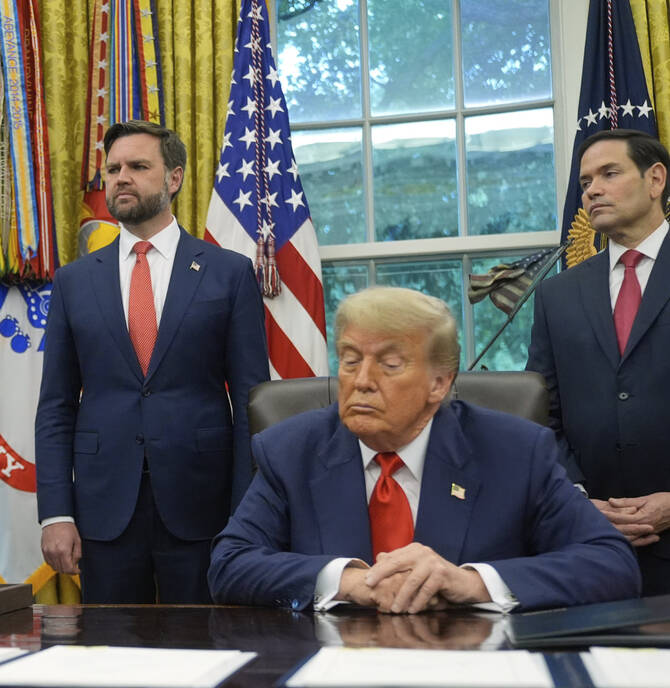
WASHINGTON: Although President Donald Trump has not directly said he thinks JD Vance should be the heir to his “Make America Great Again” base of support, he acknowledged this week that his vice president is probably the favorite to succeed him “at this point.”
But even as he promoted Vance, Trump also made sure to mention Secretary of State Marco Rubio, telling reporters at the White House on Tuesday that his administration’s top diplomat is “somebody that maybe would get together with JD in some form” on a future political ticket.
The remarks reflect the massive influence the Republican president currently has over his party. They also serve to promote two of Trump’s top advisers without telegraphing the president’s singular preference for a successor. Not definitively anointing Vance, or any other Republican, keeps those hoping to succeed Trump vying for his favor, both inside his administration and in the wider Republican field of possible contenders.
It’s early for the 2028 presidential field to begin forming, and other contenders will ultimately emerge. A challenge for anyone wading into the race, even with strong Trump connections, will be staying in the president’s good graces for the duration.
Speaking with reporters following an executive order signing at the White House, Trump was asked if Vance were the “heir apparent to MAGA.”
“I think most likely, in all fairness, he’s the vice president,” Trump said. “I think Marco is also somebody that maybe would get together with JD in some form. ... It’s too early obviously, to talk about it, but certainly he’s doing a great job and he would be, probably favored at this point.”
When Trump selected the then-39-year-old Vance over other more established Republicans — including Rubio — as his running mate last year, many theorized that Trump was planning for the future of his political movement, angling for a vice president who could carry MAGA forward.
Vance has embraced the role at every turn, doing the president’s bidding on everything from his relationship with Ukraine to the fight over records related to the Jeffrey Epstein sex trafficking scandal.
Trump, meanwhile, has not hesitated to give Vance high-visibility assignments. As the White House promotes mid-decade redistricting efforts in Texas — and acknowledges it would like the notion to expand to other states — Vance is expected Thursday to discuss redrawing district lines with Gov. Mike Braun during a trip to Indiana. While there, Vance will also headline a fundraiser for the Republican National Committee, which he serves as treasurer.
In June he traveled to Los Angeles to tour a multiagency Federal Joint Operations Center and a mobile command center amid clashes between protesters and police and outbreaks of vandalism and looting following immigration raids across Southern California.
And earlier this year, Vance was in swing congressional districts in his role as lead cheerleader for Trump’s signature tax cut and spending law, an assortment of conservative priorities that Republicans dubbed the “One Big, Beautiful Bill.” He also lobbied senators on Capitol Hill, working to swing GOP holdouts to support the legislation, and in July cast a tie-breaking vote to get the measure passed in the Senate.
He’s also taken on a robust role related to foreign policy, holding meetings of his own with world leaders, including Indian Prime Minister Narendra Modi during a trip to New Delhi, and Israeli Prime Minister Benjamin Netanyahu at the White House.
Rubio, who has described Vance as among his closest friends in politics, said on Fox News Channel on Sunday that he felt Vance “would be a great nominee if he decides he wants to do that.”
Other Republicans mentioned as possible 2028 contenders are already making the rounds of early-voting states. Virginia Gov. Glenn Youngkin speaks at a GOP fundraiser in South Carolina this weekend, and Arkansas Gov. Sarah Huckabee Sanders headlines an event in that state later this month. Both have taken pains to curry the president’s favor.
Not every Republican contender has gone that route. Kentucky Sen. Rand Paul, who lost the 2016 nomination to Trump, has been visiting early-voting states, too, but he voted against the president’s signature legislative measure. And Georgia Gov. Brian Kemp — who has long harbored ambitions to run for president but has a complicated history with Trump — recently said he was sitting out of a Senate race in his state, a decision telegraphed by some as an indication Kemp might be eyeing the 2028 White House race.


![]()

Trump wields influence over GOP and keeps potential successors vying for his favor
Short Url
https://arab.news/jmu83
Trump wields influence over GOP and keeps potential successors vying for his favor
- Trump has not hesitated to give Vice President JD Vance high-visibility assignment, while not definitively anointing Vance to succeed him
- That will keep those hoping to succeed Trump vying for his favor, both inside his administration and in the wider Republican field of possible contenders


Latest updates


© 2026 SAUDI RESEARCH & PUBLISHING COMPANY, All Rights Reserved And subject to Terms of Use Agreement.