

Pakistan starts deporting registered Afghan refugees, says UN agency

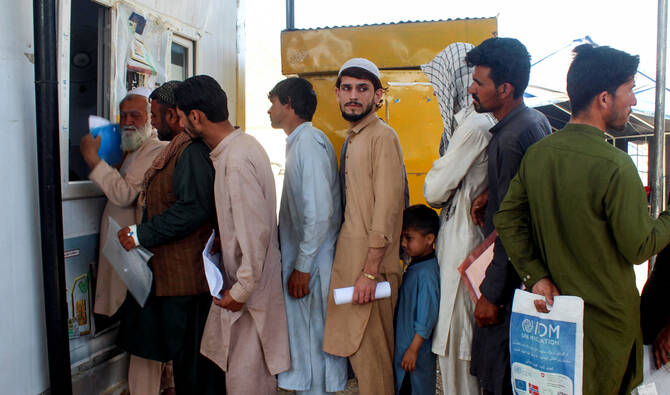
Afghan nationals, who were expelled from Pakistan, stand in queue for registration upon their arrival at the Omari refugee camp in Mohmand Dara, Torkham border, Nangarhar province, Afghanistan on April 15, 2025. (REUTERS/File)
Short Url
Updated 06 August 2025
Follow

Pakistan starts deporting registered Afghan refugees, says UN agency

  • UNHCR says Pakistan arresting and expelling Afghan PoR card holders ahead of deportation deadline
  • UN agency calls sending the Afghans back in such a way a breach of Pakistan’s international obligations

PESHAWAR: Pakistan has started to deport documented Afghan refugees ahead of its deadline for them to leave, according to the United Nations, in a move that could see more than one million Afghans expelled from the country.

The United Nations High Commissioner for Refugees said that it had received reports of arrests and expulsions of legally registered Afghans across the country before Pakistan’s September 1 deadline for them to leave.

The UNHCR said that sending the Afghans back in this way was a breach of Pakistan’s international obligations.

“UNHCR is calling on the government to stop the forcible return and adopt a humane approach to ensure voluntary, gradual, and dignified return of Afghans,” it said in a statement.

The voluntary return of the documented refugees shall commence forthwith, said a Pakistan’s interior ministry order seen by Reuters. It said the formal deportation process will start after the deadline.

But Qaisar Khan Afridi, a spokesman for the UNHCR, told Reuters on Wednesday that hundreds of legally registered Afghan refugees had already been detained and deported to Afghanistan from August 1 to August 4.

The interior ministry did not respond a Reuters request for a comment.

More than 1.3 million Afghans hold documentation known as Proof of Registration cards, while 750,000 more have another form of registration known as an Afghan Citizen Card.

Many Afghans have been settled in Pakistan since the 1980s, to escape cycles of war in Afghanistan.

“Such massive and hasty return could jeopardize the lives and freedom of Afghan refugees, while also risking instability not only in Afghanistan but across the region,” UNHRC said.

Pakistani authorities have said that Islamabad wants all Afghan nationals to leave except for those who have valid visas.

The repatriation drive by Pakistan is part of a campaign called the Illegal Foreigners Repatriation Plan launched in late 2023.

Pakistan has in the past blamed militant attacks and crimes on Afghan citizens, who form the largest migrant group in the country. Afghanistan has rejected the accusations, and has termed the repatriations as forced deportation.

In addition to the repatriation from Pakistan, Afghanistan also faces a fresh wave of mass deportations from Iran.

Aid groups worry that the influx risks further destabilising the country.


Pakistan reports current account surplus in Jan. owing to improved trade, remittances

Updated 17 February 2026
Follow

Pakistan reports current account surplus in Jan. owing to improved trade, remittances

  • Pakistan’s exports crossed the $3 billion mark in Jan. as the country received $3.5 billion in remittances
  • Last month, IMF urged Pakistan to accelerate pace of structural reforms to strengthen economic growth

ISLAMABAD: Pakistan recorded a current account surplus of more than $120 million in January, the country’s finance adviser said on Tuesday, attributing it to improved trade balance and remittance inflows.

Pakistan’s exports rebounded in January 2026 after five months of weak performance, rising 3.73 percent year on year and surging 34.96 percent month on month, according to data released by the country’s statistics bureau.

Exports crossed the $3 billion mark for the first time in January to reach $3.061 billion, compared to $2.27 billion in Dec. 2025. The country received $3.5 billion in foreign remittances in Jan. 2026.

Khurram Schehzad, an adviser to the finance minister, said Pakistan reported a current account surplus of $121 million in Jan., compared to a current account deficit of $393 million in the same month last year.

“Improved trade balance in January 2026, strong remittance inflows, and sustained momentum in services exports (IT/Tech) continue to reinforce the country’s external account position,” he said on X.

Pakistan has undergone a difficult period of stabilization, marked by inflation, currency depreciation and financing gaps, and international rating agencies have acknowledged improvements after Islamabad began implementing reforms such as privatizing loss-making, state-owned enterprises (SOEs) and ending subsidies as part of a $7 billion International Monetary Fund (IMF) loan program.

Late last month, the IMF urged Pakistan to accelerate the pace of these structural reforms to strengthen economic growth.

Responding to questions from Arab News at a virtual media roundtable on emerging markets’ resilience, IMF’s director of the Middle East and Central Asia Jihad Azour said Islamabad’s implementation of the IMF requirements had been “strong” despite devastating floods that killed more than 1,000 people and devastated farmland, forcing the government to revise its 4.2 percent growth target to 3.9 percent.

“What is important going forward in order to strengthen growth and to maintain the level of macroeconomic stability is to accelerate the structural reforms,” he said at the meeting.

Azour underlined Pakistan’s plans to privatize some of the SOEs and improve financial management of important public entities, particularly power companies, as an important way for the country to boost its capacity to cater to the economy for additional exports.

“This comes in addition to the effort that the authorities have made in order to reform their tariffs, which will allow the private sector of Pakistan to become more competitive,” the IMF official said.