Italy to approve world’s largest suspension bridge

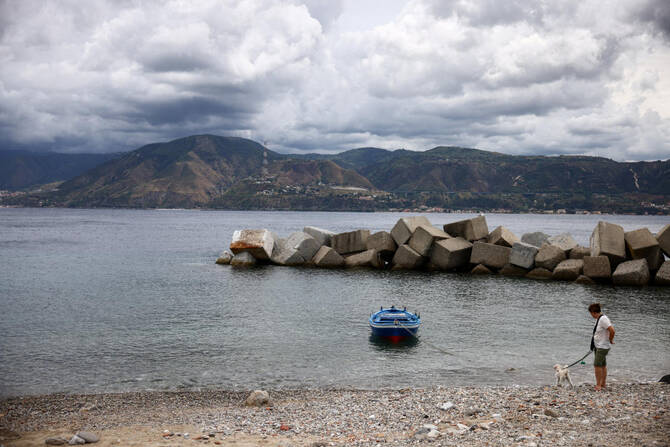
Deputy Prime Minister and Infrastructure Minister Matteo Salvini said a ministerial committee will back the state-funded bridge over the Strait of Messina, marking a “page in history” following decades of planning. (FILE/REUTERS)
Short Url
Updated 06 August 2025
Follow

Italy to approve world’s largest suspension bridge

  • Italy’s government is to give final approval Wednesday to a 13.5-billion-euro ($15.6-billion) project to build the world’s longest suspension bridge, connecting the island of Sicily to the mainland

ROME: Italy’s government is to give final approval Wednesday to a 13.5-billion-euro ($15.6-billion) project to build the world’s longest suspension bridge, connecting the island of Sicily to the mainland.
Deputy Prime Minister and Infrastructure Minister Matteo Salvini said a ministerial committee will back the state-funded bridge over the Strait of Messina, marking a “page in history” following decades of planning.
The bridge has been designed with two railway lines in the middle and three lanes of traffic on either side, with a suspended span of 3.3 kilometers (2.05 miles) — a world record — stretching between two 400-meter (1,300 feet) high towers.
Due for completion by 2032, the government says the bridge is at the cutting edge of engineering, able to withstand high winds and earthquakes in a region that lies across two tectonic plates.
Ministers hope it will bring economic growth and jobs to two impoverished Italian regions — Sicily and Calabria on the mainland — with Salvini promising the project will create tens of thousands of jobs.
Yet it has sparked local protests, over the environmental impact and the cost that critics say could be better spent elsewhere.
Some critics believe it will never materialize, pointing to a long history of public works announced, financed and never completed in Italy.
The bridge has had several false starts, with the first plans drawn up more than 50 years ago.
Eurolink, a consortium led by Italian group Webuild, won the tender in 2006 only to see it canceled after the eurozone debt crisis. The consortium remains the contractor on the revived project.
This time, Rome has an added incentive to press ahead — by classifying the cost of the bridge as defense spending.
Debt-laden Italy has agreed along with other NATO allies to massively increase its defense expenditure to five percent of GDP, at the demand of US President Donald Trump.
Of this, 1.5 percent can be spent on “defense-related” areas such as cybersecurity and infrastructure. Rome is hoping the Messina bridge will qualify, particularly as Sicily hosts a NATO base.


Over 400 civilians killed in fighting in eastern Congo, despite US-mediated peace deal

Updated 8 sec ago
Follow

Over 400 civilians killed in fighting in eastern Congo, despite US-mediated peace deal

GOMA: More than 400 civilians have been killed as the Rwanda-backed M23 armed group continues its offensive in Kivu province in eastern Congo, regional officials said late Wednesday, adding that Rwandan special forces were in the strategic city of Uvira.
M23’s latest offensive comes despite a US-mediated peace agreement signed last week by the Congolese and Rwandan presidents in Washington. The accord didn’t include the rebel group, which is negotiating separately with Congo and agreed earlier this year to a ceasefire that both sides accuse the other of violating. However, it obliges Rwanda to halt support for armed groups and work to end hostilities.
“More than 413 civilians (have been) killed by bullets, grenades, and bombs, including many women, children, and young people” in localities between Uvira and Bukavu, the regional capital, the South Kivu government spokesperson said in a statement late Wednesday.
“According to the information gathered, the forces present in the city are composed of Rwandan special forces and some of their foreign mercenaries, operating in clear violation of the ceasefire as well as the Washington and Doha agreements, in total disregard of the commitments made,” the statement added.
M23 said it had taken control of the strategic city of Uvira in eastern Congo on Wednesday afternoon, following a rapid offensive since the start of the month.
The announcement by M23 spokesperson Lawrence Kanyuka, posted on the social platform X, encouraged citizens who fled to return to their homes. Uvira is an important port city on the northern tip of Lake Tanganyika and is directly across from neighboring Burundi’s largest city, Bujumbura.
Congo, the US and UN experts accuse Rwanda of backing M23, which had hundreds of members in 2021. Now, according to the UN, the group has around 6,500 fighters.
While Rwanda denies that claim, it acknowledged last year that it has troops and missile systems in eastern Congo, allegedly to safeguard its security. UN experts estimate there are up to 4,000 Rwandan forces in Congo.
Burundian Foreign Minister Edouard Bizimana, in an interview with French state media RFI on Wednesday, urged the US to pressure Rwandan President Paul Kagame to ensure the implementation of the agreement signed in the US, saying, “M23 without Kagame, without Rwanda, is nothing.”
Bizimana said the capture of Uvira poses a threat to the economic capital, Bujumbura.
“We have registered more than 30,000 refugees and asylum seekers in the last three days… Uvira and Bujumbura are coastal cities. What threatens Uvira also threatens Bujumbura.”
In a statement Wednesday, the US Embassy in Kinshasa urged M23 and Rwandan troops to cease all offensive operations and for the Rwandan Defense Forces to withdraw to Rwanda.
On Wednesday morning, the Rwandan Ministry of Foreign Affairs blamed the Congolese armed forces for the recent ceasefire violations in a statement on X.
“The DRC has openly stated that it would not observe any ceasefire, and was fighting to recapture territories lost to AFC/M23, even as the peace process unfolded,” it said.
More than 100 armed groups are vying for a foothold in mineral-rich eastern Congo near the border with Rwanda, most prominently M23. The conflict has created one of the world’s most significant humanitarian crises, with more than 7 million people displaced, officials say.
Local UN partners report that more than 200,000 people have been displaced across the province since Dec. 2, with more than 70 killed. Civilians also have crossed into Burundi, and there have been reports of shells falling in the town of Rugombo, on the Burundian side of the border, raising concerns about the conflict spilling over into Burundian territory.