

Pakistan, China to host business forum in September with focus on EV, green tech cooperation

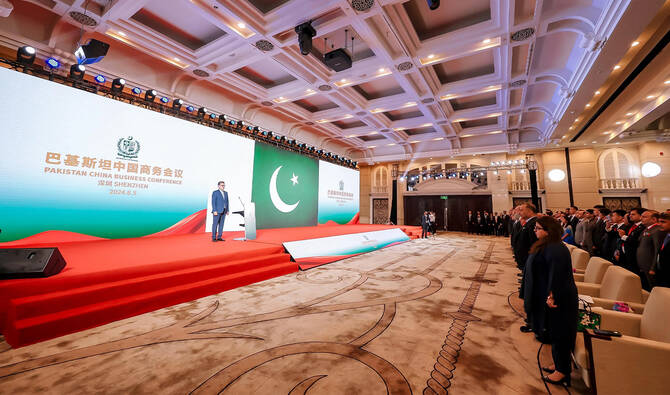
Pakistani and Chinese officials attend Pakistan-China Business Conference in Shenzhen, China, on June 6, 2024. (Sparx/File)
Short Url
Updated 06 August 2025
Follow

Pakistan, China to host business forum in September with focus on EV, green tech cooperation

  • Forum, scheduled for September 4 in China, expected to draw participation from over 250 Pakistani and 200 Chinese companies 
  • Chinese automakers like BYD and Chery already active in Pakistan through vehicle assembly, charging infrastructure development

ISLAMABAD: Islamabad and Beijing will co-host the Pakistan-China Business Conference next month aimed at boosting bilateral trade and investment across sectors including electric vehicles (EVs), solar energy, chemicals, and agriculture, state-run APP reported on Wednesday, as Islamabad pushes to deepen industrial cooperation under its long-standing economic partnership with Beijing.

The forum, scheduled for September 4 in China, is expected to draw participation from more than 250 companies from Pakistan and over 200 from China, with government officials touting it as a platform for sectoral matchmaking and investment mobilization.

“There will be industry matchmaking across sectors such as electric vehicles, solar energy, chemicals, and agriculture,” state news agency APP reported, quoting Federal Minister for Planning, Development and Special Initiatives Ahsan Iqbal Chaudhary as saying at a press conference in Beijing this week. 

Iqbal emphasized the strategic role of electric vehicles in the future of Pakistan-China economic cooperation, noting the opportunities they offer for industrial development and sustainable energy transition.

“EVs have become a very important segment,” Iqbal said. “We want to benefit from China’s technological advancements, including the development of next-generation batteries such as sodium-ion batteries, which offer advantages over traditional lithium technology.”

The minister said Pakistan’s newly approved National Electric Vehicle Policy 2025–2030, which mandates that 30 percent of new vehicle sales be electric by 2030 and aims for net-zero transport by 2060, offers generous incentives for local and foreign investors. These include tax reductions, subsidies, support for charging infrastructure, and an emphasis on local manufacturing.

“Establishing EV manufacturing in Pakistan offers cost advantages for Chinese companies and will help Pakistan reduce dependence on fossil fuels,” Iqbal added. “We welcome Chinese investment in localized EV production. It’s a strategic step toward energy efficiency, job creation, and sustainable development.”

Chinese automakers, including BYD and Chery, are already active in Pakistan’s EV sector through vehicle assembly, charging infrastructure development, and partnerships aimed at positioning Pakistan as a regional EV production hub.

Pakistan and China are strategic economic partners, primarily linked through the China-Pakistan Economic Corridor (CPEC), a flagship project under Beijing’s Belt and Road Initiative (BRI). Launched in 2015, CPEC has driven major infrastructure investment in Pakistan, including power plants, motorways, and the development of the Gwadar deep-sea port.

While the first phase of CPEC focused on large-scale infrastructure, the current second phase aims to enhance industrial cooperation, agriculture modernization and technology transfer.

The upcoming September conference is being positioned as a key initiative within this broader CPEC framework, reinforcing Islamabad’s efforts to attract green technology and innovation-focused investments from China.


Pakistan reviews austerity measures amid Middle East crisis, urges strict nationwide implementation

Updated 11 March 2026
Follow

Pakistan reviews austerity measures amid Middle East crisis, urges strict nationwide implementation

  • Deputy Prime Minister Ishaq Dar chairs review meeting of austerity steps
  • Officials briefed on salary cuts, school closures, four‑day week, petrol conservation

ISLAMABAD: Pakistan’s government on Wednesday assessed progress on a sweeping set of austerity measures introduced to mitigate the country’s economic strain from sharply rising global oil prices and supply disruptions linked to the ongoing war in the Middle East.

Prime Minister Shehbaz Sharif this week announced a series of austerity steps, including a four‑day work week for government offices, requiring 50  percent of staff to work from home, cutting fuel allowances for official vehicles by half, grounding up to 60  percent of the government fleet and closing all schools for two weeks to conserve fuel amid the global oil crisis.

The measures were unveiled in response to global oil market volatility triggered by the conflict involving the United States, Israel and Iran, which has disrupted supply routes such as the Strait of Hormuz and pushed crude prices sharply higher, straining Pakistan’s heavily import‑dependent energy sector.

“The meeting stressed the importance of strict and transparent adherence to the austerity measures, promoting fiscal responsibility and prudent use of public resources,” Deputy Prime Minister and Foreign Minister Senator Mohammad Ishaq Dar said in a statement.

He was chairing a meeting of the Committee for Monitoring and Implementation of Conservation and Additional Austerity Measures, constituted under the directions of the PM, bringing together federal and provincial officials to review execution of the broad cost‑cutting plan. 

Dar emphasized the government’s commitment to enforcing the PM’s austerity steps nationwide. The committee’s review also covered reductions in departmental expenditure, deductions from salaries of senior officials earning over Rs. 300,000 ($1,120), and coordination with provincial administrations to ensure uniform implementation of the plan.

Participants at the meeting reiterated that all ministries and divisions must continue strict monitoring and reporting, with transparent oversight mechanisms, as Pakistan navigates the economic pressures from the prolonged Middle East crisis and its fallout on global energy and trade markets.