Al-Hilal face ban from 2026-27 Saudi Super Cup

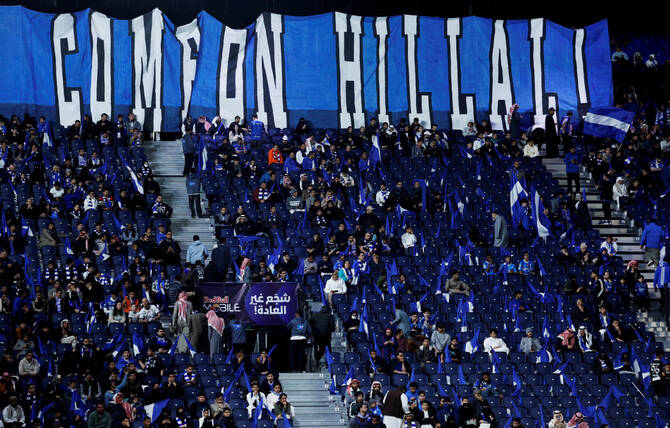
General view of Al Hilal fans and a giant banner inside the stadium before their Saudi Pro League match against Al Wehda — Kingdom Arena, Riyadh, Jan. 21, 2025. (Reuters/File)
Short Url
Updated 05 August 2025
Follow

Al-Hilal face ban from 2026-27 Saudi Super Cup

  • Al-Hilal had violated Article (59-3) of the Disciplinary and Ethics Regulations and was fined $133,000
  • The committee said the decision is subject to appeal

RIYADH: Holders Al-Hilal will be banned from the 2026-27 Saudi Super Cup if they qualify after withdrawing from this season’s four-team competition, the Saudi Arabia Football Federation’s (SAFF) Disciplinary and Ethics Committee said on Tuesday.

The decision came after Al-Hilal pulled out of the Super Cup, scheduled to be played from August 19-23 in Hong Kong, citing player fatigue following their Club World Cup campaign. They lost 2-1 to Fluminense in the quarter-finals on July 4.

“Al-Hilal refused to participate in the Saudi Super Cup for the 2025-2026 season after the official schedule for the competition was issued,” the Disciplinary and Ethics Committee said in a statement.

“As a result, the committee ruled that Al-Hilal had violated Article (59-3) of the Disciplinary and Ethics Regulations and fined the club 500,000 Saudi Riyals ($133,000) to be paid to the SAFF,” the statement added.

In addition to the fine, the club was banned from participating in the 2026-27 Super Cup and stripped of any financial awards allocated for this season’s competition.

The committee said the decision is subject to appeal.

Al-Hilal have been asked for comment.

They won the Super Cup by beating Al-Nassr last season for a record-extending fifth title.

The Saudi Super Cup is contested by the winners and runners-up of the King’s Cup and Saudi Pro League. Al-Hilal finished second in the 2024-25 Pro League behind Al-Ittihad.

Al-Hilal, who were due to face King’s Cup runners-up Al-Qadsiah in the Super Cup semifinals on August 20, have been replaced by AFC Champions League winners Al-Ahli.

Since Al-Ittihad won the Pro League and King’s Cup, the extra Super Cup spot was awarded to Al-Nassr — the third-placed team in the league — who they face in the semis on August 19.


Most women’s national team players earn less than $20,000, FIFPRO study shows

Updated 9 sec ago
Follow

Most women’s national team players earn less than $20,000, FIFPRO study shows

  • Some 66 percent of players earn below $20,000 annually from football
  • Nearly one-third of respondents reported earning between $0 and $4,999 from football

MANCHESTER: Two-thirds of women’s national team players earn less than $20,000 annually, according to a new FIFPRO survey that highlights persistent financial insecurity and structural gaps in the women’s game.
The global players union and affiliated national players unions surveyed 407 footballers from 41 nations who participated in the UEFA Women’s Euros, Copa America Femenina, the Women’s Africa Cup of Nations and the OFC Women’s Nations Cup.
Some 66 percent of players earn below $20,000 annually from football and nearly one-third of respondents reported earning between $0 and $4,999 from football, while only a small minority reached higher income brackets.
Professional clubs remain the main source of income, followed by national team payments, yet one in four players still rely on jobs outside football to make ends meet.
“Financial stability is a cornerstone of any career,” said FIFPRO’s Director of Women’s Football Alex Culvin. “The data is very clear: most players are earning insufficient income to ensure secure careers within the game.
“It is a risk to the sustainability of the sport because players will be inclined to leave football early to make ends meet.”
The survey, conducted between August and October, also revealed short-term contracts remain common: 33 percent of players were signed for one year or less, and 22 percent had no contract at all.
International competition schedules continue to strain players, with 58 percent saying pre-match rest was inadequate and 57 percent reporting insufficient recovery after games.
Travel conditions are also an issue, with three-quarters of players flying economy class during tournaments, with only 11 percent in premium economy or business.
While FIFPRO noted improvements since their 2022 survey – including increased prize money and a player-dedicated share at the Women’s Euros – similar reforms have not been replicated across other confederations.
Culvin said stakeholders must “continue to raise standards to support the increased professionalization of the women’s game.”