

Over 200 arrested as opposition party holds rallies to demand ex-PM Imran Khan’s release

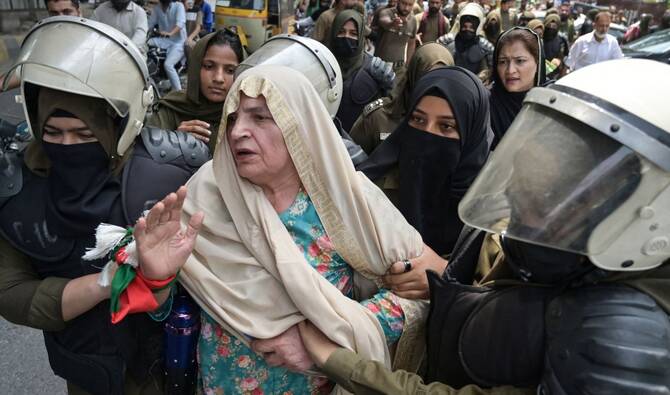
Police detain a member of Pakistan Tehreek-e-Insaf (PTI) party during a protest demanding the release of jailed former Prime Minister Imran Khan, outside the Provincial Assembly in Lahore on August 5, 2025. (AFP)
Short Url
Updated 05 August 2025
Follow

Over 200 arrested as opposition party holds rallies to demand ex-PM Imran Khan’s release

  • The rallies, which marked the second anniversary of Khan’s arrest, aimed to secure his released and an audit of last general election
  • Pakistan’s election authorities deny election irregularities, while government accuses Khan’s party of trying to hamper economic growth

PESHAWAR: The Pakistan Tehreek-e-Insaf (PTI) opposition party on Tuesday held coordinated rallies across the Khyber Pakhtunkhwa (KP) province to demand the release of jailed ex-premier Imran Khan but failed to mobilize masses in the capital Islamabad and other key regions, with more than 200 arrested for violating restrictions on public gatherings.

The rallies marked the second anniversary of Khan’s arrest and came amid a 90-day “do or die” protest campaign the party launched in mid-July. The PTI leadership has pledged peaceful but sustained mobilization against what it calls politically motivated cases against Khan and other party leaders.

Police arrested more than 240 opposition party activists at the protests calling for the release of Khan, security and police officials told Reuters. Most of the detentions were made on Monday night and early Tuesday in the eastern city of Lahore, where the PTI had promised its biggest demonstration.

KP, a province the PTI has ruled since 2018, saw widespread mobilization on Tuesday. District-level convoys converged on motorway interchanges and city centers across the province, but there was no clue of Chief Minister Ali Amin Gandapur, who was to supposed to lead the main gathering in Peshawar.

“At the call of their captain Imran Khan, the nation once again came out and proved that Imran will be there,” the PTI wrote on X on Tuesday evening.

Rallies were held in Swabi, Charsadda, Mardan, Nowshera, Mohmand, Battagram, Abbottabad, Upper Chitral, Shangla, Upper Dir, Mansehra and Kurram, among other areas.

“Free Imran Khan!” chanted supporters outside a Lahore courthouse, while smaller groups staged protests across the city, Reuters reported.

The federal capital of Islamabad and the nearby Rawalpindi city remained largely quiet, with heavy police deployments on main roads, while police fired teargas in the cities of Karachi and Muzaffarabad.

The protests followed a national call to action by PTI, which announced in July it would stage “do or die” demonstrations every week for 90 days to demand Khan’s release. The party’s leadership claims he is facing over 170 cases, including charges of corruption, sedition and terrorism, which they allege are part of a military-backed crackdown to keep him out of politics. The government and army deny the charges of political persecution.

The PTI ruled Pakistan from 2018 until 2022, when Khan was ousted in a parliamentary no-confidence vote. He was arrested in May 2023 and again in August 2023, and is currently imprisoned at Adiala Jail in Rawalpindi, where he is serving sentences in multiple cases. He has also been disqualified from holding public office by Pakistan’s election commission.

The PTI has staged several protests in recent years to secure Khan’s release and demand an audit of the February 2024 general election, with a number of demonstrations resulting in clashes with law enforcers and in some cases paralyzing the capital Islamabad for days.

Pakistan’s election authorities deny the allegation of election irregularities, while the federal and Punjab governments have repeatedly warned in recent weeks that they would not tolerate any form of violence, accusing the PTI of trying to derail efforts for sustainable economic growth.

Khan’s party had always created “chaos,” Uzma Bukhari, a spokesperson of the Punjab provincial government, told a press conference on Monday.

“No political party can be barred from politics in Pakistan, but a terrorist organization disguised as a political party is not allowed to disrupt Pakistan’s peace.”


Pakistan to launch AI screening in January to target fake visas, agent networks

Updated 5 sec ago
Follow

Pakistan to launch AI screening in January to target fake visas, agent networks

  • New system to flag forged-document travelers before boarding and pre-verify eligibility
  • Move comes amid increasing concern over fake visas, fraudulent agents, forged papers

ISLAMABAD: Pakistan will roll out an AI-based immigration screening system in Islamabad from January to detect forged documents and prevent illegal overseas travel, the government said on Thursday. 

The move comes amid increasing concern over fake visas, fraudulent agents and forged papers, with officials warning that such activity has contributed to deportations, human smuggling and reputational damage abroad. Pakistan has also faced scrutiny over irregular migration flows and labor-market vulnerability, particularly in the Gulf region, prompting calls for more reliable pre-departure checks and digital verification.

The reforms include plans to make the protector-stamp system — the clearance required for Pakistani citizens seeking overseas employment — “foolproof”, tighten labor-visa documentation, and cancel the passports of deportees to prevent them from securing visas again. The government has sought final recommendations within seven days, signalling a rapid enforcement timeline.

“To stop illegal immigration, an AI-based app pilot project is being launched in Islamabad from January,” Interior Minister Mohsin Naqvi said following a high-level meeting chaired by him and Minister for Overseas Pakistanis Chaudhry Salik Hussain.

Naqvi said the new screening technology is intended to determine travelers’ eligibility in advance, reducing airport off-loads and closing loopholes exploited by traffickers and unregistered agents.

The interior minister added that Pakistan remains in contact with foreign governments to improve the global perception and ranking of the green passport, while a uniform international driving license will be issued through the National Police Bureau.

The meeting also approved zero-tolerance measures against fraudulent visa brokers, while the Overseas Pakistanis Ministry pledged full cooperation to streamline the emigration workflow. Minister Hussain said transparency in the protector process has become a “basic requirement,” particularly for labor-migration cases.

Pakistan’s current immigration system has long struggled with document fraud, with repeated cases of passengers grounded at airports due to forged papers or agent-facilitated travel. The launch of an AI screening layer, if implemented effectively, could shift the burden from manual counters to pre-flight verification, allowing authorities to identify risk profiles before departure rather than after arrival abroad.

The reforms also come at a moment when labor mobility is tightening globally. Gulf states have begun demanding greater documentation assurance for imported labor, while European and Asian destinations have increased scrutiny following trafficking arrests and irregular-entry routes from South Asia. For Pakistan, preventing fraudulent departures is increasingly linked to protecting genuine workers, reducing deportation cycles and stabilizing the country’s overseas employment footprint.