

Pakistan to start deporting Afghan Proof of Registration card holders from Sept. 1

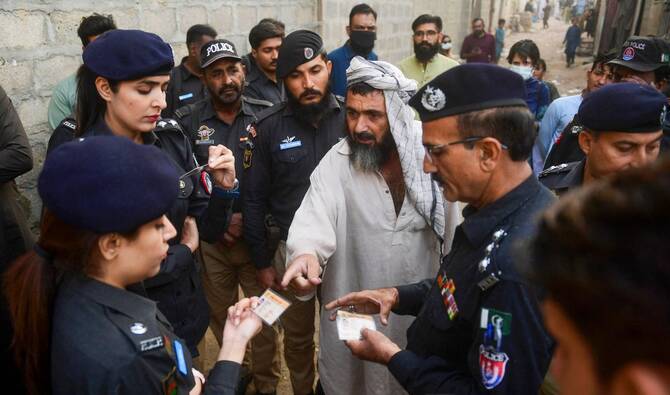
Police personnel check documents of Afghan refugees during a search operation to identify alleged illegal immigrants, on the outskirts of Karachi on November 17, 2023. (AFP/ file)
Short Url
Updated 05 August 2025
Follow

Pakistan to start deporting Afghan Proof of Registration card holders from Sept. 1

  • Millions of Afghans have poured into Pakistan over the past several decades, fleeing successive wars and instability
  • Islamabad this year said it wanted 3 million Afghans to leave the country, including 1.4 million people with PoR cards

ISLAMABAD: Pakistan will start deporting around 1.4 million Afghan Proof of Registration (PoR) card holders from September 1, the Pakistani interior ministry said on Monday, as Islamabad gave a fresh call for Afghan nationals to leave the country.

Millions of Afghans have poured into Pakistan over the past several decades, fleeing successive wars, as well as hundreds of thousands who arrived after the return of the Taliban government in 2021.

A deportation drive first launched in 2023 was renewed in April when Pakistan’s government rescinded hundreds of thousands of residence permits for Afghans, threatening to arrest anyone who did not leave.

Islamabad this year said it wanted 3 million Afghans to leave the country, including 1.4 million people with PoR cards and some 800,000 with Afghan Citizen Cards (ACC).

“Afghan nationals holding Proof of Registration (PoR) cards shall be repatriated to Afghanistan as part of the ongoing implementation of the Illegal Foreigners Repatriation Plan (IFRP),” the interior ministry said in a notification issued on Monday.

“It has been decided that the voluntary return of PoR card holders shall commence forthwith, while the formal repatriation and deportation process will take effect from 1st September 2025.”

More than a million Afghans have left Pakistan since the expulsion drive first began in 2023, according to data from the UN refugee agency (UNHCR). Pakistan previously said those with PoR cards could stay until June 30, while the government has deported thousands of ACC holders.

“The repatriation of illegal foreign nationals, including Afghan Citizen Card (ACC) holders, will continue as per the earlier decision under the IFRP,” the interior ministry added.

In 2023, Islamabad said many of these Afghan refugees were found involved in militancy and crimes. Analysts say the expulsions are designed to pressure neighboring Afghanistan’s Taliban authorities to control militancy in the border regions.

Pakistan’s security forces are under enormous pressure along the border with Afghanistan, battling a growing insurgency by ethnic nationalists in Balochistan in the southwest and the Pakistani Taliban and its affiliates in the northwest.

Last year, Pakistan recorded the highest number of deaths from attacks in a decade and the government frequently accused Afghan nationals of taking part in assaults.

Qaiser Khan Afridi, a spokesperson for the UN refugee agency, this week urged Islamabad to adopt a “humane approach to ensure voluntary, gradual, and dignified return of Afghans” and praised Pakistan for hosting millions of Afghan refugees for more than 40 years, the AP news agency reported.

“We call on the government to halt the forcible return and ensure a gradual, voluntary and dignified repatriation process,” Afridi said.

“Such massive and hasty return could jeopardize the lives and freedom of Afghan refugees, while also risking instability not only in Afghanistan but across the region.”


Imran Khan not a ‘national security threat,’ ex-PM’s party responds to Pakistan military

Updated 06 December 2025
Follow

Imran Khan not a ‘national security threat,’ ex-PM’s party responds to Pakistan military

  • Pakistan’s military spokesperson on Friday described Khan’s anti-army narrative as a “national security threat”
  • PTI Chairman Gohar Ali Khan says words used by military spokesperson for Khan were “not appropriate”

ISLAMABAD: Former prime minister Imran Khan’s Pakistan Tehreek-e-Insaf (PTI) party on Saturday responded to allegations by Pakistan military spokesperson Lt. Gen. Ahmed Sharif Chaudhry from a day earlier, saying that he was not a “national security threat.”

Chaudhry, who heads the military’s media wing as director general of the Inter-Services Public Relations (ISPR), spoke to journalists on Friday, in which he referred to Khan as a “mentally ill” person several times during the press interaction. Chaudhry described Khan’s anti-army narrative as a “national security threat.”

The military spokesperson was responding to Khan’s social media post this week in which he accused Chief of Defense Forces Field Marshal Asim Munir of being responsible for “the complete collapse of the constitution and rule of law in Pakistan.” 

“The people of Pakistan stand with Imran Khan, they stand with PTI,” the party’s secretary-general, Salman Akram Raja, told reporters during a news conference. 

“Imran Khan is not a national security threat. Imran Khan has kept the people of this country united.”

Raja said there were several narratives in the country, including those that created tensions along ethnic and sectarian lines, but Khan had rejected all of them and stood with one that the people of Pakistan supported. 

PTI Chairman Gohar Ali Khan, flanked by Raja, criticized the military spokesperson as well, saying his press talk on Thursday had “severely disappointed” him. 

“The words that were used [by the military spokesperson] were not appropriate,” Gohar said. “Those words were wrong.”

NATURAL OUTCOME’

Speaking to reporters earlier on Saturday, Pakistan’s Defense Minister Khawaja Asif defended the military spokesperson’s remarks against Khan.

“When this kind of language is used for individuals as well as for institutions, then a reaction is a natural outcome,” he said. 

“The same thing is happening on the Twitter accounts being run in his [Khan’s] name. If the DG ISPR has given any reaction to it, then I believe it was a very measured reaction.”

Khan, who was ousted after a parliamentary vote of confidence in April 2022, blames the country’s powerful military for removing him from power by colluding with his political opponents. Both deny the allegations. 

The former prime minister, who has been in prison since August 2023 on a slew of charges he says are politically motivated, also alleges his party was denied victory by the army and his political rivals in the 2024 general election through rigging. 

The army and the government both deny his allegations.