

Pakistan issues fresh flood alert as major rivers swell, monsoon deaths surpass 300

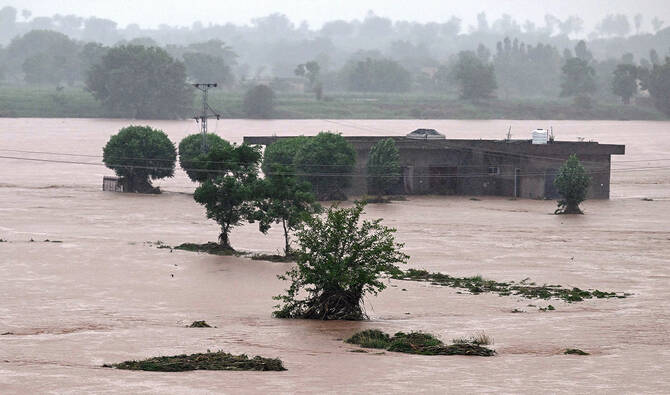
Local people catch fish in the floodwaters near a partially submerged house during heavy monsoon rains at the Ladian village of Rawalpindi, Pakistan, on July 17, 2025. (AFP/File)
Short Url
Updated 05 August 2025
Follow

Pakistan issues fresh flood alert as major rivers swell, monsoon deaths surpass 300

  • Monsoon currents actively entering upper and central Pakistan, with westerly trough persisting in the north
  • NDMA warns of flood risk in Ravi and Chenab tributaries, urges residents to stay alert during heavy rainfall

ISLAMABAD: Pakistan’s disaster management authority on Tuesday issued a fresh flood alert as monsoon-related deaths rose to 303, with authorities warning that intensifying rainfall could swell all major rivers and trigger flash floods across the country’s upper and central regions.

According to the National Disaster Management Authority (NDMA), more than half of the deaths since July 26 have occurred due to house collapses, followed by drownings and flash floods, while over 700 people have been injured during the ongoing monsoon season.

The latest alert cites the combined effect of active monsoon currents penetrating upper and central Pakistan and a westerly trough persisting over the north, with heavy rainfall forecast between August 5 and 8.

“Increased inflows are anticipated in all major rivers, especially Indus, Chenab and Ravi, with nullahs of Ravi and Chenab likely to reach up to medium flood levels,” the NDMA’s National Emergencies Operation Center (NEOC) said in a statement.

“NDMA urges residents living near rivers, streams and nullahs to stay vigilant for sudden rises in water levels, especially at night and during periods of intense rainfall,” it added.

According to the alert, Tarbela, Guddu, and Sukkur barrages are already at low flood stage, while continued rain may push Chashma and Taunsa toward similar levels.

River Chenab at Marala is projected to reach low flood, with rising water levels also recorded in River Jhelum near Mangla Dam, and in tributaries of River Kabul, Swat and Panjkora.

Gilgit-Baltistan’s mountain streams in Hunza, Shigar and Ghanche may also be prone to localized flash floods.

Earlier, the NDMA warned of a potential flood situation along the Sutlej River due to sharp increases in water discharge and forecast heavy rainfall across northern India. The Sutlej runs from the Himalayas through India into eastern Pakistan.

The NDMA also urged residents in flood-prone areas to prepare emergency kits, relocate livestock and valuables and identify safe evacuation routes. Urban centers in northeastern and central Punjab were advised to activate dewatering systems to manage water accumulation, and the public was warned not to cross submerged roads or causeways.

Pakistan is among the countries most vulnerable to climate change and has experienced a series of extreme weather events in recent years, including heatwaves, droughts and floods.

In 2022, record monsoon rains submerged a third of the country, killing over 1,700 people, affecting more than 30 million and causing an estimated $35 billion in damages.

NDMA said it is monitoring the evolving situation round the clock through NEOC and remains in close coordination with provincial and district authorities to ensure a timely response.



IMF board to meet tomorrow to consider $1.2 billion disbursement for Pakistan

Updated 11 sec ago
Follow

IMF board to meet tomorrow to consider $1.2 billion disbursement for Pakistan

  • Pakistan, IMF reached a Staff-Level Agreement for second review of $7 billion loan program 
  • Economists view disbursement crucial for cash-strapped Pakistan as it tackles economic crisis

ISLAMABAD: The International Monetary Fund’s (IMF) Executive Board will meet tomorrow, Monday, to consider and approve a $1.2 billion disbursement for Pakistan, according to the global lender’s official schedule. 

The meeting takes place nearly two months after the Fund reached a Staff-Level Agreement (SLA) with Pakistan for the second review of its $7 billion Extended Fund Facility (EFF) and the first review of its $1.4 billion Resilience and Sustainability Facility (RSF). 

The SLA followed a mission led by IMF’s Iva Petrova, who held discussions with Pakistani authorities during a Sept. 24–Oct. 8 visit to Karachi, Islamabad and Washington, DC.

“The International Monetary Fund’s (IMF) Executive Board will convene on Dec. 8 to consider Pakistan’s request for a $1.2 billion disbursement under the Extended Fund Facility (EFF) and the Resilience and Sustainability Facility (RSF), according to the Fund’s updated schedule,” the state-run Pakistan TV reported on Sunday.

Economists view IMF’s bailout packages as crucial for cash-strapped Pakistan, which has relied heavily on financing from bilateral partners such as Saudi Arabia, China and the United Arab Emirates, as well as multilateral lenders including the IMF, World Bank, Asian Development Bank and Islamic Development Bank. 

The South Asian country has been grappling with a prolonged macroeconomic crisis that has drained its financial resources and triggered a balance of payments crisis. Islamabad, however, has recorded some financial gains since 2022, which include recording a surplus in its current account and bringing inflation down considerably. 

Speaking to Arab News last month, Pakistan’s former finance adviser Khaqan Najeeb said the $1.2 billion disbursement will further stabilize Pakistan’s near-term external position and unlock additional official inflows. 

“Continued engagement also reinforces macro stability, as reflected in recent improvements in inflation, the current account, and reserve buffers,” Najeeb said. 

Pakistan came close to sovereign default in mid-2023, when foreign exchange reserves fell below three weeks of import cover, inflation surged to a record 38 percent in May, and the country struggled to secure external financing after delays in its IMF program. Fuel shortages, import restrictions, and a rapidly depreciating rupee added to the pressure, while ratings agencies downgraded Pakistan’s debt and warned of heightened default risk.

The crisis eased only after Pakistan reached a last-minute Stand-By Arrangement with the IMF in June 2023, unlocking emergency support and preventing an immediate default.