

Islamabad rejects Zelenskyy’s ‘baseless’ allegations of Pakistani nationals’ involvement in Ukraine conflict 

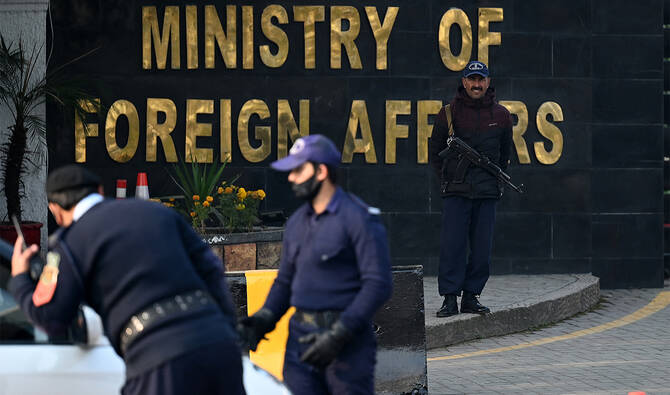
Pakistani police officers stand guard outside the Ministry of Foreign Affairs in Islamabad on January 18, 2024. (AFP/File)
Short Url
Updated 05 August 2025
Follow

Islamabad rejects Zelenskyy’s ‘baseless’ allegations of Pakistani nationals’ involvement in Ukraine conflict 

  • Zelenskyy said this week “mercenaries” from China, Tajikistan, Uzbekistan, Pakistan, and African countries are participating in war against Ukraine
  • Pakistan’s foreign office says Ukraine has not presented “any verifiable evidence” to substantiate claims Pakistani nationals are involved in war

ISLAMABADA: Pakistan’s foreign office on Tuesday rejected “baseless and unfounded” allegations by Ukrainian President Volodymyr Zelenskyy, who said this week that his country was fighting “mercenaries” from various states including China, Pakistan and parts of Africa. 

After visiting a frontline area in the northeastern Kharkiv region, Zelenskyy wrote on X on Monday that as per reports from his “warriors,” mercenaries from China, Tajikistan, Uzbekistan, Pakistan, and African countries are participating in the war against Ukraine.

Zelenskyy has previously accused Moscow of recruiting Chinese fighters for its war effort against Ukraine, charges Beijing denied, while North Korea has also reportedly provided thousands of its troops in Russia’s Kursk region.

“The Government of Pakistan categorically rejects the baseless and unfounded allegations of the involvement of Pakistani nationals in the conflict in Ukraine,” the foreign office said in a statement.

“To date, Pakistan has not been formally approached by the Ukrainian authorities, nor has any verifiable evidence been presented to substantiate such claims.”

It said the government will discuss the matter with Ukrainian authorities and seek clarification on Zelenskyy’s statement. 

“Pakistan reaffirms its commitment to the peaceful resolution of the Ukraine conflict through dialogue and diplomacy, in accordance with the principles of the UN Charter,” the foreign office concluded. 

Russia invaded Ukraine on Feb. 24, 2022, amid protests from Western governments and peace activists worldwide. Thousands have been killed on both sides since the conflict began and rages on, with Washington and other powers calling for an end to the fighting that has dealt setbacks to the global economy and developing countries. 

Pakistan has repeatedly called for de-escalation and cessation of hostilities between Russia and Ukraine ever since the war began. Pakistan has also welcomed talks between both countries and agreements on prisoner exchanges while raising alarm at the increasing surge in civilian casualties as the war continues. 

Islamabad has moved closer to Russia in recent months, signing trade and investment agreements with Moscow as it seeks to escape a prolonged economic crisis. Pakistan has avoided criticizing Russia for invading the eastern European country, calling instead for a peaceful resolution to the conflict. 


Pakistan official vows to address trade challenges arising out of Afghan border closures

Updated 5 sec ago
Follow

Pakistan official vows to address trade challenges arising out of Afghan border closures

  • Pakistan closed key border crossings with Afghanistan in October following fierce clashes
  • Border crossings have led to financial losses, rising unemployment for traders on both sides

KARACHI: Prime Minister’s Coordinator on Commerce Rana Ihsaan Afzal on Wednesday reassured traders in the southwestern Chaman city that Islamabad would address issues arising out of the closure of Pakistan-Afghanistan border crossings since October. 

Pakistan closed its key border crossings with Afghanistan, including the one in Chaman, for trade and movement of people in October after fierce clashes between the two countries. Pakistan and Afghanistan both claimed to have killed scores of each other’s soldiers during the conflict. 

Traders on both sides have urged their governments to reopen the borders, saying that closures have caused financial losses and led to disruptions in perishable goods exports, rising unemployment and hardships for the local community dependent on cross-border trade. 

Afzal chaired a high-level consultative meeting with leaders, traders and community representatives from Chaman District and the Chaman Chamber of Commerce & Industry in Islamabad on Wednesday, the Pakistani commerce ministry said in a statement. 

“The coordinator reaffirmed the government’s commitment to addressing border trade challenges and ensuring that local communities continue to thrive,” the ministry said. 

The statement said Afzal noted the concerns raised by the stakeholders, stressing that resolving the issues of Chaman’s communities is a priority for the government.

Delegates spokes about the socio-econmic impact such as financial losses and rising unemployment due to the suspension of border trade between both sides. 

“The matters discussed will be escalated to relevant national and bilateral forums to seek sustainable solutions, with a focus on establishing predictable, transparent, and efficient border management protocols that balance security with legitimate trade,” the statement said. 

Ties between Islamabad and Kabul have remained strained since the Afghan Taliban seized power in Afghanistan in 2021. Pakistan has since then suffered a surge in militant attacks that it blames on militants based in Afghanistan, a charge Kabul denies. 

Tensions between the two sides have resulted in frequent border closures over the years, hampering trade and commerce. 

Islamabad has repeatedly accused the administration in Kabul of failing to take action against militant outfits such as the Tehreek-e-Taliban Pakistan (TTP) and the separatist Balochistan Liberation Army (BLA), which it alleges carry out attacks targeting Pakistan from Afghan soil. Kabul denies the allegations.

According to figures shared by the Pak-Afghan Joint Chamber of Commerce and Industry (PAJCCI) in October, the annual Pakistan-Afghan trade volume declined from $2.5 billion dollars to $10 million during the last two fiscal years.