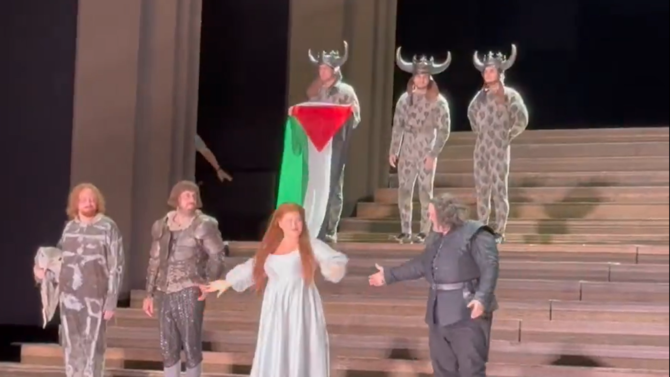

LONDON: The UK’s Royal Ballet and Opera has canceled a planned 2026 production of “Tosca” at the Israeli Opera in Tel Aviv, after nearly 200 members of staff signed a letter criticizing the organization’s ties to Israel amid the war in Gaza, it was reported on Monday.
Company chief executive officer Alex Beard confirmed the decision in an internal message in which he acknowledged the letter and told staff: “We have made the decision that our new production of “Tosca” will not be going to Israel.”
A total of 182 members of the Royal Opera and Ballet, including dancers, musicians, singers and technical staff, signed the open letter on Friday denouncing the “recent actions and decisions taken by the RBO in the context of the ongoing genocide in Gaza.”
In particular, they condemned the recent hiring out of the organization’s “Turandot” production to the Israeli Opera for performances that took place last month, The Guardian newspaper reported on Monday.
“The decision cannot be viewed as neutral,” they wrote. “It is a deliberate alignment, materially and symbolically, with a government currently engaged in crimes against humanity.
“The venue itself, the Israeli Opera, publicly offers free tickets to soldiers of the Israeli Defense Forces ‘in recognition of their work,’ as stated on their website.
“The RBO is clearly making a strong political statement by allowing its production and intellectual property to be presented in a space that openly rewards and legitimizes the very forces responsible for the daily killings of civilians in Gaza.”
The letter demanded that the organization “withholds our productions from institutions that legitimise and economically support a state engaged in the mass killing of civilians,” and rejects “any current or future performances in Israel.”
It also offered support for performer Daniel Perry, who raised a Palestinian flag on stage during a curtain call on July 19 in what the letter described as “an act of courage and moral clarity.” It accused the RBO’s director of opera, Oliver Mears, of reacting aggressively.
“We witnessed (Mears) attempting to forcibly snatch the flag from the performer, displaying visible anger and aggression in front of the entire audience,” the letter said.
“Far from being a neutral administrative intervention, (his) act was itself a loud political statement. It sent a clear message that any visible solidarity with Palestine would be met with hostility.”
Perry has stated that Mears subsequently told him he would “never work for the Opera House ever again.”
The employees who signed the letter also highlighted what they described as a “deafening” double standard, noting the organization’s open support for Ukraine following the invasion by Russia in 2022, adding: “We understood then that silence was unacceptable. Why is it different now?”
In response, Beard said: “I am appalled by the crisis in Gaza and recognize the deep emotional impact this has had across our community and wider society. On this issue, we acknowledge and respect the full range of views held by our staff, artists and audiences.
“The events at the curtain call on July 19 were without precedent. We have reflected carefully and reviewed our internal protocols. We always endeavor to act with integrity and compassion. We want our stage to remain a space for shared cultural appreciation, free from individual political statements.”
The RBO’s support for Ukraine was “aligned with the global consensus at the time,” he added, but global geopolitics had become more complex and so the organization’s stance had changed to ensure its actions reflected its “purpose and values.”
The Israeli Opera removed details of the production of “Tosca” from its website but has not commented on the cancellation.