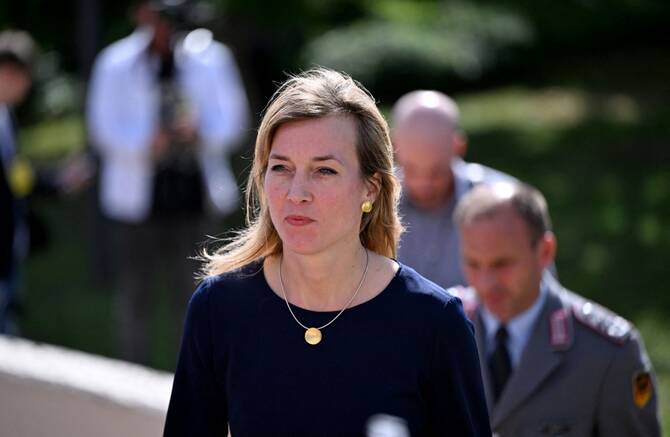
BERLIN: A senior lawmaker in German Chancellor Friedrich Merz’s coalition on Monday said Berlin should consider sanctions on Israel including a partial suspension of weapons exports or the suspension of a European Union-wide political agreement.
The call by Siemtje Moeller, the deputy leader of the Social Democrats (SPD) parliamentary faction, reflects a sharpening of rhetoric from Berlin against Israel which has yet to yield any major policy changes however.
Moeller, whose SPD joined a coalition with Merz’s conservatives this year, wrote a letter to SPD lawmakers after returning from a trip to Israel with Foreign Minister Johann Wadephul last week.
“My assessment is that the Israeli government will move little without pressure. If such concrete improvements fail to materialize in the near future, there must be consequences,” she said in the letter, seen by Reuters.
Recognition of a Palestinian state should not be “taboo,” she said, adding that Israeli statements that there were no restrictions on aid to Gaza were not convincing.
At the same time, Moeller demanded the immediate and unconditional release of the hostages held by Hamas. She said Hamas must no longer play a role in a political future in Gaza. “It must be disarmed, its reign of terror must end.”
Western nations have intensified efforts to exert pressure on Israel, with Britain, Canada and France signalling their readiness to recognize a Palestinian state in Israeli-occupied territory at the United Nations General Assembly this September.
Israel has criticized France, Britain and Canada, saying their decision will reward Hamas.
Critics argue that Germany’s response remains overly cautious, shaped by an enduring sense of historical guilt for the Holocaust and reinforced by pro-Israel sentiment in influential media circles, weakening the West’s collective ability to apply meaningful pressure on Israel.
The Gaza war began when Hamas killed more than 1,200 people and took 251 hostage in a cross-border attack on southern Israel on October 7, 2023, according to Israeli figures.
Israel’s air and ground war in densely populated Gaza has since killed more than 60,000 Palestinians, according to enclave health officials. A growing number of civilians are dying from starvation and malnutrition, Gaza health authorities say, with images of starving children shocking the world and intensifying criticism of Israel over its curbs on aid into the enclave.
Israel blames Hamas for the suffering in Gaza but, in response to a rising international outcry, it announced steps last week to let more aid reach the population, including pausing fighting for part of the day in some areas, approving air drops and announcing protected routes for aid convoys.

Germany should consider Israel sanctions, senior lawmaker says after trip
Short Url
https://arab.news/63v9z
Germany should consider Israel sanctions, senior lawmaker says after trip
- Recognition of a Palestinian state should not be “taboo,” Siemtje Moeller said
- Moeller demanded the immediate and unconditional release of the hostages held by Hamas
Spain begins 3 days of mourning for deadly train wreck while searchers look for more bodies
ADAMUZ: Spain woke to flags at half staff on Tuesday as the nation began three days of mourning for the victims of the deadly train accident in the country’s south, while emergency crews continue searching for possible bodies.
The official death toll of Sunday’s accident rose to 40 by late Monday. But officials warned that that count may not be definitive, with emergency workers still probing for bodies among what Andalusian regional president Juanma Moreno called “a twisted mass of metal.”
Interior Minister Fernando Grande-Marlaska told Spanish national television RTVE late Monday that searchers believe they have found three more bodies still trapped in the wreckage. Those bodies are not included in the official count, the minister said.
The crash took place Sunday at 7:45 p.m. when the tail end of a train carrying 289 passengers on the route from Malaga to the capital, Madrid, went off the rails. It slammed into an incoming train traveling from Madrid to Huelva, another southern Spanish city, according to rail operator Adif.
The head of the second train, which was carrying nearly 200 passengers, took the brunt of the impact. That collision knocked its first two carriages off the track and sent them plummeting down a 4-meter (13-foot) slope. Some bodies were found hundreds of meters (feet) from the crash site, Moreno said.
Officials are continuing to investigate the causes of the incident that Spanish Transport Minister Óscar Puente has called “strange” since it occurred on a straight line and neither train was speeding.
But Puente said late Monday that officials had found a broken section of track.
“Now we have to determine if that is a cause or a consequence (of the derailment),” Puente told Spanish radio Cadena Ser.
Spanish Prime Minister Pedro Sánchez visited the accident site near the town of Adamuz on Monday, where he declared three days of mourning with flags lowered on all public buildings and navy vessels. Spain’s King Felipe and Queen Letizia are scheduled to visit on Tuesday.
Meanwhile, Spain’s Civil Guard is collecting DNA samples from family members who fear they have loved ones among the unidentified dead.
The official death toll of Sunday’s accident rose to 40 by late Monday. But officials warned that that count may not be definitive, with emergency workers still probing for bodies among what Andalusian regional president Juanma Moreno called “a twisted mass of metal.”
Interior Minister Fernando Grande-Marlaska told Spanish national television RTVE late Monday that searchers believe they have found three more bodies still trapped in the wreckage. Those bodies are not included in the official count, the minister said.
The crash took place Sunday at 7:45 p.m. when the tail end of a train carrying 289 passengers on the route from Malaga to the capital, Madrid, went off the rails. It slammed into an incoming train traveling from Madrid to Huelva, another southern Spanish city, according to rail operator Adif.
The head of the second train, which was carrying nearly 200 passengers, took the brunt of the impact. That collision knocked its first two carriages off the track and sent them plummeting down a 4-meter (13-foot) slope. Some bodies were found hundreds of meters (feet) from the crash site, Moreno said.
Officials are continuing to investigate the causes of the incident that Spanish Transport Minister Óscar Puente has called “strange” since it occurred on a straight line and neither train was speeding.
But Puente said late Monday that officials had found a broken section of track.
“Now we have to determine if that is a cause or a consequence (of the derailment),” Puente told Spanish radio Cadena Ser.
Spanish Prime Minister Pedro Sánchez visited the accident site near the town of Adamuz on Monday, where he declared three days of mourning with flags lowered on all public buildings and navy vessels. Spain’s King Felipe and Queen Letizia are scheduled to visit on Tuesday.
Meanwhile, Spain’s Civil Guard is collecting DNA samples from family members who fear they have loved ones among the unidentified dead.
© 2026 SAUDI RESEARCH & PUBLISHING COMPANY, All Rights Reserved And subject to Terms of Use Agreement.


