

Australia lifts foreign student cap to 295,000 and prioritizes Southeast Asia

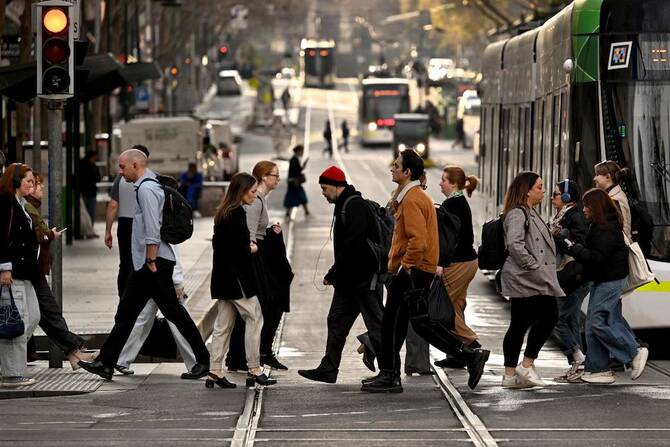
Australia’s largest cohorts of students come from China and India. Above, people cross a street in Melbourne’s central business district on Aug. 14, 2024. (AFP)
Short Url
Updated 04 August 2025
Follow

Australia lifts foreign student cap to 295,000 and prioritizes Southeast Asia

  • Limits on places were announced last year as a way to rein in record migration that had contributed to a surge in housing prices
  • An additional 25,000 places being granted in 2026 as the policy successfully brought down ‘out of control’ international student numbers

SYDNEY: Australia will raise its cap on foreign students by 9 percent to 295,000 next year and prioritize applicants from Southeast Asia, the government said on Monday.

Limits on places were announced last year as a way to rein in record migration that had contributed to a surge in housing prices, with 270,000 places made available for 2025.

An additional 25,000 places were being granted in 2026 as the policy was successfully bringing down “out of control” international student numbers, the government said.

“This is about making sure international education grows in a way that supports students, universities and the national interest,” Education Minister Jason Clare said in a statement.

Australia granted nearly 600,000 student visas in the 2023 financial year, as international students returned to the country in record numbers following COVID-19.

Australia’s largest cohorts of students come from China and India.

As well as introducing the cap on numbers, the government also more than doubled the visa fee for foreign students in 2024 and pledged to close loopholes in rules that allowed them to continuously extend their stay.

The government’s measures to curb migration were “bearing fruit” and allowed for a modest increase in the cap in 2026, International Education Assistant Minister Julian Hill said.

“The numbers were growing out of control,” Hill told national broadcaster ABC.

“The government has taken tough decisions over the last 12 months, not always loved by the sector, to get the numbers down and get them to a more sustainable footing.”

Roughly two-thirds of places will be allocated to universities and one-third to the vocational skills training sector.

Larger, public universities would need to demonstrate domestic and international students had “access to safe and secure housing” and recruit more students from Southeast Asia to increase their individual allocations, the government said.

It was important “for Australia’s future soft power that we continue to bring the best and brightest from our (Southeast Asian) neighbors to have a bit of Australia with them for the rest of their life,” Hill said.

Relations with Southeast Asia have been a focus of Prime Minister Anthony Albanese’s Labor government as it looks to reduce Australia’s economic dependence on China.

Universities Australia welcomed the “sensible” increase in places.

“Universities have called for growth in this critically important sector, and the government has honored this,” CEO Luke Sheehy said.

Australia has one of the highest shares of international students globally. The sector contributed more than A$51 billion ($33.05 billion) to the economy in 2024, the country’s top services export.


February fifth warmest on record, extreme rain in Europe: EU monitor

Updated 5 sec ago
Follow

February fifth warmest on record, extreme rain in Europe: EU monitor

  • Global temperatures last month were 1.49C above preindustrial times
  • Temperatures and precipitation varied widely in Europe

PARIS: The world logged its fifth hottest February on record, with western Europe drenched by extreme rainfall and widespread flooding, the European Union’s climate monitor said on Tuesday.
Global temperatures last month were 1.49C above preindustrial times, defined as the 1850-1900 period before large-scale fossil fuel use drove climate change.
Temperatures and precipitation varied widely in Europe.
The average temperature in Europe was among the three coldest in the past 14 years at -0.07C.
But western, southern and southeast Europe experienced above-average temperatures, according to the Copernicus Climate Change Service.
Colder conditions were experienced in northwest Russia, Baltic countries, Finland and its Scandinavian neighbors.
“Wet and dry conditions across the continent showed a pronounced contrast: much of western and southern Europe was wetter than average, whereas the rest of the continent... was mostly drier than average,” the service said in its monthly report.
The United States, northeast Canada, the Middle East, Central Asia and east Antarctica had warmer-than-average temperatures.

- Need for global action -

Sea surface temperatures were the second highest for the month of February.
In the Arctic, the average sea ice extent was at its third lowest level for the month at five percent below average.
In the Antarctic, the monthly sea ice extent was close to average for February — a “sharp contrast to the much below-average” levels observed over the past four years, Copernicus said.
“The extreme events of February 2026 highlight the growing impacts of climate change and the pressing need for global action,” said Samantha Burgess, strategic lead for climate at the European Center for Medium-Range Weather Forecasts, which operates Copernicus.
“Europe experienced stark temperature contrasts,” Burgess said.
“Exceptional atmospheric rivers — narrow bands of very moist air — brought record rainfall and widespread flooding to western and southern Europe,” she said.
Human-driven climate change intensified torrential downpours that killed dozens and forced thousands of people from their homes across Spain, Portugal and Morocco between January and February, according to the World Weather Attribution (WWA) network of climate scientists.