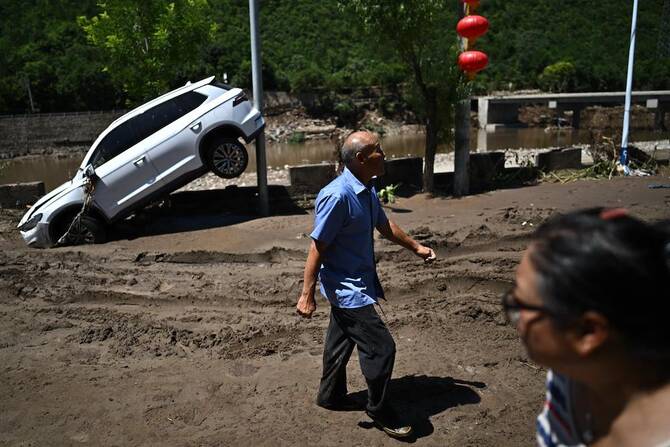
Beijing expands storm alert as fatal floods keep city on edge

Beijing warned residents in all city districts to brace for a new round of heavy rainfall, a week after catastrophic floods killed dozens in the deadliest deluge to hit the Chinese capital since 2012. (AFP)
Short Url
Updated 04 August 2025
Follow

Beijing expands storm alert as fatal floods keep city on edge

  • Up to 200mm (7.9 inches) of rain could hit parts of Beijing over a six-hour period from midday, weather forecasters warn
  • By noon on Monday, Beijing had placed all of its 16 districts on the highest level of preparedness

BEIJING: Beijing on Monday warned residents in all city districts to brace for a new round of heavy rainfall, telling them to avoid going out, a week after catastrophic floods killed dozens in the deadliest deluge to hit the Chinese capital since 2012.

Up to 200mm (7.9 inches) of rain could hit parts of Beijing over a six-hour period from midday, weather forecasters warned. The city of 22 million people receives on average 600mm of rainfall each year.

The warning comes as authorities rush to reinforce aging flood defenses, fine-tune weather forecasts and update evacuation plans amid reports of bodies being pulled from raging flood waters across the country, including at least three at a flooded wellness camp in Hebei province.

At least 44 people died in Beijing after heavy rains from July 23 to 29. Most of the dead were people unexpectedly trapped by rapidly rising waters at a nursing home in Miyun district on the city’s northeastern outskirts. The fatalities led authorities to admit to shortcomings in their contingency plans for extreme weather.

By noon on Monday, Beijing had placed all of its 16 districts on the highest level of preparedness, in the first citywide state of readiness since July 28, shutting parts of the Great Wall and other outdoor leisure venues and halting operations of below-ground businesses.

The risk of flash floods and landslides is “extremely high,” authorities said.

In the summer of 2012, 79 people died in Beijing in the city’s deadliest flooding in living memory. Fangshan district was the worst-hit, with one resident reporting a rise in floodwaters of 1.3 meters in just 10 minutes.

Beijing’s topography has been described by some as a rain “trap,” with its mountains to the west and north capturing moist air and amplifying any ensuing rainfall as a result.

Wellness retreat

As of Saturday, torrential rains that swept through “Beijing Valley,” a riverside wellness retreat in the Hebei city of Chengde adjacent to Beijing, had claimed three lives, with four still missing, China’s state news agency Xinhua reported.

Around 40 people had gathered on July 27 for an event at the site, where organizers directed them into tents pitched on low-lying land next to a river bend, Caixin Media reported.

By 2 a.m. the next morning, floodwaters had risen to knee height, forcing attendees to scramble toward the camp’s only exit.

The site bore similarities to Camp Mystic in Texas, where at least 28 children were swept to their deaths last month by floodwaters after the Guadalupe River burst its banks amid torrential rain.

In China’s southern Guangdong province over the weekend, the bodies of five people were recovered after a large-scale search operation involving more than 1,300 rescuers.

The five people, who went missing on Friday night, were “swept away by water” following heavy rainfall in recent days, Xinhua reported on Sunday.


Lawsuit challenges Trump administration’s ending of protections for Somalis

Updated 10 March 2026
Follow

Lawsuit challenges Trump administration’s ending of protections for Somalis

  • The lawsuit cites a series of statements Trump has made describing Somalis as “garbage” and “low IQ people” who “contribute nothing.”

BOSTON: Immigrant rights advocates filed a lawsuit on Monday seeking to stop US President Donald Trump’s administration from next ​week ending legal protections that allow nearly 1,100 Somalis to live and work in the United States. The lawsuit, brought by four Somalis and two advocacy groups, challenges the US Department of Homeland Security’s decision to end Temporary Protected Status for Somali immigrants, whom Trump has derided in public remarks. Outgoing Homeland Security Secretary Kristi Noem in January announced that TPS for Somalis would end on March 17, arguing that Somalia’s conditions had improved, despite fighting continuing between Somali forces and Al-Shabab militants. The plaintiffs, who ‌include the groups ‌African Communities Together and Partnership for the Advancement ​of ‌New ⁠Americans, in the ​lawsuit filed ⁠in Boston federal court argue the move was procedurally flawed and driven by a discriminatory, predetermined agenda.
The lawsuit cites a series of statements Trump has made describing Somalis as “garbage” and “low IQ people” who “contribute nothing.”
The plaintiffs said the administration is ending TPS for Somalia and other countries due to unconstitutional bias against non-white immigrants, not based on objective assessments of country conditions.
“The termination of TPS for Somalia is racism masking as immigration policy,” ⁠Omar Farah, executive director at the legal group Muslim Advocates, said ‌in a statement.
DHS did not respond to ‌a request for comment. It has previously said TPS ​was “never intended to be a de ‌facto amnesty program.”
TPS is a form of humanitarian immigration protection that shields eligible migrants ‌from deportation and allows them to work. Under Noem, DHS has moved to end TPS for a dozen countries, sparking legal challenges. The administration on Saturday announced plans to pursue an appeal at the US Supreme Court in order to end TPS for over 350,000 Haitians. It ‌also wants the high court to allow it to end TPS for about 6,000 Syrians.

SOMALI COMMUNITY TARGETED
Somalia was first designated ⁠for TPS in ⁠1991, with its latest extension in 2024. About 1,082 Somalis currently hold TPS, and 1,383 more have pending applications, according to DHS. Somalis in Minnesota in recent months had become a target of Trump’s immigration crackdown, with officials pointing to a fraud scandal in which many people charged come from the state’s large Somali community. The Trump administration cited those fraud allegations as a basis for a months-long immigration enforcement surge in Democratic-led Minnesota, during which about 3,000 immigration agents were deployed, spurring protests and leading to the killing of two US citizens by federal agents.
In November, Trump announced he would end TPS for Somalis in Minnesota, and a month later said ​he wanted them sent “back to where they ​came from.”
The US Department of State advises against traveling to Somalia, citing crime and civil unrest among numerous factors.