Russia to start trial of suspects in Moscow concert hall attack

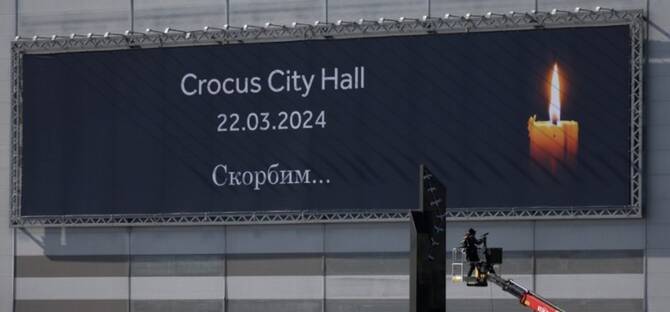
A memorial in memory of the victims of the terrorist attack at the Crocus City Hall concert venue in Krasnogorsk, outside Moscow, Russia. (AFP)
Short Url
Updated 04 August 2025
Follow

Russia to start trial of suspects in Moscow concert hall attack

  • Armed men stormed the Crocus City Hall music venue on March 22 last year, opening fire and then setting the building alight in what was one of the deadliest attacks in Russia’s history

MOSCOW: The trial opens in Moscow on Monday of 19 people accused of involvement in an attack on a Moscow concert hall last year that killed 149 people.
Armed men stormed the Crocus City Hall music venue on March 22 last year, opening fire and then setting the building alight in what was one of the deadliest attacks in Russia’s history.
Hundreds of people were injured. The Islamic State (IS) group claimed responsibility.
The four suspected attackers, all from Tajikistan — an ex-Soviet republic in Central Asia — and another 15 people accused of being accomplices were expected to go on trial.
The first three hearings were to take place on Monday, Tuesday and Thursday, according to a Moscow court website.
The attack shocked Russia, which was battling Ukraine in a military offensive that it started on February 24, 2022.
Despite the IS claim of responsibility, Russia implicated Ukraine in the attack, an allegation that Kyiv called baseless and absurd.
Nearly half of the victims were killed by smoke and carbon monoxide inhalation from the fire that broke out, not from gunfire, the state TASS news agency reported on Sunday, citing case materials.
The attack sparked a wave of xenophobia against Central Asian migrants in Russia.


Spanish police evict hundreds of migrants from squat deemed a safety hazard

Updated 7 sec ago
Follow

Spanish police evict hundreds of migrants from squat deemed a safety hazard

BARCELONA: Police in northeastern Spain began carrying out eviction orders Wednesday to clear an abandoned school building where hundreds of mostly undocumented migrants were living in a squat north of Barcelona.
Knowing that the eviction was coming, most of the occupants had left before police in riot gear from Catalonia’s regional police entered the school’s premises early in the morning under court orders.
The squat was located in Badalona, a working class city that borders Barcelona. Many sub-Saharan migrants, mostly from Senegal and Gambia, had moved into the empty school building since it was left abandoned in 2023.
The mayor of Badalona, Xavier García Albiol, announced the evictions in a post on X. “As I had promised, the eviction of the squat of 400 illegal squatters in the B9 school in Badalona begins,” he wrote.
Lawyer Marta Llonch, who represents the squatters, said that many of them lived from selling scrap metal collected from the streets, while a few others have residency and work permits but were forced to live there because they couldn’t afford housing.
“Many people are going to sleep on the street tonight,” Llonch told The Associated Press. “Just because you evict these people it doesn’t mean they disappear. If you don’t give them an alternative place to live they will now be on the street, which will be a problem for them and the city.”
García Albiol, of the conservative Popular Party, has built his political career as Badalona’s long-standing mayor with an anti-immigration stance.
The Badalona town hall had argued that the squat was a public safety hazard. In 2020, an old factory occupied by around a hundred migrants in Badalona caught fire and four people were killed in the blaze.
Like other southern European countries, Spain has for more than a decade seen a steady influx of migrants who risked their lives crossing the Mediterranean or Atlantic in small boats.
While many developed countries have taken a hard-line position against migration, Spain’s left-wing government has said that legal migration has helped its economy grow.