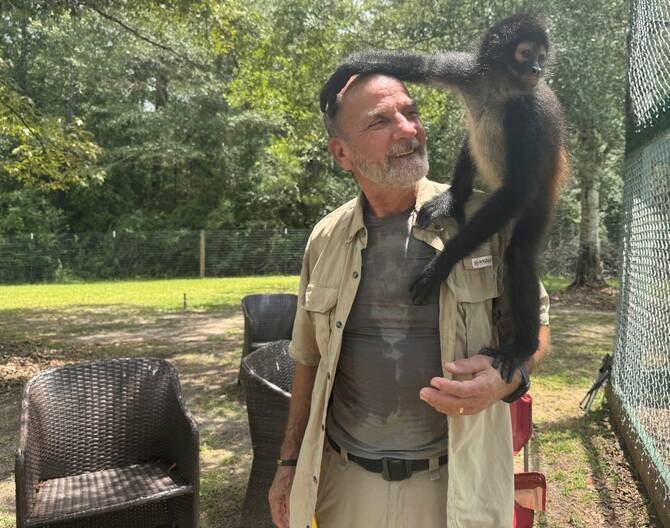
PERKINSTON: In the embrace of a cheerfully chittering spider monkey named Louie, an Army veteran who grappled for decades with post-traumatic stress disorder says he finally feels at peace.
“Being out here has brought a lot of faith back to me,” said John Richard. “There’s no feeling like it.”
The bond began last fall when Richard was helping two married veterans set up the Gulf Coast Primate Sanctuary, volunteering his time to build the enclosure that’s now Louie’s home in rural southeast Mississippi.
During a recent visit, Louie quickly scampered up Richard’s body, wrapping his arms and tail around him in a sort of hug. Richard, in turn, placed his hand on the primate’s back and whispered sweetly until Louie disentangled himself and swung away.
“He’s making his little sounds in my ear, and you know, he’s always telling you, ‘Oh, I love you,’” Richard said. “‘I know you’re OK. I know you’re not going to hurt me.’”
Richard said his connection with Louie helped more than any other PTSD treatment he received since being diagnosed more than 20 years ago.
It’s a similar story for the sanctuary’s founder, April Stewart, an Air Force veteran who said she developed PTSD as a result of military sexual trauma.
“It was destroying my life. It was like a cancer,” she said. “It was a trauma that was never properly healed.”
Stewart’s love of animals was a way to cope. She didn’t necessarily set out to create a place of healing for veterans with PTSD, but that’s what the sanctuary has become for some volunteers.
“By helping the primates learning to trust, we’re also reteaching ourselves how to trust, and we’re giving ourselves grace with people,” she said.
Her 15-acre property, nestled amid woods and farmland, is filled with rescue dogs, two rather noisy geese and a black cat. It’s also now home to three spider monkeys, two squirrel monkeys and two kinkajous, a tropical mammal that is closely related to raccoons.
The sanctuary in the town of Perkinston, about 30 miles (50 kilometers) due north of the Gulf coast, includes three large enclosures for the different species. Each has a smaller, air-conditioned area and a large fenced-in outdoor zone, where the primates swing from platforms and lounge in the sun. Checking on the animals — changing their blankets, bringing food and water — is one of the first and last things Stewart does each day.
However, she can’t do it alone. She relies on a group of volunteers for help, including several other veterans, and hopes to open the sanctuary to the public next summer for guided educational tours.
Stewart and her husband, also a veteran, decided to open the sanctuary in October after first rescuing and rehoming monkeys. With the help of two exotic-animal veterinarians, they formed a foundation that governs the sanctuary — which she said is the only primate sanctuary in Mississippi licensed by the US Department of Agriculture — and ensures the animals will be cared for even when the Stewarts are no longer able to run it themselves.
All the animals were once somebody’s pet, but their owners eventually couldn’t take care of them. Stewart stressed that primates do not make good or easy pets. They need lots of space and socialization, which is often difficult for families to provide.
The sanctuary’s goal is to provide as natural a habitat as possible for the animals, Stewart said, and bring them together with their own species.
“This is their family,” she said.


![]()

A Mississippi monkey sanctuary helps veterans with PTSD find peace
Short Url
https://arab.news/bmnsx
A Mississippi monkey sanctuary helps veterans with PTSD find peace
- John Richard, an army veteran, said Richard said his connection with Louie the monkey helped more than any other PTSD treatment he received since being diagnosed more than 20 years ago


Latest updates


© 2026 SAUDI RESEARCH & PUBLISHING COMPANY, All Rights Reserved And subject to Terms of Use Agreement.