

Philippine, Indian navies begin first joint South China Sea patrols

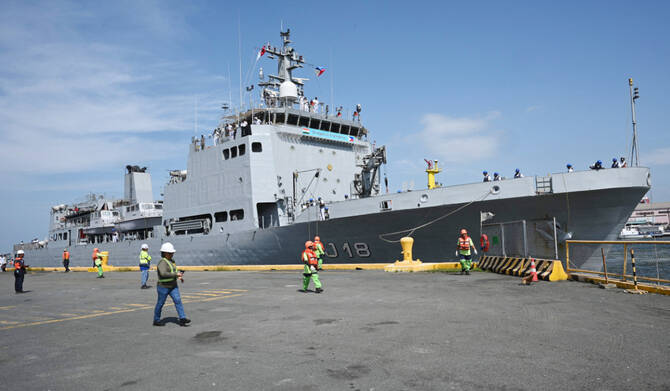
The Indian Navy survey vessel INS Sandhayak docks at the international port of Manila on August 1, 2025. (AFP)
Short Url
Updated 04 August 2025
Follow

Philippine, Indian navies begin first joint South China Sea patrols

  • While in India, Marcos is expected to sign pacts in such fields as law, culture and technology, according to Foreign Affairs Assistant Secretary Evangeline Ong Jimenez-Ducrocq, but all eyes will be on any potential defense agreements

MANILA: Indian Navy warships have begun patrolling areas of the disputed South China Sea with their Philippine counterparts for the first time, Manila’s military said Monday.
The two-day sail includes three Indian vessels and started Sunday, a day ahead of Philippine President Ferdinand Marcos’ scheduled trip to New Delhi for talks with Indian Prime Minister Narendra Modi.
The Philippines has heightened defense cooperation with a range of allies over the past year after a series of clashes in the contested waterway.
Beijing claims nearly the entirety of the South China Sea despite an international ruling that its assertion has no legal basis.
India’s naval vessels arrived in Manila for a port visit late last week.
The patrol “started yesterday afternoon, then it’s ongoing up to this moment... the activity at the moment is replenishment at sea,” Lt. Col. John Paul Salgado told AFP.
While in India, Marcos is expected to sign pacts in such fields as law, culture and technology, according to Foreign Affairs Assistant Secretary Evangeline Ong Jimenez-Ducrocq, but all eyes will be on any potential defense agreements.
The Philippines has previously purchased BrahMos supersonic cruise missiles from India, a weapon which has a top speed of 3,450 kilometers (2,140 miles) per hour.
India, which has engaged in border clashes with China in the Himalayas, is a member of the so-called Quad, a group that includes fellow democracies the United States, Japan and Australia.
Beijing has repeatedly alleged that the four-way partnership, first conceived by late Japanese prime minister Shinzo Abe, was created as a way of containing China.


Report highlights role of British Muslim charitable giving in supporting UK public services

Updated 7 sec ago
Follow

Report highlights role of British Muslim charitable giving in supporting UK public services

  • The study, “Building Britain: British Muslims Giving Back,” finds that donations from British Muslims are helping to bolster overstretched service

LONDON: British Muslim charitable giving is playing an increasingly significant role in supporting frontline public services across the UK, according to a new report by policy and research organization Equi.

The study, “Building Britain: British Muslims Giving Back,” finds that donations from British Muslims are helping to bolster overstretched services, including local councils, the NHS and welfare systems, at a time of growing financial pressure.

The report estimates that Muslim donors contribute around £2.2 billion ($2.9 billion) annually, making them the UK’s most generous community.

This figure is around four times the national giving average and rises to almost 10 times the average among higher earners.

According to the findings, Muslim-led charities are providing a wide range of support, including housing assistance, emergency cash grants, food provision and mental health services, easing demand on statutory services.

Equi points to evidence from 2023 showing that housing support delivered by the National Zakat Foundation helped prevent evictions that would have cost councils an estimated £28.8 million, with every £1 of charitable spending generating £73 in public sector savings.

The report also highlights a generational shift, with younger British Muslims increasingly directing their donations toward domestic causes such as homelessness, child poverty and mental health challenges.

Despite their growing impact, Muslim charities face a number of barriers, including de-banking, restrictive funding rules, securitization measures and what the report describes as limited recognition from government. Equi argues that these challenges are constraining the sector’s ability to maximize its contribution.

“British Muslim giving is not just generosity but a lifeline for public services that needs recognizing,” said Equi Managing Director Prof. Javed Khan.

“From preventing evictions to supporting mental health, these donations are saving millions for the taxpayer and strengthening communities across Britain. The evidence is clear that Muslim-led action is delivering frontline support where the state is struggling,” he added.

Equi is calling on policymakers to engage more closely with Muslim-led charities and to move beyond what it describes as symbolic recognition.

The report recommends measures such as UK-based match-funding schemes and greater faith literacy within policymaking, which it says could unlock billions of pounds in additional domestic spending while maintaining the UK’s global humanitarian commitments.

The study concluded that with greater collaboration between government and Muslim charities, charitable giving could play an even more transformative role in strengthening public services and social cohesion across the country.