

Pakistan warns of earthquake aftershocks in capital, nearby cities in coming days

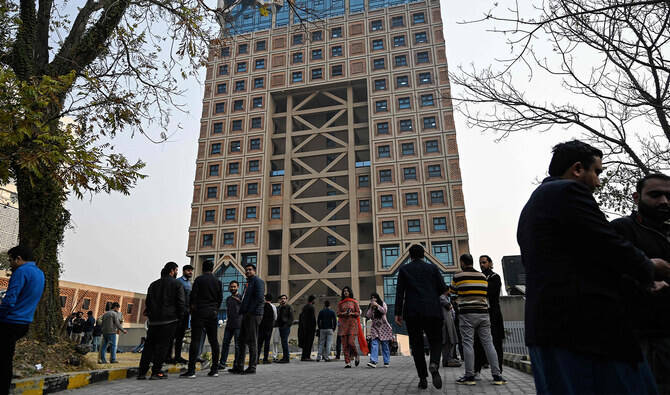
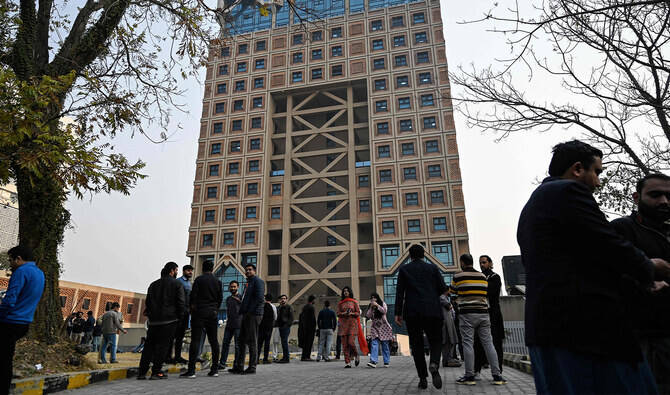
People gather outside a building in the aftermath of an earthquake in Islamabad, Pakistan, on January 11, 2024. (AFP/File)
Short Url
Updated 03 August 2025
Follow

Pakistan warns of earthquake aftershocks in capital, nearby cities in coming days

  • A 5.1-magnitude earthquake struck at a depth of 10 kilometers near Islamabad at 12:10am on Sunday
  • The shallow depth of the earthquake contributed to the widespread tremors felt in nearby cities, towns

ISLAMABAD: Authorities have warned of potential aftershocks of a 5.1-magnitude earthquake that hit the Pakistani capital of Islamabad and several other cities in wee hours of Sunday, the Press Information Department (PID) said, urging citizens to remain vigilant.

The earthquake struck approximately 15 km east-southeast of Rawat, near Islamabad and Rawalpindi, at 12:10am on Sunday. The shallow earthquake, with a depth of 10 kilometers, caused tremors that were felt in Islamabad Capital Territory, Rawalpindi, Gujrat, Jhelum, Nankana Sahib, Jalalpur Bhatian, Wazirabad, Shahkot, Bhalwal as well as regions in Azad Kashmir.

Its epicenter lied near the Rawat Fault, a known active fault line in the seismically active Potohar Plateau, which is influenced by the tectonic interactions of the Indian-Eurasian plate boundary. The maximum shaking intensity, measured on the Modified Mercalli Intensity (MMI) scale, reached V, indicating moderate to strong shaking near the epicenter, the PID said, citing seismic and disaster management authorities.

The shallow depth of the earthquake contributed to the widespread tremors felt in nearby cities and towns, though the moderate intensity suggests limited potential for significant structural damage. Fortunately, no immediate reports of casualties or property damage have been received, and authorities are continuing to monitor the situation closely.

“Seismologists anticipate minor aftershocks of up to magnitude 3.0 in the coming days, which is typical following an earthquake of this magnitude,” the PID said on Sunday.

Pakistan’s Rawat region is situated in a seismically active zone characterized by frequent small to moderate magnitude earthquakes, as evidenced by historical seismic activity associated with the Rawat Fault.

“Local authorities and disaster management agencies are actively assessing the situation and urge residents to remain vigilant for potential aftershocks,” the PID said.

“Citizens are advised to follow standard earthquake safety protocols.”

The protocols include dropping down on one’s hands and knees to prevent the earthquake from knocking one down; covering body, particularly one’s head and neck, underneath a sturdy table or desk, or getting down near an interior wall if there is no shelter nearby until the shaking stops.

Sunday’s earthquake was the second one to hit the country this week.

A 5-magnitude earthquake jolted parts of Pakistan and Afghanistan early Saturday, the United States Geological Survey (USGS) reported, with tremors felt in Islamabad, Rawalpindi, Lahore, Muzaffarabad, Peshawar, Mardan, Swabi and several other Pakistani cities.

The quake hit at 2:03am on Saturday, with its epicenter located in Farkhār, Afghanistan at a depth of 122.6 kilometers.


ADB approves $381 million for climate-resilient agriculture, social services in Punjab

Updated 8 sec ago
Follow

ADB approves $381 million for climate-resilient agriculture, social services in Punjab

  • Support will upgrade Punjab’s education and nursing systems, improving learning outcomes and health care capacity
  • Package includes $124 million for agriculture, $107 million for STEM schooling and $150 million for nursing reforms

KARACHI: The Asian Development Bank (ADB) said on Saturday it approved $381 million in financing for Pakistan’s Punjab province to modernize agriculture and strengthen education and health services, with a major focus on building climate resilience after monsoon floods this year caused widespread destruction across the country’s most populous province.

The package includes concessional loans and grants for farm mechanization, STEM education, and nursing sector reforms.

ADB said the investments are intended to help Punjab, home to more than half of Pakistan’s population and a key contributor to its economy, recover from climate shocks and transition toward more sustainable and resilient development.

“Investing in education, health, and agricultural mechanization will play a transformative role in driving the growth of Punjab, a vital pillar of Pakistan’s economy,” said ADB Country Director for Pakistan Emma Fan. “These strategic investments will modernize agriculture, enhance human capital, and significantly improve livelihoods for millions of people across Punjab.”

The bank approved $120 million in concessional loans and a $4 million grant for the Punjab Climate-Resilient and Low-Carbon Agriculture Mechanization Project, which will support 220,000 rural farm households.

The program aims to reduce climate vulnerability by shifting farmers toward modern, low-emission machinery, provide alternative livelihoods for agricultural workers and train 15,000 women in new skills. It will also introduce a financing model to help small farmers access advanced equipment.

Punjab produces most of Pakistan’s wheat, rice, and maize but still relies on outdated machinery, contributing to grain losses and routine burning of crop residues, a major source of air pollution, said ADB.

It noted the new project will promote modern mechanization, including rice harvesters, to address these issues.

ADB also approved $107 million for the Responsive, Ready, and Resilient STEM Secondary Education in Punjab Program, including a $7 million grant from the Asian Development Fund.

The results-based program aims to modernize secondary schooling by expanding inclusive STEM education, improving access and quality across the province.

A further $150 million concessional loan was approved for the Punjab Nursing and Health Workforce Reform Program, which will upgrade nursing curricula, develop disaster-resilient training facilities, strengthen workforce governance, and introduce digital human-resource systems.

The program seeks to expand the pool of qualified nurses to strengthen health service delivery and meet rising national and global demand.

Key components include the establishment of three centers of excellence in Lahore, Multan and Rawalpindi, equipped with simulation labs, digital learning platforms, and gender-responsive hostels.

ADB said it remains committed to supporting climate-resilient and inclusive development across Asia and the Pacific through innovative financing tools and partnerships.