

Pro-Palestine online content in UK risks censorship, rights groups warn

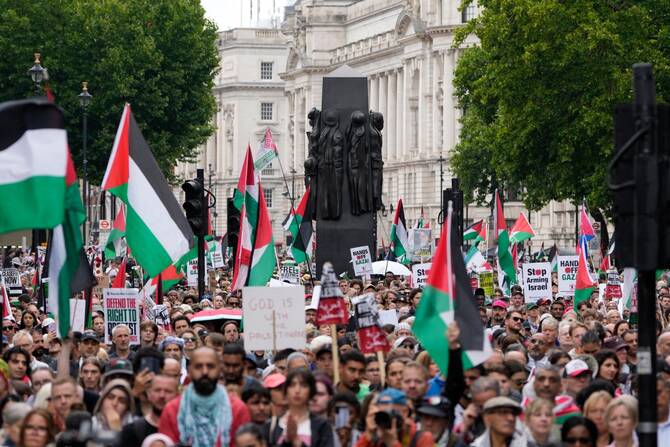
Content in support of Palestinians published online could be misconstrued as supporting Palestine Action, a protest group that was proscribed under anti-terrorism laws on July 5. (AFP/File Photo)
Short Url
Updated 02 August 2025
Follow

Pro-Palestine online content in UK risks censorship, rights groups warn

  • Online Safety Act, banning of Palestine Action present dual threat for users, letter says
  • Content supporting Palestinians risks being identified as supporting terrorism

LONDON: Pro-Palestine online content in the UK could be censored through the twin threat of the Online Safety Act and banning of Palestine Action, human rights groups have warned.

Content in support of Palestinians published online could be misconstrued as supporting Palestine Action, a protest group that was proscribed under anti-terrorism laws on July 5, The Guardian reported on Saturday.

Index on Censorship, Open Rights Group and other organizations have written to Ofcom, the UK’s independent communications regulator, to request clarification on the matter.

Signatories to the letter also warned that online content objecting to Palestine Action’s banning could be misidentified as unlawful support for the group.

Open Rights Group’s Sara Chitseko, a pre-crime program manager, told The Guardian: “Crucial public debate about Gaza is being threatened by vague, overly broad laws that could lead to content about Palestine being removed or hidden online.

“There’s also a real danger that people will start self-censoring, worried they might be breaking the law just by sharing or liking posts related to Palestine and nonviolent direct action.

“This is a serious attack on freedom of expression and the right to protest in the UK. We need to ensure that people can share content about Palestine online without being afraid that they will be characterised as supportive of terrorism.”

Major online social media platforms such as Facebook, Instagram and TikTok have been advised by Ofcom that they can avoid concerns about meeting the requirements of the Online Safety Act if they are more stringent with censoring content than is mandated by the act.

The letter sent to Ofcom by the rights groups warned: “This approach risks encouraging automated moderation that disproportionately affects political speech, particularly from marginalised communities, including Palestinian voices.”

The UK, unlike the EU, lacks a mechanism through which users can appeal the censoring of their online content.

Signatories to the letter — which was also sent to Meta, Alphabet, X and ByteDance, owners of the world’s top social media platforms — called for the creation of a British dispute mechanism to discourage the censoring of lawful content.

The letter added: “We are concerned that the proscription of Palestine Action may result in an escalation of platforms removing content, using algorithms to hide Palestine solidarity posts and leave individuals and those reporting on events vulnerable to surveillance or even criminalisation for simply sharing or liking content that references nonviolent direct action.

“We are also concerned about what platforms understand by their legal duties regarding expressions of ‘support’ for Palestine Action.”

An Ofcom spokesperson said: “We have provided detailed guidance to platforms about how to identify the particular types of illegal and harmful material prohibited or restricted by the act, including how to determine whether content may have been posted by a proscribed organisation.

“There is no requirement on companies to restrict legal content for adult users. In fact, they must carefully consider how they protect users’ rights to freedom of expression while keeping people safe.”


BBC slammed for ‘shameful’ cut to ‘free Palestine’ comment at BAFTA Awards

Updated 23 February 2026
Follow

BBC slammed for ‘shameful’ cut to ‘free Palestine’ comment at BAFTA Awards

  • Broadcaster removes from broadcast part of filmmaker Akinola Davies Jr.’s acceptance speech at the British Academy Film Awards
  • Amnesty UK praises filmmaker for speaking up for those ‘facing and fleeing from persecution and mass atrocities’

LONDON: The BBC was accused on Monday of a “shameful” decision after it cut part of an acceptance speech at the previous night’s British Academy Film Awards in which a filmmaker uttered the phrase “free Palestine.”

British-Nigerian director and co-writer Akinola Davies Jr. and his brother, co-writer Wale Davies were collecting the award for outstanding debut by a British writer, director or producer for their film “My Father’s Shadow” when the former made the comment.

The BBC chose not to include the final part of his speech when it broadcast the BAFTAs ceremony later in the evening. However, the corporation did broadcast an inadvertent racist slur shouted by a person with Tourette syndrome while Black actors Michael B. Jordan and Delroy Lindo were presenting an award.

Akinola thanked industry figures and family for their support as he accepted the award, before dedicating it to “all those whose parents migrated to obtain a better life for their children.”

In the final part of his speech, cut by the BBC, he said: “To the economic migrant, the conflict migrant, those under occupation, dictatorship, persecution and those experiencing genocide, you matter and your stories matter more than ever.

“Your dreams are an act of resistance. To those watching at home, archive your loved ones, archive your stories yesterday, today and forever. For Nigeria, for London, Congo, Sudan, free Palestine. Thank you.”

The BBC, which broadcast the ceremony with a two-hour time delay, said the cut was made for timing reasons.

A spokesperson told Deadline: “The live event is three hours, and it has to be reduced to two hours for its on-air slot. The same happened to other speeches made during the night, and all edits were made to ensure the program was delivered to time. All winners’ speeches will be available to watch via BAFTA’s YouTube Channel.”

Human rights campaign group Amnesty UK described the decision by the BBC to cut part of the speech as “shameful.”

It added: “Thank you Akinola Davies Jr. for using your platform to speak out for the rights of migrants and people facing and fleeing from persecution and mass atrocities, from the Congo to Sudan to Palestine.”

In June last year, the BBC was at the center of a row after it broadcast a Glastonbury Festival performance by the duo Bob Vylan, during which the lead singer chanted “death to the IDF” in protest against the Israeli Defense Forces’ assault on Gaza.