

Iranian president due in Pakistan today on state visit to strengthen ties

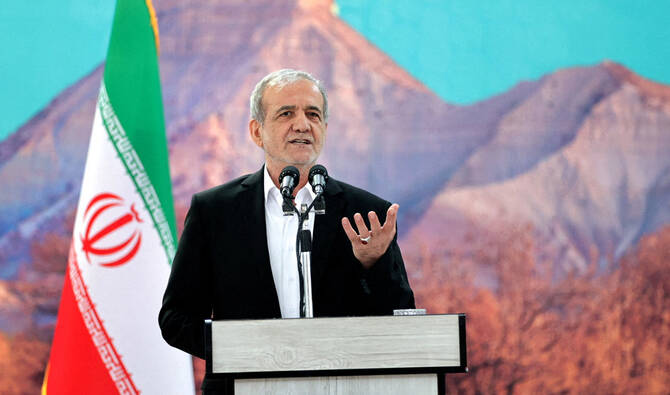
Iranian President Masoud Pezeshkian speaks during a meeting in Ilam, Iran, on June 12, 2025. (Handout via REUTERS)
Short Url
Updated 02 August 2025
Follow

Iranian president due in Pakistan today on state visit to strengthen ties

  • Pakistan and Iran enjoy close ties and have signed several pacts, but the two neighbors have also been at odds over instability along their shared border
  • Their ties warmed up after Islamabad voiced support for Tehran during the 12-day Israel-Iran war that began after Israeli strikes on Iranian nuclear sites

ISLAMABAD: Iranian President Dr. Masoud Pezeshkian will arrive in Pakistan today, Saturday, on a two-day state visit aimed at strengthening bilateral relations, the Pakistani foreign office said.

Pakistan and Iran enjoy close ties and have signed several pacts in trade, energy and security in recent years. However, the two countries have also been at odds over instability along their shared porous border but have always been quick in moving to ease tensions each time.

In May, Iranian Foreign Minister Seyyed Abbas Araghchi visited Pakistan at a time of heightened tensions between Pakistan and India over an attack in the disputed Kashmir region. His visit was followed by another by Prime Minister Shehbaz Sharif to Iran, where he had met Iranian President Masoud Pezeshkian and Supreme Leader Ayatollah Ali Khamenei.

This is Pezeshkian’s first official visit to Pakistan as the Iranian president, according to the Pakistani foreign office. He will be accompanied by a high-level delegation, including FM Araghchi, senior ministers and other high-ranking officials.

“During his stay, President Pezeshkian will meet with the President of Pakistan, H.E. Asif Ali Zardari, and hold delegation-level talks with Prime Minister of Pakistan, H.E. Shehbaz Sharif,” the foreign office said on Friday.

Tensions surged between Pakistan and Iran in January last year when both countries exchanged rare, tit-for-tat airstrikes on what they said were militant hideouts on each other’s soil.

Late Iranian president Ebrahim Raisi had later traveled to Pakistan on a three-day visit in April to de-escalate tensions and strengthen bilateral relations. The two sides had also signed memorandums of understanding in the fields of trade, science technology, agriculture, health, culture, and judicial matters.

The bilateral ties initially witnessed a thaw during FM Araghchi’s visit to Pakistan this year and further warmed up after Islamabad voiced its support of Tehran during the 12-day Israel-Iran war in June, which began after Israeli strikes on Iranian nuclear sites.

Pakistan remained engaged in talks with regional partners like Saudi Arabia, Iran, China and Qatar to de-escalate tensions in the Middle East after Iran conducted retaliatory strikes on Israel and a US base in Qatar, raising fears the conflict could draw in other regional states.

“The visit [by Iranian president] is expected to further strengthen the brotherly relations between Pakistan and Iran,” the Pakistani foreign office said.

Four people, including two policemen, killed in twin blasts in northwest Pakistan

Updated 07 March 2026
Follow

Four people, including two policemen, killed in twin blasts in northwest Pakistan

  • Attack on police van in South Waziristan and motorbike-mounted IED in Lakki Marwat hits KP province
  • Violence comes amid a surge in militancy and cross-border clashes between Pakistan and Afghanistan

ISLAMABAD: At least four people, including two policemen, were killed and about 20 others wounded in two separate blasts in Pakistan’s northwestern Khyber Pakhtunkhwa province on Saturday, officials said, the latest violence in a region grappling with militant violence.

One explosion targeted a police patrol van in Wana, the main town of South Waziristan district near the Afghan border, while another blast caused by explosives mounted on a motorbike struck a market area in Lakki Marwat district, according to police officials and preliminary reports.

The incidents come amid rising militant violence in Pakistan’s northwest, where authorities say armed groups operate from across the border in Afghanistan, straining relations between Islamabad and the Taliban administration in Kabul, with both sides engaged in a military conflict since last month.

“The control room received information in the evening about a bomb blast targeting a police van in Wana Bazaar,” a police official in the area, who did not want to be named, confirmed while speaking to Arab News over the phone.

He confirmed two deaths in the incident while saying more than 25 people had been injured.

The official said rescue teams responded promptly and shifted three seriously injured people to a nearby hospital in Wana.

In another incident during the day in Lakki Marwat, an improvised explosive device attached to a motorbike exploded near shops.

“Two people have been killed and about 10 have been injured in an IED blast in Lakki Marwat,” Raza Khan, Deputy Superintendent of Police in Bannu, told Arab News.

“The deceased are identified as Shoaib Ur Rehman and Furqan Ullah,” he added. “Shoaib, the owner of the shop, was the brother of the Lakki peace committee head.”

Peace committees in the region are informal, community-based groups that work with security forces to report militant activity and maintain order, making their members frequent targets of attacks.

Pakistan’s Interior Minister Mohsin Naqvi condemned the attacks and expressed grief over the incidents.

“I strongly condemn the blast near a police patrolling vehicle in Wana Bazaar,” Naqvi said in a statement, confirming the killing of four people, including two police personnel.

“Khyber Pakhtunkhwa police are on the front line in the war against terrorism,” he said, noting the force had made “unforgettable sacrifices” in the fight against militant groups.

Militant violence has surged in Pakistan’s border regions in recent months, particularly in Khyber Pakhtunkhwa and Balochistan provinces.
Islamabad has repeatedly accused the Afghan Taliban government of allowing militant groups, including the Tehreek-e-Taliban Pakistan (TTP), to operate from Afghan territory — a charge Kabul denies — as cross-border tensions between the two neighbors have escalated.