


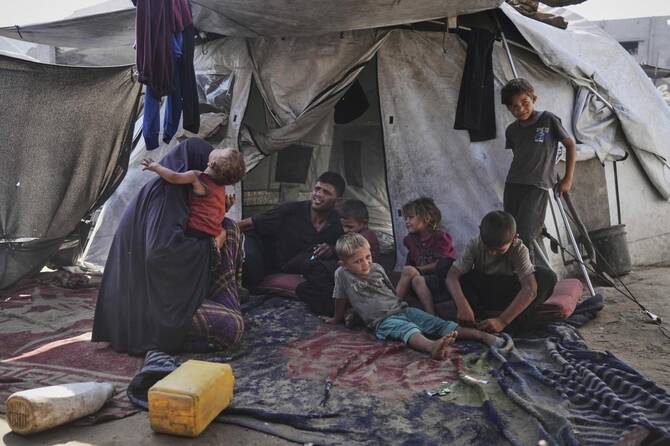


DEIR AL-BALAH, Gaza Strip: Every morning, Abeer and Fadi Sobh wake up in their tent in the Gaza Strip to the same question: How will they find food for themselves and their six young children?
The couple has three options: Maybe a charity kitchen will be open and they can get a pot of watery lentils. Or they can try jostling through crowds to get some flour from a passing aid truck. The last resort is begging.
If those all fail, they simply don’t eat. It happens more and more these days, as hunger saps their energy, strength and hope.
The predicament of the Sobhs, who live in a seaside refugee camp west of Gaza City after being displaced multiple times, is the same for families throughout the war-ravaged territory.
Hunger has grown throughout the past 22 months of war because of aid restrictions, humanitarian workers say. But food experts warned earlier this week the “worst-case scenario of famine is currently playing out in Gaza.”
Israel enforced a complete blockade on food and other supplies for 2½ months beginning in March. It said its objective was to increase pressure on Hamas to release dozens of hostages it has held since its attack on Israel on Oct. 7, 2023.
Though the flow of aid resumed in May, the amount is a fraction of what aid organizations say is needed.
A breakdown of law and order has also made it nearly impossible to safely deliver food. Much of the aid that does get in is hoarded or sold in markets at exorbitant prices.
Here is a look at a day in the life of the Sobh family:
A morning seawater bath
The family wakes up in their tent, which Fadi Sobh, a 30-year-old street vendor, says is unbearably hot in the summer.
With fresh water hard to come by, his wife Abeer, 29, fetches water from the sea.
One by one, the children stand in a metal basin and scrub themselves as their mother pours the saltwater over their heads. Nine-month-old Hala cries as it stings her eyes. The other children are more stoic.
Abeer then rolls up the bedding and sweeps the dust and sand from the tent floor. With no food left over from the day before, she heads out to beg for something for her family’s breakfast. Sometimes, neighbors or passersby give her lentils. Sometimes she gets nothing.
Abeer gives Hala water from a baby bottle. When she’s lucky, she has lentils that she grinds into powder to mix into the water.
“One day feels like 100 days, because of the summer heat, hunger and the distress,” she said.
A trip to the soup kitchen
Fadi heads to a nearby soup kitchen. Sometimes one of the children goes with him.
“But food is rarely available there,” he said. The kitchen opens roughly once a week and never has enough for the crowds. Most often, he said, he waits all day but returns to his family with nothing “and the kids sleep hungry, without eating.”
Fadi used to go to an area in northern Gaza where aid trucks arrive from Israel. There, giant crowds of equally desperate people swarm over the trucks and strip away the cargo of food. Often, Israeli troops nearby open fire, witnesses say. Israel says it only fires warning shots, and others in the crowd often have knives or pistols to steal boxes.
Fadi, who also has epilepsy, was shot in the leg last month. That has weakened him too much to scramble for the trucks, so he’s left with trying the kitchens.
Meanwhile, Abeer and her three eldest children — 10-year-old Youssef, 9-year-old Mohammed and 7-year-old Malak — head out with plastic jerrycans to fill up from a truck that brings freshwater from central Gaza’s desalination plant.
The kids struggle with the heavy jerrycans. Youssef loads one onto his back, while Mohammed half-drags his, his little body bent sideways as he tries to keep it out of the dust of the street.
A scramble for aid
Abeer sometimes heads to Zikim herself, alone or with Youssef. Most in the crowds are men — faster and stronger than she is. “Sometimes I manage to get food, and in many cases, I return empty-handed,” she said.
If she’s unsuccessful, she appeals to the sense of charity of those who succeeded. “You survived death thanks to God, please give me anything,” she tells them. Many answer her plea, and she gets a small bag of flour to bake for the children, she said.
She and her son have become familiar faces. One man who regularly waits for the trucks, Youssef Abu Saleh, said he often sees Abeer struggling to grab food, so he gives her some of his. “They’re poor people and her husband is sick,” he said. “We’re all hungry and we all need to eat.”
During the hottest part of the day, the six children stay in or around the tent. Their parents prefer the children sleep during the heat — it stops them from running around, using up energy and getting hungry and thirsty.
Foraging and begging in the afternoon
As the heat eases, the children head out. Sometimes Abeer sends them to beg for food from their neighbors. Otherwise, they scour Gaza’s bombed-out streets, foraging through the rubble and trash for anything to fuel the family’s makeshift stove.
They’ve become good at recognizing what might burn. Scraps of paper or wood are best, but hardest to find. The bar is low: plastic bottles, plastic bags, an old shoe — anything will do.
One of the boys came across a pot in the trash one day — it’s what Abeer now uses to cook. The family has been displaced so many times, they have few belongings left.
“I have to manage to get by,” Abeer said. “What can I do? We are eight people.”
If they’re lucky, lentil stew for dinner
After a day spent searching for the absolute basics to sustain life — food, water, fuel to cook — the family sometimes has enough of all three for Abeer to make a meal. Usually it’s a thin lentil soup.
But often there is nothing, and they all go to bed hungry.
Abeer said she’s grown weak and often feels dizzy when she’s out searching for food or water.
“I am tired. I am no longer able,” she said. “If the war goes on, I am thinking of taking my life. I no longer have any strength or power.”


