

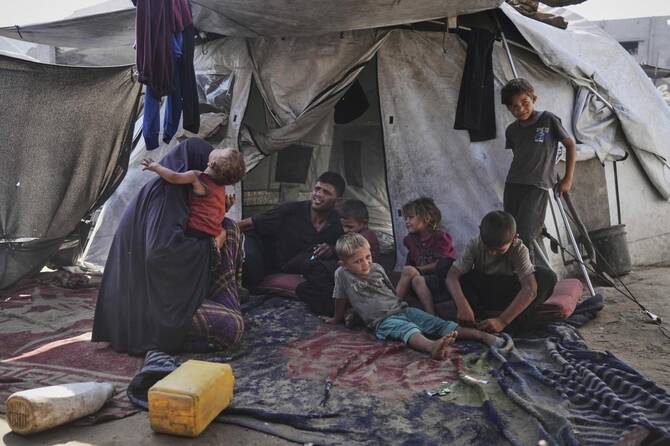
From dawn to dusk, a Gaza family focuses on one thing: finding food

1 / 4
Abeer Sobh cleans her family's tent at a camp for displaced Palestinians in Gaza City on Thursday, July 24, 2025. (AP Photo/Jehad Alshrafi)
2 / 4
Abeer and Fadi Sobh gather in their tent with their children at a camp for displaced Palestinians in Gaza City, Thursday, July 24, 2025. (AP Photo/Jehad Alshrafi)
3 / 4
Children from the Sobh family rest inside their tent at a camp for displaced Palestinians in Gaza City, Thursday, July 24, 2025. (AP Photo/Jehad Alshrafi)
4 / 4
Abeer Sobh washes clothes inside her family's tent at a camp for displaced Palestinians in Gaza City on Thursday, July 24, 2025. (AP Photo/Jehad Alshrafi)
Short Url
Updated 02 August 2025
Follow

From dawn to dusk, a Gaza family focuses on one thing: finding food

  • The couple has three options: Maybe a charity kitchen will be open and they can get a pot of watery lentils
  • Or they can try jostling through crowds to get some flour from a passing aid truck. The last resort is begging.

DEIR AL-BALAH, Gaza Strip: Every morning, Abeer and Fadi Sobh wake up in their tent in the Gaza Strip to the same question: How will they find food for themselves and their six young children?

The couple has three options: Maybe a charity kitchen will be open and they can get a pot of watery lentils. Or they can try jostling through crowds to get some flour from a passing aid truck. The last resort is begging.

If those all fail, they simply don’t eat. It happens more and more these days, as hunger saps their energy, strength and hope.

The predicament of the Sobhs, who live in a seaside refugee camp west of Gaza City after being displaced multiple times, is the same for families throughout the war-ravaged territory.

Hunger has grown throughout the past 22 months of war because of aid restrictions, humanitarian workers say. But food experts warned earlier this week the “worst-case scenario of famine is currently playing out in Gaza.”

Israel enforced a complete blockade on food and other supplies for 2½ months beginning in March. It said its objective was to increase pressure on Hamas to release dozens of hostages it has held since its attack on Israel on Oct. 7, 2023.

Though the flow of aid resumed in May, the amount is a fraction of what aid organizations say is needed.

A breakdown of law and order has also made it nearly impossible to safely deliver food. Much of the aid that does get in is hoarded or sold in markets at exorbitant prices.

Here is a look at a day in the life of the Sobh family:

A morning seawater bath

The family wakes up in their tent, which Fadi Sobh, a 30-year-old street vendor, says is unbearably hot in the summer.

With fresh water hard to come by, his wife Abeer, 29, fetches water from the sea.

One by one, the children stand in a metal basin and scrub themselves as their mother pours the saltwater over their heads. Nine-month-old Hala cries as it stings her eyes. The other children are more stoic.

Abeer then rolls up the bedding and sweeps the dust and sand from the tent floor. With no food left over from the day before, she heads out to beg for something for her family’s breakfast. Sometimes, neighbors or passersby give her lentils. Sometimes she gets nothing.

Abeer gives Hala water from a baby bottle. When she’s lucky, she has lentils that she grinds into powder to mix into the water.

“One day feels like 100 days, because of the summer heat, hunger and the distress,” she said.

A trip to the soup kitchen

Fadi heads to a nearby soup kitchen. Sometimes one of the children goes with him.

“But food is rarely available there,” he said. The kitchen opens roughly once a week and never has enough for the crowds. Most often, he said, he waits all day but returns to his family with nothing “and the kids sleep hungry, without eating.”

Fadi used to go to an area in northern Gaza where aid trucks arrive from Israel. There, giant crowds of equally desperate people swarm over the trucks and strip away the cargo of food. Often, Israeli troops nearby open fire, witnesses say. Israel says it only fires warning shots, and others in the crowd often have knives or pistols to steal boxes.

Fadi, who also has epilepsy, was shot in the leg last month. That has weakened him too much to scramble for the trucks, so he’s left with trying the kitchens.
Meanwhile, Abeer and her three eldest children — 10-year-old Youssef, 9-year-old Mohammed and 7-year-old Malak — head out with plastic jerrycans to fill up from a truck that brings freshwater from central Gaza’s desalination plant.

The kids struggle with the heavy jerrycans. Youssef loads one onto his back, while Mohammed half-drags his, his little body bent sideways as he tries to keep it out of the dust of the street.

A scramble for aid

Abeer sometimes heads to Zikim herself, alone or with Youssef. Most in the crowds are men — faster and stronger than she is. “Sometimes I manage to get food, and in many cases, I return empty-handed,” she said.

If she’s unsuccessful, she appeals to the sense of charity of those who succeeded. “You survived death thanks to God, please give me anything,” she tells them. Many answer her plea, and she gets a small bag of flour to bake for the children, she said.

She and her son have become familiar faces. One man who regularly waits for the trucks, Youssef Abu Saleh, said he often sees Abeer struggling to grab food, so he gives her some of his. “They’re poor people and her husband is sick,” he said. “We’re all hungry and we all need to eat.”

During the hottest part of the day, the six children stay in or around the tent. Their parents prefer the children sleep during the heat — it stops them from running around, using up energy and getting hungry and thirsty.

Foraging and begging in the afternoon

As the heat eases, the children head out. Sometimes Abeer sends them to beg for food from their neighbors. Otherwise, they scour Gaza’s bombed-out streets, foraging through the rubble and trash for anything to fuel the family’s makeshift stove.

They’ve become good at recognizing what might burn. Scraps of paper or wood are best, but hardest to find. The bar is low: plastic bottles, plastic bags, an old shoe — anything will do.

One of the boys came across a pot in the trash one day — it’s what Abeer now uses to cook. The family has been displaced so many times, they have few belongings left.

“I have to manage to get by,” Abeer said. “What can I do? We are eight people.”

If they’re lucky, lentil stew for dinner

After a day spent searching for the absolute basics to sustain life — food, water, fuel to cook — the family sometimes has enough of all three for Abeer to make a meal. Usually it’s a thin lentil soup.

But often there is nothing, and they all go to bed hungry.

Abeer said she’s grown weak and often feels dizzy when she’s out searching for food or water.

“I am tired. I am no longer able,” she said. “If the war goes on, I am thinking of taking my life. I no longer have any strength or power.”


Nations must stop arming Sudan factions, ICC should deliver Gaza justice, EU envoy Kajsa Ollongren tells Arab News

Updated 5 sec ago
Follow

Nations must stop arming Sudan factions, ICC should deliver Gaza justice, EU envoy Kajsa Ollongren tells Arab News

  • EU special representative for human rights warns governments are flouting multilateral rules designed to safeguard civilians during conflict
  • Kajsa Ollongren says EU must work with states committed to multilateralism and humanitarian law to preserve a rules-based global order

NEW YORK CITY: Kajsa Ollongren, the EU special representative for human rights, has warned that Sudan is enduring “atrocities beyond imagination,” urging all countries supplying arms to the warring factions to immediately halt transfers.

Speaking to Arab News following missions to Lebanon and Egypt and a human rights dialogue with Saudi Arabia, Ollongren said foreign weapons are fueling one of the world’s most devastating and under-reported conflicts, with no political resolution in sight.

Her comments came shortly after Volker Turk, the UN high commissioner for human rights, issued one of his starkest warnings yet that Sudan faces “another wave of atrocities,” with civilians facing ethnic cleansing and mass displacement.

Turk has repeatedly cautioned that the violence could reach “catastrophic levels” if the flow of weapons continues. Ollongren said these warnings match what she has heard from regional human rights personnel.

“The atrocities are really beyond your imagination,” she told Arab News. “For a long time, the world did not pay enough attention to what was happening in Sudan. We are paying attention now, at least, but attention alone will not stop it.”

She said that governments enabling the conflict must be confronted. “There also has to be genuine interaction with those countries providing weapons. Without those weapons, we would see an end to the atrocities sooner … It’s unacceptable.”

She said coordinated pressure from Europe, the Gulf, and the wider international community is essential. “It’s very important, at the Gulf level, in Europe, and globally, to call for a stop to arms exports,” she added.

The conflict in Sudan began in April 2023 when a power struggle between armed forces chief Abdel Fattah Al-Burhan and his former deputy Mohammed Hamdan Dagalo, head of the paramilitary Rapid Support Forces, erupted into open conflict.

About 12 million people have been displaced, according to UN figures, creating what many consider to be the world’s worst humanitarian catastrophe. Death toll estimates vary widely, with the former US envoy for Sudan suggesting as many as 400,000 have been killed.

Although the Sudanese Armed Forces have reclaimed the capital, Khartoum, from the RSF, the country is effectively bisected, with the SAF-led government controlling the east and the RSF and allied militias dominating the west, including the troubled Darfur region.

October produced one of the most brutal episodes of the conflict, when RSF fighters captured El-Fasher, the capital of North Darfur, and began slaughtering civilians, triggering mass displacement.

Sudan has returned to the diplomatic spotlight following Saudi Crown Prince Mohammed bin Salman’s recent visit to Washington, where he discussed developments with US President Donald Trump and urged a more active role in ending the conflict and preventing regional spillover.

Soon after, Trump announced that the US would “immediately start a new effort” to end the conflict in Sudan, which he described as “the most violent place on Earth and the single biggest humanitarian crisis” — a move widely interpreted as a response to the crown prince’s appeal.

“The fact that the president of the US comments this way about the atrocities is important, and it will be heard in Sudan,” Ollongren said.

But she cautioned that declarations alone are meaningless without serious follow-through. “It’s not enough to just declare an end to a war or conflict,” she said. “There has to be a plan — one that includes reconstruction, accountability, and rebuilding societies while empowering the victims.”

Turning to Lebanon, Ollongren said she sensed “momentum” during her recent meetings in Beirut, where diplomatic engagement has accelerated since the ceasefire in the Israel-Hezbollah war a year ago.

This comes despite Israel’s refusal to withdraw from southern Lebanon and its continued strikes against suspected Hezbollah positions, including last month’s attack on a Beirut neighborhood that killed a militia commander.

Hezbollah’s leaders insist they will not disarm until Israel withdraws its troops.

“There is momentum for more peace and stability and for a stable future for many countries in the region,” Ollongren said. “I see the role that Saudi Arabia is taking in all of this, and also Egypt’s efforts to negotiate between parties.”

Still, she emphasized the fragility of the situation. “There is still uncertainty about whether the ceasefire is being violated, and there is not yet a clear plan to disarm Hezbollah,” she said.

“Accountability is crucial. In Lebanon, we talked a lot about political assassinations and the Beirut port explosion. All of that has to be addressed with justice, because without it impunity persists, which can lead to further issues in the future.”

On Syria, which she plans to visit early next year, Ollongren said the situation remains unstable.

“We’ve seen violence and casualties in several parts of the country. It is not under control,” she said, referring to attacks on ethnic and religious minorities over the past year since the Assad regime was forced from power.

Although she welcomed the recent return of Syrian refugees from Lebanon as “a good sign,” she cautioned that broader stabilization remains distant as the transitional government of President Ahmad Al-Sharaa pursues national reintegration and sanctions relief.

Ollongren also highlighted Saudi Arabia’s growing diplomatic influence as one of the most significant shifts in the region. “Saudi Arabia is taking a different path,” she said, referencing Vision 2030 reforms and the Kingdom’s expanded global engagement.

“Saudi Arabia is also engaging with Europe and the EU, establishing ties that could be very important for a more stable Middle East.

“Of course, this also recalibrates the influence of other powers. Egypt has played a longstanding role but is struggling with its economy and population pressures. Saudi Arabia’s engagement could be very impactful.”

On Gaza, Ollongren described “complete destruction” and extremely limited access as challenges for media and humanitarian efforts. “We have not had independent journalists able to report on casualties or destruction,” she said.

“Bit by bit, more is coming out, and we see complete destruction in many parts of Gaza. People have no homes to return to and have lost a huge number of civilians, including children. There must be accountability.”

Israel launched its military operations in Gaza after the Oct. 7, 2023, Hamas-led attack on southern Israel, which killed 1,200 people and in which 250 were taken hostage. Since then, about 70,000 Palestinians have been killed, according to the Gaza health ministry.

A fragile ceasefire came into force on Oct. 10, with Israeli forces scaling back operations in exchange for Hamas releasing its remaining hostages. A small flow of humanitarian aid has been allowed into the territory, but medical, nutritional, and shelter needs remain immense.

Ollongren emphasized that accountability for alleged war crimes committed by both sides must be secured through the International Criminal Court.

“The ICC should play a role in this,” she said. “They have looked at both Hamas and Israel. That is the right place to seek justice and accountability.”

Asked whether European states support ICC arrest warrants for Israeli Prime Minister Benjamin Netanyahu and his former defense minister, Yoav Gallant, Ollongren said: “We are signatories to the Rome Statute, so we are bound by the treaty.

“The court decides on arrests, cases, and prosecutions independently. Our role is to ensure its independence and continued functioning. So yes.”

A growing number of legal scholars, including a UN independent international commission of inquiry, have concluded that genocide has taken place in Gaza over the past two years.

Francesca Albanese, the UN special rapporteur on the situation of human rights in the Palestinian territories, recently told Arab News that EU and Western responses to the genocide in Gaza have been “pathetic, hypocritical, and shaped by double standards.”

She said that the same governments invoking international law to condemn Russia’s actions in Ukraine have been largely silent on Gaza, allowing “egregious violations” to unfold.

Ollongren responded to the criticism. “We should, and we must, apply international law consistently in all cases,” she said.

“We feel the accusation of double standards. After the Oct. 7 attacks by Hamas, Europe was very supportive of Israel, recognizing its right to defend itself. But as the war in Gaza unfolded and civilian casualties mounted, we became more critical.

“The EU has increasingly called on Israel to abide by international humanitarian law and has worked to ensure humanitarian aid reaches those in need.

“At the same time, we support the Palestinian Authority in taking a governance role. I think we have now become a much more critical and fair partner for both sides.”

Asked whether the international system is failing, she said the problem lies not with institutions but with governments.

“The architecture we have needs to be protected,” she said. “We don’t need a new system. The problem is that it is not being respected. That is why it’s important for the EU to engage with countries that uphold the multilateral system, the rule of law, and international humanitarian law.

“These frameworks were designed to protect the most vulnerable in conflicts, not prevent wars.”

She concluded with a message to civilians in Gaza and Sudan.

“I understand that you have lost faith in the international system because it was not there to protect you when you were attacked and lost loved ones,” she said.

“It’s still the best system we have. From my side, I will focus on accountability and justice, because from a human rights perspective, that is what I must do for you.”
