

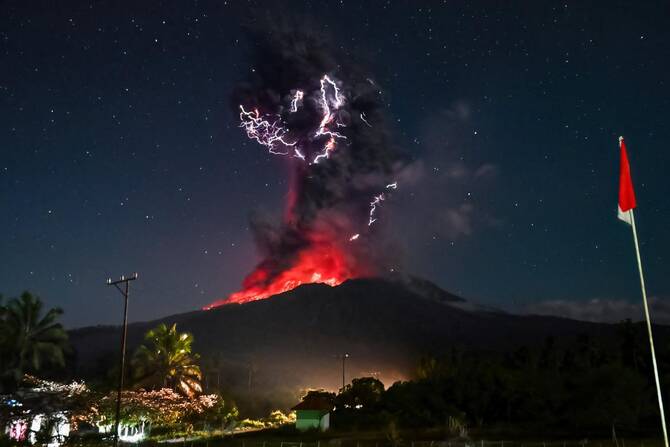
Indonesia’s Mount Lewotobi Laki Laki erupts again, spews giant ash plumes

Mount Lewotobi Laki-Laki spewing lava and volcanic ash up to approximately 10 kilometers high during its eruption as observed from the monitoring post in East Flores, in East Nusa Tenggara province. (Indonesia’s Geological Agency/AFP)
Short Url
Updated 02 August 2025
Follow

Indonesia’s Mount Lewotobi Laki Laki erupts again, spews giant ash plumes

  • An avalanche of searing gas clouds mixed with rocks and lava travels up to 5 kilometers down the slopes of the mountain
  • Lewotobi Laki Laki, a 1,584-meter volcano on the remote island of Flores, has been at the highest alert level since it erupted on June 18

JAKARTA: Mount Lewotobi Laki Laki, one of Indonesia’s most active volcanoes, erupted for a second straight day, sending a column of volcanic materials and ash up to 18 kilometers into the sky early Saturday and blanketing villages with debris. No casualties were immediately reported.

Another eruption Friday evening had sent clouds of ash up to 10 kilometers high and had lit up the night sky with glowing lava and bolts of lightning. The two eruptions happened in a span of less than five hours.

Indonesia’s Geology Agency recorded an avalanche of searing gas clouds mixed with rocks and lava traveling up to 5 kilometers down the slopes of the mountain. Drone observations showed deep movement of magma, setting off tremors that registered on seismic monitors.

Volcanic material, including hot thumb-sized gravel, was thrown up to 8 kilometers from the crater, covering nearby villages and towns with thick volcanic residue, the agency said. It asked residents to be vigilant about heavy rainfall that could trigger lava flows in rivers originating from the volcano.

Saturday’s eruption was one of Indonesia’s largest since 2010 when Mount Merapi, the country’s most volatile volcano, erupted on the densely populated island of Java. That eruption killed more than 350 people and forced hundreds of thousands to evacuate.

It also came less than a month after a major eruption on July 7 forced the delay or cancelation of dozens of flights at Bali’s Ngurah Rai airport, and covered roads and rice fields with thick, gray mud and rocks.

Lewotobi Laki Laki, a 1,584-meter volcano on the remote island of Flores, has been at the highest alert level since it erupted on June 18, and an exclusion zone has been doubled to a 7-kilometer radius as eruptions became more frequent.

The Indonesian government has permanently relocated thousands of residents after a series of eruptions there killed nine people and destroyed thousands of homes in November.

Indonesia is an archipelago of more than 280 million people with frequent seismic activity. It has 120 active volcanoes and sits along the “Ring of Fire,” a horseshoe-shaped series of seismic fault lines encircling the Pacific Basin.


Philippines, US, Japanese planes drill over Bashi Channel

Updated 5 sec ago
Follow

Philippines, US, Japanese planes drill over Bashi Channel

  • Aircraft from the three nations patrolled over the Philippines’ northernmost Batanes islands in drills aimed at showcasing their “ability to operate seamlessly together in complex maritime environments,” the Philippine military said in a statement

MANILA: The Philippine, US and Japanese militaries conducted joint exercises this week over the Bashi Channel that separates the Philippines from Taiwan, officials said Friday.

Aircraft from the three nations patrolled over the Philippines’ northernmost Batanes islands in drills aimed at showcasing their “ability to operate seamlessly together in complex maritime environments,” the Philippine military said in a statement.

It marks the first time that so-called Multilateral Maritime Cooperative Activities involving the countries have expanded beyond the South China Sea, where the Philippines and China have engaged in repeated clashes over disputed territory.

Little more than 100 km separates the Philippines and self-ruled Taiwan, which China views as its territory and has not ruled out taking by force.

“Air operations were conducted within airspace over Philippine territory and its territorial sea, north of Luzon,” the Philippine military said in a statement, adding naval vessels had stayed west of the Batanes island chain.

Armed forces public affairs chief Colonel Xerxes Trinidad said it was the “first time” MMCA operations had been conducted in the “said operational box.”

The military’s statement said that box extended “up to the northern tip of Luzon, particularly Mavulis Island,” which hosts small Philippine navy and marine detachments.

China’s military reacted angrily to the drills on Friday.

“The Philippines co-opted countries outside the region to organise the so-called joint patrols, disrupting peace and stability in the region,” said Zhai Shichen, spokesperson for the PLA’s Southern Theater Command.

He added that China had conducted a “routine patrol” of the South China Sea from Feb. 23 to 26.

In November, Japanese Prime Minister Sanae Takaichi sent relations with Beijing into a tailspin by suggesting that Tokyo could intervene militarily in any attack on Taiwan.

Beijing imposed export restrictions and warned its citizens against visiting Japan, while accusing Tokyo of attempting to “revive militarism.”

Japan’s defense minister upped the ante by saying on Tuesday that Tokyo planned to deploy surface-to-air missiles on one of its remote western islands located near Taiwan by early 2031.

In August, Philippine President Ferdinand Marcos warned that the Philippines would be dragged “kicking and screaming” into any war over Taiwan.

“I hope it doesn’t happen ... But if it does, we have to plan for it already,” he said, citing the large numbers of Filipinos working in Taiwan.

The Philippine-US-Japanese exercise took place over six days and concluded on Thursday. It included a live-fire gunnery exercise conducted by the guided missile frigate BRP Antonio Luna.