



RIYADH: Once a staple of ancient civilizations, green walls — also known as living walls — are making a comeback as a modern solution to some of the planet’s most pressing urban challenges.
Dating back thousands of years, they once served both aesthetic and practical functions, providing shade, cooling and even food.
The concept received a 20th-century reboot when French botanist Patrick Blanc introduced a hydroponic method of vertical gardening that eliminated the need for soil.
His innovation inspired a new wave of architects and designers to reimagine how plants could be integrated into buildings, inside and out.

During the past century, a French botanist, Patrick Blanc, introduced a new way to grow plants vertically by using a soil-free, hydroponic method. His creative method sparked interest among architects and designers at the time, who began to explore its decorative and environmental possibilities. (AFP photo)
In the decades that followed, green wall systems evolved with smarter materials and sustainable technologies.
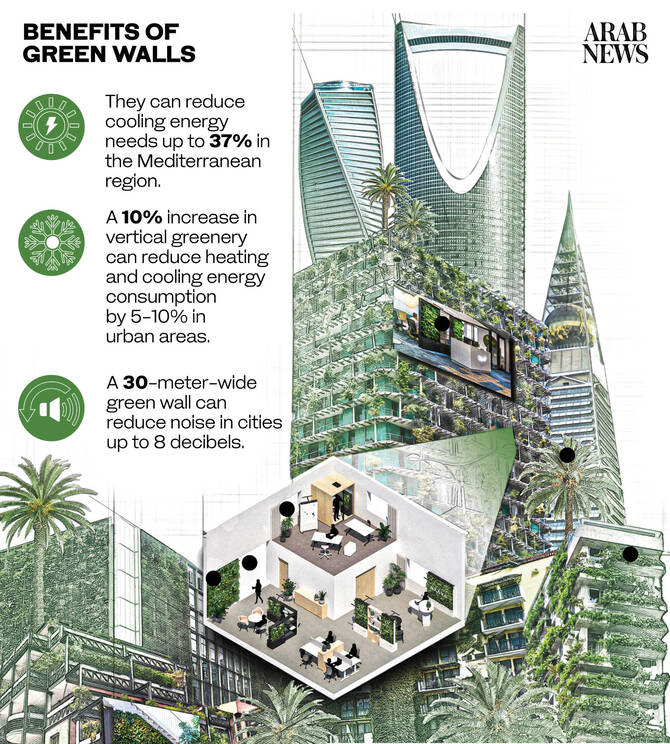
No longer just decorative features, they have become powerful tools in the fight against climate change — regulating temperatures, reducing noise, filtering air pollutants and even producing food in urban areas.
“Green walls are advanced vegetated systems installed on vertical surfaces to deliver functional environmental benefits,” Faisal Al-Fadl, an award-winning architect, urban planner and global sustainability advocate, told Arab News.
“These systems combine engineering, water management, plant science and materials innovation, integrating a modular or structural frame, a growing substrate or hydroponic base, smart irrigation and drainage systems, and a curated selection of locally adapted plant species.”
DID YOU KNOW?
Exposure to greenery can help reduce stress and promote mental well-being.
Green walls can act as sound barriers, lowering indoor and outdoor noise pollution.
Greenery can boost mood and productivity in workspaces and educational settings.
Al-Fadl is the secretary-general of the Saudi Green Building Forum, a nongovernmental organization with consultative status at the UN. He represents Saudi Arabia on the global stage, advocating for green innovation and climate resilience.
With more than two decades of experience, he has played a key role in localizing sustainability practices across architecture, policy, and engineering. He also founded the Saaf certification system.
For Al-Fadl, green walls offer far more than visual appeal.

Faisal Al-Fadl, an award-winning architect, urban planner and global sustainability advocate. (Supplied)
“They filter air pollutants and improve microclimates, provide ecological value and usable green space in dense cities, encourage innovation in construction materials and urban design, as well as demonstrate commitment to sustainable resource cycles, especially water,” he said.
Yet the Kingdom’s arid climate and water scarcity present real challenges to green wall adoption. Al-Fadl argues that these very conditions make the technology even more relevant — not less.
“In Saudi Arabia’s hyper-arid environment, green walls present an integrated solution to multiple urban sustainability challenges,” he said. “Their significance lies in their ability to deliver transformational change across five key UN Sustainability Development Goals prioritized by Saaf.”

Adopting green walls, not for decoration, but as nature-based infrastructure, brings various environmental benefits such as enhancing building energy efficiency through insulation and passive cooling. (AFP)
As examples, he points to SDG 6 — clean water and sanitation — highlighting how green walls can use recycled greywater or HVAC condensate, easing the burden on fresh water supplies.
For SDG 7 — clean and affordable energy — living walls can insulate buildings and reduce cooling demand, helping to cut energy use and lower carbon emissions.
Under SDG 9 — industry, innovation, and infrastructure — Al-Fadl said green walls “promote local green innovation in architecture, landscaping, and construction technologies, including the use of recyclable materials and modular components.”
“In essence, green walls enable cities to move from consumption to regeneration,” he added
Opinion
This section contains relevant reference points, placed in (Opinion field)
But that does not mean simply copying models from other countries: “The climate of Saudi Arabia demands context-specific design, not replication,” said Al-Fadl.
With the right technical adaptations, he believes green walls can flourish even in the Kingdom’s harshest environments.
They are not a luxury or a trend, he stressed. Green walls are “a necessary infrastructure for a sustainable, dignified, and climate-adapted future.”


