

Israel intercepts Houthi missile fired from Yemen

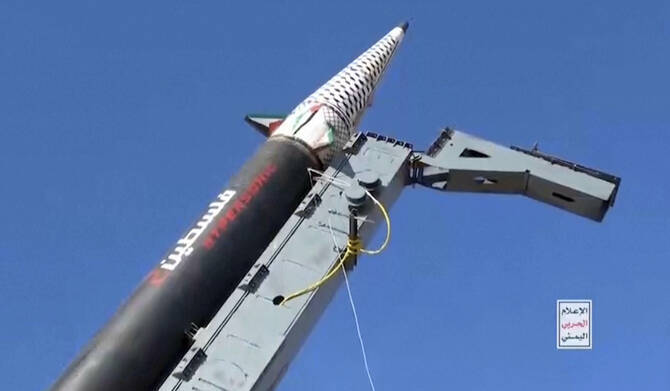
The Israeli military said it intercepted a missile fired from Yemen on Friday, which the Iran-backed Houthi militants said they had launched. (AFP/File)
Short Url
Updated 01 August 2025
Follow

Israel intercepts Houthi missile fired from Yemen

  • The Houthis targeted Israel’s Ben Gurion airport using a Palestine 2 hypersonic ballistic missile
  • Israel has carried out several retaliatory strikes in Yemen

JERUSALEM: The Israeli military said it intercepted a missile fired from Yemen on Friday, which the Iran-backed Houthi militants said they had launched.

“Following the sirens that sounded a short while ago in several areas in Israel, a missile that was launched from Yemen was intercepted,” the Israeli military said.

The Houthis targeted Israel’s Ben Gurion airport “using a ‘Palestine 2’ hypersonic ballistic missile,” their military spokesman Yahya Saree said in a video statement.

The militants have launched repeated missile and drone attacks against Israel since their Palestinian ally Hamas’s October 2023 attack on Israel sparked the Gaza war.

The Houthis, who say they are acting in support of the Palestinians, paused their attacks during a two-month ceasefire in Gaza that ended in March, but renewed them after Israel resumed major operations.

Israel has carried out several retaliatory strikes in Yemen, targeting Houthi-held ports and the airport in the militant-held capital Sanaa.`


Lebanon foreign minister declines Tehran visit, proposes talks in neutral country

Updated 10 December 2025
Follow

Lebanon foreign minister declines Tehran visit, proposes talks in neutral country

  • Lebanon’s foreign minister Youssef Raji cited ‘current conditions’ for the decision not to go to Iran

Lebanon’s foreign minister Youssef Raji said on Wednesday he had declined an invitation to visit Tehran for now, proposing instead talks with Iran in a mutually agreed neutral third country, Lebanese state news agency NNA reported.

Raji cited “current conditions” for the decision not to go to Iran, without elaborating, and stressed that the move did not mean rejection of dialogue with Iran. He did not immediately respond to a request from Reuters for additional comment.

Iran’s Foreign Minister Abbas Araqchi had extended the invitation last week, seeking talks on bilateral ties.

Raji said Lebanon stood ready to open a new phase of constructive relations with Iran, on the condition that ties be based strictly on mutual respect, full recognition of each country’s independence and sovereignty, and non-interference in internal affairs under any pretext.

In an apparent reference to calls to disarm Hezbollah, the Lebanese armed movement allied for decades to Iran, Raji added that no strong state could be built unless the government held the exclusive right to hold weapons.

Hezbollah, once a dominant political force with wide influence over the Lebanese state, was severely weakened by Israeli strikes last year that ended with a US-brokered ceasefire. It has been under mounting domestic and international pressure to surrender its weapons and place all arms under state control.

In August, Iran’s top security official Ali Larijani visited Beirut, warning Lebanon not to “confuse its enemies with its friends.” In June, Foreign Minister Araqchi said Tehran sought a

“new page” in ties.