US sanctions force vessels with Russian oil to divert from India, sources say

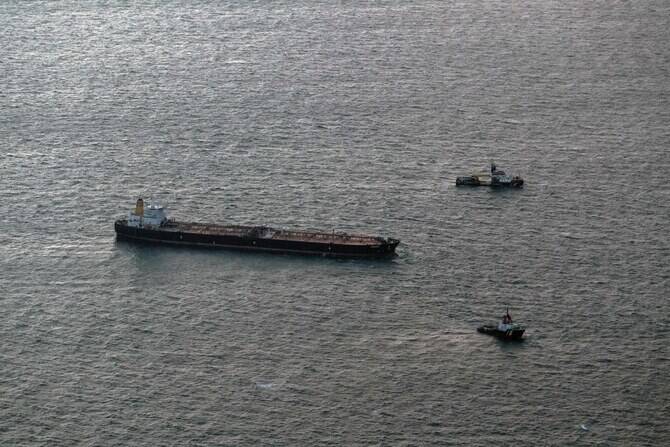
At least two vessels loaded with Russian oil bound for refiners in India have diverted to other destinations following new U.S. sanctions, trade sources said, and LSEG trade flows showed. (AP/File)
Short Url
Updated 01 August 2025
Follow

US sanctions force vessels with Russian oil to divert from India, sources say

  • Three ships — the Aframaxes Tagor and Guanyin and the Suezmax Tassos — were scheduled to deliver Russian oil to Indian ports this month, trade sources said
  • All three vessels are under US sanctions

NEW DELHI/MOSCOW: At least two vessels loaded with Russian oil bound for refiners in India have diverted to other destinations following new US sanctions, trade sources said, and LSEG trade flows showed.

The US Treasury Department this week imposed sanctions on more than 115 Iran-linked individuals, entities, and ships, some of which are involved in transporting Russian oil.

US President Donald Trump has urged countries to halt purchases of oil from Moscow, threatening 100 percent tariffs unless Russia agrees to a significant peace deal with Ukraine.

Three ships — the Aframaxes Tagor and Guanyin and the Suezmax Tassos — were scheduled to deliver Russian oil to Indian ports this month, trade sources said. All three vessels are under US sanctions.

Tagor was bound for Chennai on India’s east coast, while Guanyin and Tassos were headed to ports in western India, according to trade sources and Russian ports data.

Tighter Western sanctions aimed at cutting Russia’s oil revenue, seen as funding its war against Ukraine, have been increasingly hitting Russian oil supplies for India, which buys more than a third of its oil needs from Russia.

Tagor is now heading to Dalian in China, while Tassos is diverting to Port Said in Egypt, the data shows.

Guanyin remains on course to Sikka, a port used by Reliance Industries and Bharat Petroleum Corp. Ltd..

Indian Oil Corp, which was to receive the Tagor shipment, and BPCL did not respond to Reuters’ emailed requests for comment.

Zulu Shipping, linked to Panama-flagged Tassos and Tagor, and Guanyin-owner Silver Tetra Marine could not be reached for comments. Both companies are under US sanctions.

A Reliance spokesperson said that “neither of these two vessels, Guanyin and Tassos, is coming to us.”

Reliance has previously purchased oil in Guanyin.

Separately, two other vessels, Achilles and Elyte, loaded with Russian oil, are preparing to discharge Russian Urals for Reliance, according to LSEG data. Both these vessels are sanctioned by Britain and the European Union. India has condemned the EU sanctions.


Indonesia’s new state mosque to hold first Eid prayers this year

Worshippers pray at Masjid Negara in Nusantara, East Kalimantan for the first taraweeh this year on Feb. 18, 2025. (OIKN)
Updated 4 sec ago
Follow

Indonesia’s new state mosque to hold first Eid prayers this year

  • Mosque is located in Nusantara Capital City on Borneo island, a $32bn project set for 2045 completion
  • Famous sculptor Nyoman Nuarta designed mosque, other government structures in new capital

JAKARTA: The state mosque in Indonesia’s planned new capital city, Nusantara, will hold its inaugural Eid Al-Fitr prayer this year, as the $62 million facility opens for its first run of Ramadan programs.

The Indonesian government has plans to relocate the capital to Borneo island to replace the overcrowded and sinking Jakarta on Java island, with the $32 billion megaproject scheduled for completion in 2045.

With a capacity of about 60,000 people, the mosque in East Kalimantan opened to the public last month, at the beginning of Ramadan.

“This mosque symbolizes that we are building the Nusantara Capital City with careful attention to spiritual, social and environmental aspects,” Troy Pantouw, spokesperson for the Nusantara Capital City Authority — the agency overseeing the new capital city — told Arab News on Saturday.

“We will hold Eid Al-Fitr prayers here and we are hoping that it would mark a historic momentum of unity here at Nusantara Capital City.”

Locally known as Masjid Negara, construction of the state mosque began in 2024. Its design was spearheaded by Balinese sculptor Nyoman Nuarta at the request of former President Joko Widodo.

Nuarta is one of Indonesia’s most famous visual artists and creator of the country’s tallest statue, Garuda Wisnu Kencana, located in Bali.

The 72-year-old is also the designer behind other main structures in Nusantara, including the new state palace.

This Ramadan marked many firsts for Masjid Negara, including its first taraweeh on Feb. 18, which was attended by thousands of worshippers in East Kalimantan.

In the same complex where the state mosque is located, the government has plans to build Christian churches, and Buddhist, Hindu and Confucian temples.

Indonesia, home to the world’s largest population of Muslims, officially recognizes Islam, Protestantism, Catholicism, Buddhism, Hinduism and Confucianism as religions.

“A church is now being built in the complex, and in the future there will also be houses of worship belonging to other religions. This reflects Nusantara’s values of harmony and respect,” Pantouw said.

“From the start, this area was designed to represent inter-religious harmony. We want the Nusantara Capital City to stand as a concrete example of how physical developments can be parallel to efforts to build tolerance in society.”