

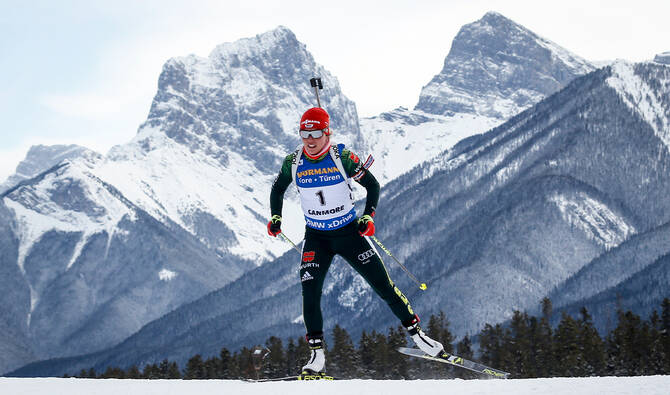

SKARDU, Pakistan: German Olympic champion Laura Dahlmeier’s climbing partners said on Thursday the decision to leave her body on a remote peak in Pakistan was based on dangerous conditions and her own written wishes that no one should risk their life in a recovery attempt.
Dahlmeier, a double gold medalist in biathlon, was struck by a falling rock on July 28 while descending Laila Peak in the Karakoram range. She lost consciousness immediately and showed no signs of life, according to her climbing partner
Marina Eva Krauss, who said she was unable to reach her without endangering herself amid an ongoing rockfall.
“It was clear to me that the only way to help her was to call the helicopter,” Krauss told Reuters in Skardu. “I called her and there was no response and she had just stopped moving … I saw that she had been hit on the head and that she only had a chance if help arrived immediately.”

Marina Eva (second right) mountaineering partner of German Olympic biathlon champion Laura Dahlmeier, looks on during a press conference along with the rescue team members in Skardu in Pakistan’s mountainous Gilgit-Baltistan region on July 31, 2025. (AFP)
Laila Peak, a dramatic 6,069-meter spire in Gilgit-Baltistan’s Hushe Valley, is known for its steep and technical routes. Dahlmeier was descending at roughly 5,700 meters when the rockfall occurred. Poor weather conditions prevented helicopter access, and two expert teams from Germany and the United States later confirmed her death on July 30.
Speaking alongside Krauss, German climber and rescue team member Thomas Huber said the rockfall had continued after Dahlmeier was struck.
“So, she was in a kind of safe spot and every attempt to go to Laura would cause her life [to be in danger],” he said.
Huber added that Dahlmeier, 31, was deeply aware of the risks of mountaineering and had made her wishes known in case of such an outcome.
“We discussed this matter to recover the body, of course, but we [knew] Laura — how her mentality [was] — and we [knew] exactly if the body recovery were a risk, she wouldn’t want this, because she [was] a mountain girl.”
Dahlmeier’s management had earlier confirmed her position, saying that she had left written instructions requesting that no one risk their life to retrieve her body, and that she wished to remain on the mountain in such a case — a sentiment her fellow climbers repeated.
“Now she is on a beautiful mountain, and we should respect this,” Huber said.

Winner Laura Dahlmeier of Germany competes during the Women’s 15 km individual race during the 2017 IBU Biathlon World Championships in Hochfilzen, on February 15, 2017. (AFP/File)
The rescue mission was officially called off on July 30, according to Kamal Khan, commissioner of Baltistan Division.
“They tried their best… but Miss Laura was stuck in a place which is inaccessible and the rocks were still falling at that place,” he told reporters.
Krauss, who was unharmed, descended safely to base camp and is in good health, officials said.
Dahlmeier was one of Germany’s most decorated biathletes, winning two golds and one bronze at the 2018 PyeongChang Winter Olympics. She retired in 2019 at the age of 25 and had since taken up mountaineering.

Women’s 7.5km biathlon sprint gold medalist Laura Dahlmeier, of Germany, celebrates during the medals ceremony at the 2018 Winter Olympics in Pyeongchang, South Korea, on February 11, 2018. (AP)
Tributes have poured in from across the sporting world.
“She was ambitious and successful, yet always remained humble and close to her homeland,” said Markus Soeder, premier of her home state of Bavaria.
The International Biathlon Union also expressed its condolences.


