

Islamabad says new tariff arrangement to help Pakistan expand footprint in US market

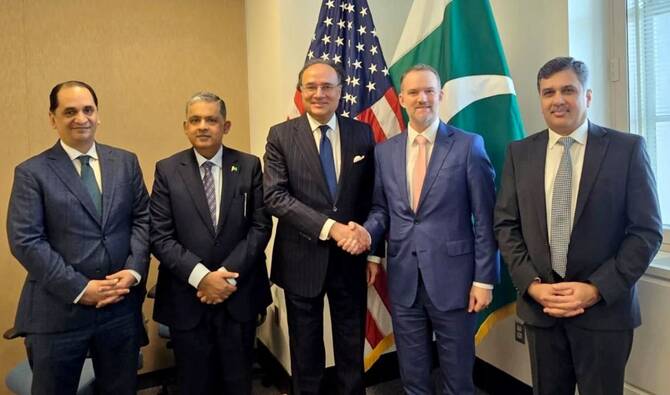
Pakistan’s Finance Minister Muhammad Aurangzeb shaking hands with U.S. Secretary of Commerce Howard Lutnick in Washington, D.C. on July 31, 2025. (Ministry of Finance)
Short Url
Updated 01 August 2025
Follow

Islamabad says new tariff arrangement to help Pakistan expand footprint in US market

  • The US is Pakistan’s top export destination, with shipments totaling $5.44 billion in fiscal year 2023-2024, according to official data
  • It is now essential for Pakistani exporters to adopt focused marketing strategy to capitalize on this development, Pakistani ministry says

ISLAMABAD: Pakistan’s new trade tariff arrangement with the United States (US) will help expand its footprint in the US market, the Pakistani finance ministry said on Friday.

The statement came a day after the White House said the US will charge a 19 percent tariff on imports from Pakistan, compared to a 29 percent reciprocal tariff announced in April that had raised alarm in Islamabad.

The US is Pakistan’s top export destination, with shipments totaling $5.44 billion in fiscal year 2023-2024, according to official data. From July 2024 to February 2025, exports rose 10 percent from a year earlier.

Pakistan’s finance ministry said the White House decision reflects a “balanced and forward-looking approach” by US authorities that kept Pakistan competitive in relation to other South and Southeast Asian nations.

“In particular, this tariff level is expected to support Pakistan’s export potential, especially in key sectors such as textiles, which remain the backbone of the country’s export economy,” the ministry said.

“The Ministry of Finance... believes that the current tariff arrangement presents a significant opportunity to expand Pakistan’s footprint in the US market.”

The previous US announcement of 29 percent tariff shook Pakistan, currently on a path to economic recovery under a $7 billion International Monetary Fund (IMF) program.

The two nations reached the deal just ahead of the August 1 deadline, followed by Finance Minister Muhammad Aurangzeb’s talks with US Commerce Secretary Howard Lutnick and Trade Representative Jamieson Greer in Washington.

“It is now essential for Pakistani exporters and trade bodies to adopt an aggressive and focused marketing strategy to capitalize on this development,” the Pakistani finance ministry said.

“In addition to textiles, there is substantial potential for growth in other sectors, and the government is committed to facilitating exporters through policy support, market intelligence, and trade promotion initiatives.”

Meanwhile, Pakistan’s largest refiner Cnergyico will import 1 million barrels of oil from Vitol in October, Reuters reported, citing its Vice Chairman Usama Qureshi.

Qureshi said the West Texas Intermediate light crude cargo will be loaded from Houston this month and is expected to arrive in Karachi in the second half of October, marking the country’s first-ever purchase of US crude following the trade deal.

“This is a test spot cargo under our umbrella term agreement with Vitol. If it is commercially viable and available, we could import at least one cargo per month,” he said, adding that the shipment was not meant for resale.

The finance ministry said it was looking forward to further positive engagements and close cooperation with the US in areas of investment, artificial intelligence, cryptocurrency, mines and minerals, energy and other emerging sectors.

“Pakistan will continue to engage closely with President Trump and the US administration to promote the shared goals of economic development and mutual prosperity,” it said.


Pakistan’s Mahnoor Omer named among TIME’s ‘Women of the Year’ for 2026

Updated 01 March 2026
Follow

Pakistan’s Mahnoor Omer named among TIME’s ‘Women of the Year’ for 2026

  • Omer moved a Pakistani court against the so-called ‘period tax’ in Sept. 2025 which has since sparked a national debate
  • Taxes on sanitary pads in Pakistan can add up to 40 percent to retail price, UNICEF says only around 12 percent women use such products

ISLAMABAD: Pakistani women’s rights activist Mahnoor Omer, who fought against taxes on menstrual products, has been named among the TIME magazine’s ‘Women of the Year’ for 2026.

Omer’s efforts have been recognized alongside 16 activists, artists, athletes and businesswomen in the TIME’s Women of the Year 2026 list, including Olympic gold medalist Sydney McLaughlin-Levrone and Oscar-nominated filmmaker Chloe Zhao.

Dissatisfied with the efforts to educate Pakistani girls about sexual violence, Omer founded the Noor Foundation at the age of 14 and held her own workshops with village girls about everything from climate change to menstruation, according to the TIME magazine.

Two years later, a conversation with a domestic worker about the price of pads made her realize that not everyone could afford these essentials. She moved a court against the so-called “period tax” in Sept. 2025 and the case has sparked a national debate on the subject, considered a taboo by many in Pakistan, since its first hearing late last year.

“A decade and one law degree after her interest in activism was sparked, Omer, now 25, is putting her passion and expertise to work in the name of gender equity,” TIME wrote about Omer on its website.

Taxes imposed on sanitary products in Pakistan can add up to 40 percent to the retail price. UNICEF estimates just 12 percent of women in the country use commercially produced pads or tampons. The alternative, using cloth, risks health impacts including rashes and infections, and can make it impossible for girls to attend school while menstruating.

Omer’s suit, which awaits the government response, has sparked a national discussion. She says she spoke about menstruation to her father and male cousins, who thanked her for standing up for their daughters.
The 25-year-old, who is currently enrolled in a master’s degree in gender, peace, and security at the London School of Economics, sees this case as just the first of many.

“I’m not free until every woman is free,” she was quoted as saying by TIME. “I want to leave no stones unturned in terms of what I can do with the next few decades, as a lawyer for the women in my country and gender minorities in general.”