

Top Pakistani general meets Egyptian president, leadership to discuss military, counterterrorism cooperation

Short Url
Updated 31 July 2025
Follow

Top Pakistani general meets Egyptian president, leadership to discuss military, counterterrorism cooperation

  • Pakistan’s chairman joints chiefs of staff committee is in Cairo for the third round of Defense and Security Talks with Egypt
  • General Sahir Shamshad Mirza meets Al-Azhar’s grand imam to discuss importance of religious harmony, says Pakistan military

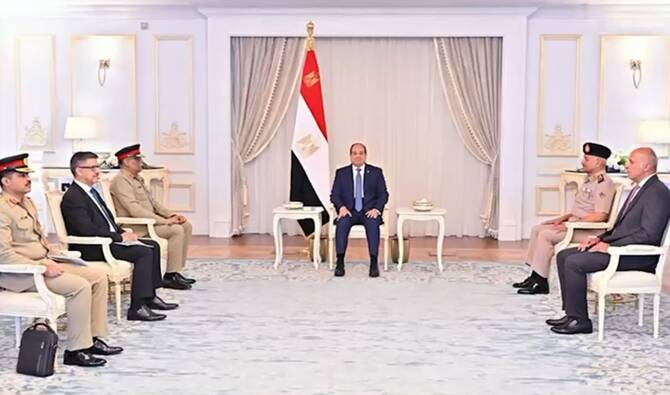
ISLAMABAD: A Pakistani top general met Egyptian President Abdel Fattah El-Sisi and the country’s senior civil and defense leadership on Thursday to discuss regional situation, military and counterterrorism cooperation, the Pakistani military’s media wing said. 

General Sahir Shamshad Mirza, who is Pakistan’s chairman joint chiefs of staff committee (CJCSC), is in Egypt for the third round of defense and security talks between the two countries. During the visit, he met senior Egyptian officials such as El-Sisi, General Abdel Mageed Ahmed Abdel Mageed Saqr, minister of defense and military production and commander-in-chief of the Egyptian Armed Forces, Admiral Osama Mounier Mohamed Rabie. 

He also met the chairman and managing director of the Suez Canal Authority, as well as Professor Dr. Ahmed Mohamed Ahmed El-Tayeb, the grand imam of the Al-Azhar institute, the Inter-Services Public Relations (ISPR), the Pakistani military’s media wing, said. 

“Discussions focused on bilateral military cooperation, security, counterterrorism and prevailing regional situation,” the ISPR said. “Dignitaries from both sides emphasized upon the shared interest in further strengthening and expanding existing military-to-military relationship in the domains of training, joint military exercises and defense cooperation.”

Speaking to El-Tayeb, Mirza highlighted the importance of religious and inter-faith harmony to promote tolerance, inclusivity and address the underlying causes of “terrorism,” the military’s media wing said. 

“Egyptian dignitaries lauded the professionalism of Pakistan Armed Forces and acknowledged their sacrifices in the fight against terrorism,” the ISPR said. 

Mirza was presented a guard of honor by an Egyptian Armed Forces contingent upon his arrival at the Ministry of Defense, the military’s media wing said. 

Pakistan and Egypt have cordial ties and both countries have resolved in recent years to facilitate businessmen with visas, exchange trade-related information and promote private-sector contacts.

Earlier this month, senior officials of Pakistan and Egypt discussed enhancing bilateral cooperation in agriculture, food security and farming, with Islamabad expressing interest in learning from Cairo’s successful experiences in these areas.


Islamabad hits back after Indian minister blames Pakistan army for ‘ideological hostility’

Updated 10 sec ago
Follow

Islamabad hits back after Indian minister blames Pakistan army for ‘ideological hostility’

  • Jaishankar tells a public forum most of India’s problems with Islamabad stem from Pakistan’s military establishment
  • Pakistan condemns the remarks, accusing India of waging a propaganda drive to deflect from its destabilizing actions

ISLAMABAD: Pakistan accused India on Sunday of running a propaganda campaign to malign its state institutions, a day after Indian External Affairs Minister Subrahmanyam Jaishankar attributed what he described as Pakistan’s “ideological hostility” toward New Delhi to the country’s powerful army.

Addressing a public forum in New Delhi, Jaishankar said most of India’s problems with Pakistan stemmed from its military establishment, which he argued had cultivated and sustained an entrenched animosity toward India.

His remarks came months after a brief but intense military confrontation between the nuclear-armed neighbors, during which both sides exchanged artillery and missile fire and deployed drones and fighter jets.

Responding to the comments, Pakistan’s Foreign Office spokesperson Tahir Andrabi called them “highly inflammatory, baseless and irresponsible.”

“Pakistan is a responsible state and its all institutions, including armed forces, are a pillar of national security, dedicated to safeguarding the sovereignty and territorial integrity of the country,” Andrabi said in a statement. “The May 2025 conflict vividly demonstrated Pakistan armed forces’ professionalism as well as their resolve to defend the motherland and the people of Pakistan against any Indian aggression in a befitting, effective yet responsible manner.”

“The attempts by Indian leadership to defame Pakistan’s state institutions and its leadership are a part of a propaganda campaign designed to distract attention from India’s destabilising actions in the region and beyond as well as state-sponsored terrorism in Pakistan,” he said, adding that such “incendiary rhetoric” showed the extent of India’s disregard for regional peace and stability.

Andrabi said that rather than making “misleading remarks about the armed forces of Pakistan,” India should confront the “fascist and revisionist Hindutva ideology that has unleashed a reign of mob justice, lynchings, arbitrary detentions and demolition of properties and places of worship.”

He warned that the Indian state and its leadership had become hostage to “this terror in the name of religion.”

India and Pakistan have fought three wars since independence in 1947. They have also engaged in countless border skirmishes and major military standoffs, including the 1999 Kargil conflict.

The four-day conflict in May 2025 ended with a US-brokered ceasefire, after Washington said both sides had expressed willingness to pursue dialogue.

Pakistan said it was ready to discuss all outstanding issues, but India declined talks.


-End