



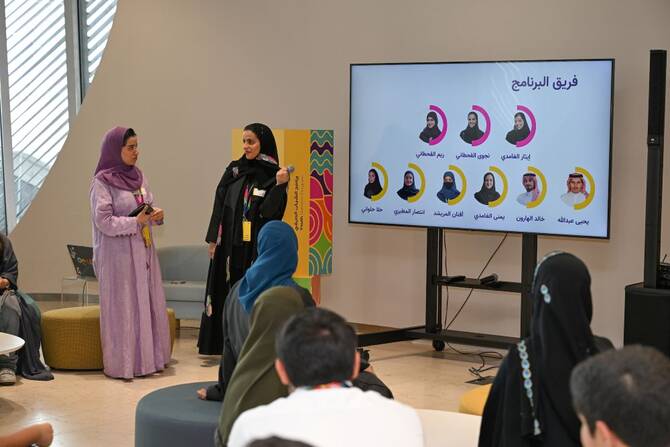


DHAHRAN: The King Abdulaziz Center for World Culture, Ithra, concluded the fourth edition of its month-long Youth Summer Program with a grand finale on Thursday.
Held at Ithra’s cinema, with its iconic vibrant colorful seats, the closing ceremony featured student-made film screenings, a piano performance and a spirited debate on AI’s role in fostering future creativity.
Running from July 7-31, the intensive program gave 30 people between the ages of 13 and 18 hands-on exposure to the arts of theater, cinema, music, creative writing and literature, among others.
The curriculum was carefully curated, grounded in a creative learning methodology. It comprised 126 hours of educational content, 28 expert speakers and 10 specialized workshops, and included collaborations with entities such as the Architecture and Design Commission, and the Museums Commission.
Now in its fourth year, Ithra’s Youth Summer Program is one of the center’s flagship initiatives aimed at nurturing Saudi Arabia’s emerging creatives.
For 15-year-old Toleen Farea, the experience offered an invaluable chance to playfully explore her interests in a streamlined way.
“The program covered many cultural fields, and each day they introduced new experts and topics, like history,” Farea told Arab News. “The cinema part was my favorite — we made a film from scratch, using professional cameras and microphones.
“I used to be shy about theater and acting, but being with peers my age made it feel natural. It was my first time meeting many of the other participants,” she said.
“The experience was really great. It felt good to step outside the school environment and meet new people — some from my city but with different backgrounds, and even some from other places.”
Fahad Al-Qahtani, a 15-year-old from Dammam, agreed.
“This program was a cultural one, and honestly, the experience was really beautiful,” he told Arab News. “It introduced us to so many fields — from museums and libraries to design studios and much more. I spent my vacation doing something genuinely fun and meaningful.
“It wasn’t just about learning from others; we also had the chance to turn our own ideas into something real — instead of just following someone else’s concept,” he added.
“One of the activities we did was pottery. We connected it to architecture and design — how a broken piece of pottery can be repaired and turned into something beautiful again. It was inspired by the Japanese technique kintsugi. That idea really stuck with me: Even something that’s been shattered can be brought back and made beautiful.
“Before this, I only made simple videos on my phone — little things I’d post online on TikTok, but this program gave me real filmmaking skills. It taught me the basics of cinematography, lighting, sound, editing — a bit of everything, really. I got to learn hands-on, and I even started thinking about how films are made behind the scenes.
“We also worked on a film that we’re presenting today. I directed it. It’s about a social issue: Repetition and routine,” he said. “I don’t want to spoil the ending, but the message is about breaking free from routine before it traps you. The film is only three minutes long, but I hope it makes people think.
“There were five films made, each with its own director. I directed just one of them. I’m now a director,” he said with pride.
Following the films, Ithra hosted a special panel discussion featuring Mansour Al-Badran of the Saudi Film Festival, which was hosted at Ithra earlier this spring. Al-Badran spoke directly with the young directors. He offered encouragement, shared professional insights from the Kingdom’s growing film scene and asked the students thoughtful questions about their creative processes, as well as the challenges they faced while filming.
Though most of the students who presented live on stage were natural speakers, some were slightly nervous and the audience applauded warmly when a few temporarily froze. The majority of the programming was in Arabic, although some English was sprinkled in.
Zaina Hejles, who took part last year when she was 14, returned this summer wearing a light blue vest with the word “volunteer.”
She told Arab News: “Through this closing ceremony today, we’re expecting a recap of everything that’s happened this entire month. Everything that the students worked really hard for, it’s all being showcased today. From their hands-on work to the movies to the debates, all of it is summed up today.”
Reflecting on last year, she said: “My focus was about acting — I was a grandma in a play. It was an interpretation of the Japanese book (by author Toshikazu Kawaguchi) ‘Before the Coffee Gets Cold.’ It was just a short little play about how you should savor your time and how life moves on so fast so you have to cherish it.
“I enjoy actually every single part, everything that this program offers — from the acting to the writing, the music. That’s why I decided to join, because it really covers all of my interests,” she said. “After that, I created deep, deep connections with so many people and also even with myself. I found out that I like things that I never knew I liked. I never knew I’d be this good at writing. I wrote a play now and I’m hoping to submit it in the Saudi program for plays.
“This program really brings out stuff in the youth that they didn’t know they had.
“It was actually my mother’s idea to join last year — I did not want to do anything. I wanted to spend time at home like any other teenager, but she really pushed for me to join because she was like ‘what are you going to do at home, just sit on your phone?’ I was like ‘yes, exactly’,” she said.
“But I’m honestly really happy I joined and I’m even more happy that they (Ithra) called me back a second time, asking me to come volunteer because this really is one of the best experiences you can have as a teenager. You’re not going to get these years back. For me to be able to relive these moments twice, it’s really something special.”
Students are only allowed to enroll once, as the curriculum is repeated. Many — like Hejles — choose to return as volunteers, something both Farea and Al-Qahtani hope to do next summer.


