

Russia hosts Syria’s new foreign minister for the first time since Assad’s ouster

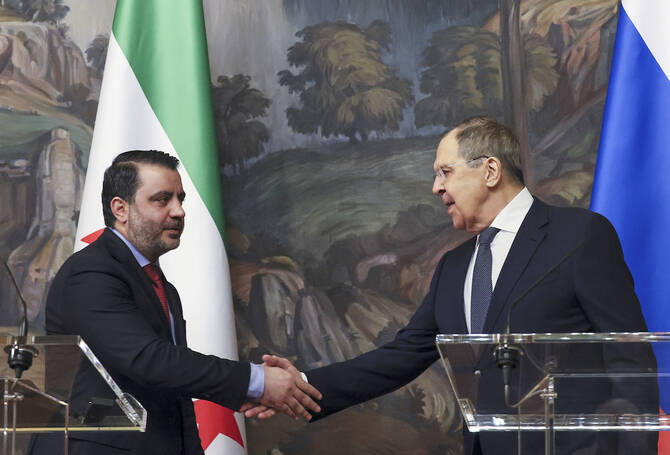
Russian Foreign Minister Sergey Lavrov and Syrian Foreign Minister Asaad Hassan Al-Shibani shake hands after a joint news conference in Moscow, Russia, July 31, 2025. (AP)
Short Url
Updated 01 August 2025
Follow

Russia hosts Syria’s new foreign minister for the first time since Assad’s ouster

  • Former Syrian President Bashar Assad took refuge in Russia after his ouster

MOSCOW: Russia’s top diplomat on Thursday met with his Syrian counterpart during the first formal to Moscow by an official of the new government in Damascus since former Syrian President Bashar Assad was ousted in a rebel offensive last year despite years of Russian support.

Opening the talks, Foreign Minister Sergey Lavrov told Syrian Foreign Minister Asaad Al-Shibani that the Russian authorities “sincerely wish that the Syrian people, with whom we have long-standing friendship, overcome all existing challenges and completely normalize the situation,” and Al-Shibani said Syria was interested in ties with Russia and having Russia “by our side.”

Assad was an ally of Russia, and Moscow’s scorched-earth intervention in support of him a decade ago turned the tide of Syria’s civil war and keep Assad in his seat for years. However, when insurgent groups launched a new offensive last year, Russia did not intervene again to save Assad.

Assad took refuge in Russia after his ouster, later claiming in a statement posted on Facebook that he had wanted to stay in the country and continue fighting but that the Russians had pulled him out.

Despite having been on opposite sides of the battle lines during the civil war, the new rulers in Damascus, headed by interim President Ahmad Al-Sharaa, have taken a pragmatic approach to relations with Moscow.

A Russian delegation visited Damascus in January, and the following month Russia’s President Vladimir Putin had a call with Al-Sharaa that the Kremlin described as “constructive and business-like.” Some Russian forces have remained on the Syrian coast, and Russia has reportedly sent oil shipments to Syria.

Al-Sharaa thanked Russia for its “strong position in rejecting Israeli strikes and repeated violations of Syrian sovereignty” after Israel intervened in clashes between Syrian government forces and armed groups from the Druze religious minority earlier this month.

Speaking to reporters after the talks on Thursday, Lavrov thanked “Syrian colleagues for the steps they’re taking to ensure the safety of Russian citizens and Russian facilities” in Syria.

“We reaffirmed our support for the preservation of the unity, territorial integrity and independence of the Syrian Arab Republic and are ready to provide the Syrian people with all possible assistance in post-conflict reconstruction. We agreed that we will continue our dialogue on these issues,” Lavrov said.

Without naming Assad, Al-Shibani called on Russia to support the country’s post-Assad “transitional justice” process and said Syria has formed a committee to review preexisting agreements with Russia.

Al-Shibani criticized Israel’s “interference in internal affairs” and said it complicates efforts to resolve conflicts between different communities in Syria.

“Many countries want stability and security in Syria, but there are some that want a weak and divided Syria, that want to prove that the government is unable to protect the minorities or that there are internal problems,” he said.

He added that Syria’s new government has “said since day one that we have no hostile intentions toward Israel. We pose no threat to Israel. Syria just wants to rebuild itself. We are tired of the war over the past 14 years.”


UN chief visits Iraq to mark end of assistance mission set up after 2003 invasion

Updated 5 sec ago
Follow

UN chief visits Iraq to mark end of assistance mission set up after 2003 invasion

  • Sudani said his country “highly values” the mission’s work in a region “that has suffered for decades from dictatorship, wars, and terrorism”
  • Guterres praised “the courage, fortitude and determination of the Iraqi people”

BAGHDAD: United National Secretary-General Antonio Guterres was in Baghdad on Saturday to mark the end of the political mission set up in 2003 following the US-led invasion of Iraq that toppled Saddam Hussein.
The UN Security Council, at Iraq’s request, voted last year to wind down the mandate of the United Nations Assistance Mission in Iraq (UNAMI), by the end of 2025. The mission was set up to coordinate post-conflict humanitarian and reconstruction efforts and help restore a representative government in the country.
Iraqi caretaker Prime Minister Mohammed Shia Al-Sudani said his country “highly values” the mission’s work in a region “that has suffered for decades from dictatorship, wars, and terrorism.” He said its conclusion showed Iraq had reached a stage of “full self-reliance.”
“Iraq emerged victorious thanks to the sacrifices and courage of its people,” he said in a joint statement with Guterres.
The ending of UNAMI’s mandate “does not signify the end of the partnership between Iraq and the UN,” Sudani said, adding that it represents the beginning of a new chapter of cooperation focused on development and inclusive economic growth.
The prime minister said a street in Baghdad would be named “United Nations Street” in honor of the UN’s work and in recognition of 22 UN staff who were killed in an Aug. 19, 2003, truck bomb attack on the Canal Hotel in Baghdad, which housed the UN headquarters.
Guterres praised “the courage, fortitude and determination of the Iraqi people” and the country’s efforts to restore security and order after years of sectarian violence and the rise of extremist groups, including the Daesh group, in the years after the 2003 invasion.
“Iraqis have worked to overcome decades of violence, oppression, war, terrorism, sectarianism and foreign interference,” the secretary-general said. “And today’s Iraq is unrecognizable from those times.”
Iraq “is now a normal country, and relations between the UN and Iraq will become normal relations with the end of UNAMI,” Guterres added. He also expressed appreciation for Iraq’s commitment to returning its citizens from the Al-Hol camp, a sprawling tent camp in northeastern Syria housing thousands of people — mostly women and children — with alleged ties to the IS.
Guterres recently recommended former Iraqi President Barham Salih to become the next head of the UN refugee agency, the first nomination from the Middle East in half a century.
Salih’s presidential term, from 2018 to 2022, came in the immediate aftermath of the Daesh group’s rampage across Iraq and the battle to take back the territory seized by the extremist group, including the key northern city of Mosul.
At least 2.2 million Iraqis were displaced as they fled the IS offensive. Many, particularly members of the Yazidi minority from the northern Sinjar district, remain in displacement camps today.
