

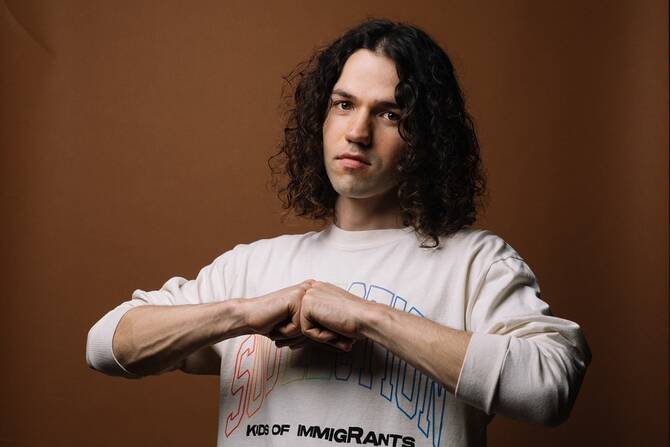

DHAHRAN: Although he lives in Los Angeles, Saudi-American songwriter and producer Reef Loretto traces the roots of his sound back to Dhahran, where he spent his childhood surrounded by extended family, hazy radio frequencies from across the causeway in Bahrain, and the early digital tools that would quietly shape his path.
“My mom was from Dammam. My dad was from New York State. I grew up in Dhahran — my whole childhood was there,” Loretto tells Arab News. “I grew up around a lot of family and got involved in music at a pretty young age. My earliest introduction was piano lessons around first grade. I had two teachers in particular that helped a lot with getting started.”

Reef Loretto (R) performing with Kackey (L) and Faisal Alqarni in Osaka at Expo 2025. (Supplied)
Outside the classroom, his cousins formed an informal band of their own. “A lot of my cousins got into playing music at a pretty young age. All of us would practice on our own and then we would meet up and jam.”
He clearly recalls the excitement of his first attempt at creating a song of his own.
“Things changed a lot when I got into original stuff — songwriting and digital production. The summer after eighth grade was when I first started trying to record things and capture ideas using a computer,” he says. “I remember very vividly the first time I had something on my computer that I felt good about. I was, like, ‘OK, I have a song! I want to record it. I want to turn it into something I can play on CD.’ I had it on the laptop, but I didn’t know how to export it at the time.”
Growing up in Dhahran came with creative limitations — access to gear and knowledge was difficult, even instruments were hard to find, and very expensive.
“At the time not much was happening, right? It was hard to go out and buy an instrument or equipment,” he says. “Nobody was really (making music) — at least nobody I knew. It was happening very privately, underground.”
Fortunately for Loretto, it was also happening at Desert Designs, a now-defunct creative space in Dhahran where Loretto got to perform with his cousins. It was an easy gig to get — the place was owned by his uncle, Farid Bukhari, and auntie, Qamar Ahmed. Bukhari, he says, would often give him mixes that he’d made on CD.
“Shout out to my uncle and auntie,” he says. “Honestly, I owe so much appreciation to them for different styles and variety.”
The sounds of his adolescence were a mix of downloads, those mix CDs, and regional radio.
“We were, like, the LimeWire, rock, rap, hip-hop generation,” he says. “I listened to 96.5 (from Bahrain). I remember them having more interesting stuff in those days.”
These days, his main source for musical inspiration is his younger sister, Ruby — an unofficial scout of heartfelt, emerging music.
“She’s the one keeping me at the pulse of the new, trendy stuff and what’s going on in terms of sound,” he says. “She’s always listening from her heart.”
Loretto’s current style is ambient and introspective — he describes it as “feelings-based” — often beginning with extended keyboard textures and expanding slowly, like a memory forming in real time.
“My main instrument is the keyboard. So it’ll start with some type of ambient idea, very extended sounds. Think of it like meditation music; introspective, a lot of contemplation. The notion of searching is always embedded in anything that I do,” he says.
Earlier this summer, that sound made its way to Japan when Loretto was selected to represent Saudi Arabia at the World Expo 2025 in Osaka. As part of his residency there, Loretto performed with Japanese djembe drummer and vocalist Kackey and Saudi oud player Faisal Alqarni.
“Every day was an exploration. The thing that was interesting — and sometimes nerve-wracking — about it was that the three of us just met up for this,” he says. “I was expecting more chaos but it was a low-drama experience. All in all, it was really beautiful.”

Loretto performing in Osaka, Japan, at Expo 2025. (Supplied)
The trio created soundscapes in real time, inspired by ecology, ancestry, and the Red Sea. Loretto also produced visuals that responded live to the sounds.
For Loretto, the collaboration was less about fusion and more about humility.
“I actually want to get better at support,” he says. “I don’t want to make fusion. I want to learn to support somebody that’s playing in a very authentic, traditional way, in a way that feels cohesive. I’ll still always bring my background, right? I can’t ever remove myself from that context. But I’m less interested in trying to bring somebody else to where I am, I’m trying to meet somebody where they are.
“I learn from yesterday and support whatever’s happening tomorrow in a better and better way,” he adds with a smile.


