

Pakistan to send two aid cargo planes for Palestine as Gaza hunger crisis deepens

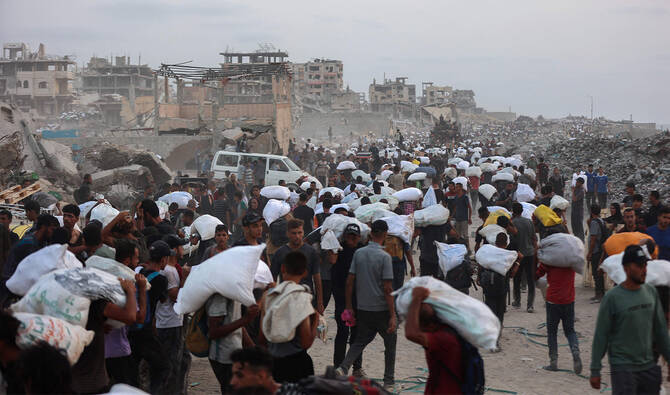
Palestinians bring back aid parcels they managed to procure as they walk on a coastal path west of Beit Lahia on July 29, 2025, after aid trucks entered the Israel-besieged Gaza Strip from the northern Zikim border crossing. (AFP)
Short Url
Updated 30 July 2025
Follow

Pakistan to send two aid cargo planes for Palestine as Gaza hunger crisis deepens

  • International humanitarian organizations say Israel is using ‘starvation as a weapon’
  • Pakistan says it relief flights will transit through Jordan and Egypt for swift distribution

ISLAMABAD: Pakistan will dispatch two cargo planes full of aid and humanitarian relief to Jordan and Egypt and ensure their delivery to the people of Palestine, an official statement said on Tuesday, as the United Nations and international aid groups warn of growing starvation in the Gaza Strip.

The aid comes as Israel’s months-long blockade has crippled the flow of humanitarian supplies into Gaza, where the closure of UN-run distribution centers and restrictions on aid convoys have created severe access challenges.

Under Israel’s new distribution system, many Palestinians are forced to travel long distances, often under humiliating and dangerous conditions, to collect food, with some reportedly coming under fire while waiting in queues.

The collapse of organized aid delivery has deepened fears of famine and widespread malnutrition, particularly among children.

“Under the directive of the Prime Minister, the Government of Pakistan has approved the urgent dispatch of critical humanitarian assistance to support the people of Palestine in distress,” the National Disaster Management Authority (NDMA) said in a statement, adding that “the NDMA has been tasked to arrange two chartered cargo aircraft, each with a capacity of 100 tons, to deliver essential aid.”

The NDMA said the special flights, carrying urgently needed rations and sustenance items, will be prepared within the next two days.

It added the aircraft will be routed through Jordan and Egypt to ensure swift delivery to affected areas.

Deputy Prime Minister Ishaq Dar and the NDMA team will see off the flights from Islamabad, while Pakistan’s ambassadors in Jordan and Egypt will coordinate receipt and onward delivery to the Palestinian areas.

The NDMA also reaffirmed Pakistan’s “unwavering commitment” to supporting the Palestinian people during this challenging time.

The UN World Food Programme has warned that nearly 100,000 women and children in Gaza are suffering from malnutrition, with about a third of the enclave’s population reportedly “not eating for days.”

Doctors Without Borders has accused Israel of using “starvation as a weapon” in its military campaign.

Gaza’s health ministry estimates that more than 60,000 people, mostly women and children, have been killed since the war began in October 2023.


Pakistan accuses India of manipulating Chenab flows, seeks clarification under Indus Waters Treaty

Updated 1 min 25 sec ago
Follow

Pakistan accuses India of manipulating Chenab flows, seeks clarification under Indus Waters Treaty

  • Foreign office spokesperson says sudden variations in river flows threaten agriculture, food security and livelihoods downstream
  • He also condemns a niqab-removal incident in India, calling it part of a broader pattern of religious intolerance and Islamophobia

ISLAMABAD: Pakistan said on Thursday it had observed abrupt variations in the flow of the River Chenab during the ongoing month, accusing India of manipulating river flows at a critical point in the agricultural cycle and saying it had written to New Delhi seeking clarification.

Local media reported quoted Pakistani officials as saying India released about 58,000 cusecs of water at Head Marala on Dec. 7–8 before sharply reducing flows to roughly 870–1,000 cusecs through Dec. 17, far below the 10-year historical average of 4,000–10,000 cusecs for this period.

Pakistan’s Foreign Office spokesman Tahir Andrabi told a weekly media briefing in Islamabad India had failed to share prior information or operational data on the Chenab flows, a practice he said New Delhi had previously followed under the 1960 Indus Waters Treaty. New Delhi said earlier this year it had put the treaty “in abeyance” following a gun attack in Indian-administered Kashmir that it blamed on Pakistan, a charge Islamabad denied, calling instead for an impartial and transparent international investigation.

Pakistan also described India’s unilateral suspension of the treaty as a violation of international law and an “act of war.”

“Pakistan would like to reiterate that the Indus Waters Treaty is a binding international agreement, which has been an instrument of peace and security and stability in the region,” Andrabi said. “Its breach or violation, on one hand, threatens the inviolability of international treaties in compliance with international law, and on the other hand, it poses serious threats to regional peace, principles of good neighborliness, and norms governing interstate relations.”

Andrabi said Pakistan viewed the sudden variations in the Chenab’s flow with “extreme concern and seriousness,” saying the country’s Indus Waters Commissioner had written to his Indian counterpart seeking clarification in line with procedures outlined in the treaty.

“Any manipulation of river flow by India, especially at a critical time of our agricultural cycle, directly threatens the lives and livelihoods, as well as food and economic security of our citizens,” he continued. “We call upon India to respond to the queries raised by Pakistan.”

He said Pakistan had fulfilled its obligations under the Indus Waters Treaty and urged the international community to take note of India’s “continued disregard” of a bilateral treaty and to counsel New Delhi to act responsibly under international law.

Andrabi maintained Pakistan remained committed to peaceful resolution of disputes with India but would not compromise on its water rights.

In the same briefing, he also condemned an incident in which the chief minister of the Indian state of Bihar was seen in a video forcibly removing the niqab of a Muslim woman during a public interaction, followed by remarks by a minister in Uttar Pradesh who mocked the episode, saying it reflected a broader pattern of religious intolerance and Islamophobia and warranted strong condemnation.
