

Hamas says delegation leaving Doha after Gaza ceasefire talks breakdown

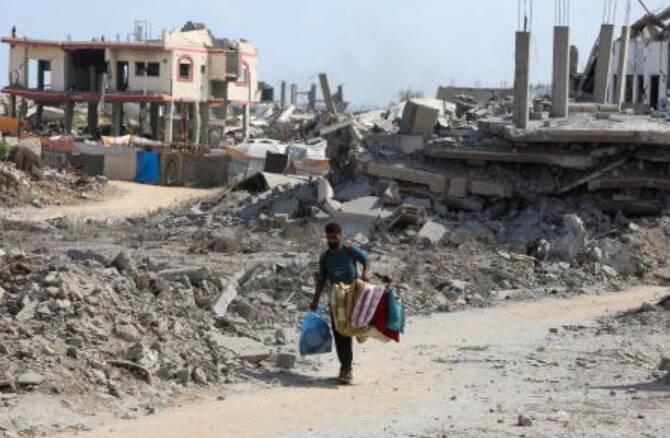
A Palestinian man walks near the rubble of houses destroyed during an Israeli raid, in western part of Nuseirat, central Gaza Strip, July 29, 2025. (Reuters)
Short Url
Updated 29 July 2025
Follow

Hamas says delegation leaving Doha after Gaza ceasefire talks breakdown

  • A high-level leadership delegation from Hamas is departing Doha heading to Istanbul
  • Israel has resisted international calls to agree a ceasefire in Gaza

GAZA CITY: Hamas’s negotiating team left the Qatari capital Doha for Turkiye on Tuesday to discuss the “latest developments” in the stalled Gaza ceasefire talks, a Hamas official told AFP.

“A high-level leadership delegation from Hamas, headed by Mohammed Darwish, president of the movement’s leadership council, and including the negotiation team and its head, Khalil Al-Hayya, is departing Doha heading to Istanbul,” the source told AFP.

“The delegation will hold several meetings with Turkish officials regarding the latest developments in the ceasefire negotiations, which stalled last week,” the source added.

For over two weeks, mediators in Qatar had been shuttling between Israeli and Hamas delegations in a bid to secure a breakthrough in indirect talks for a ceasefire and the release of hostages held in Gaza, nearly two years into the war.

The United States joined Israel last week in pulling its negotiators from the negotiations, with US Middle East envoy Steve Witkoff blaming the Palestinian militant group for the failure to reach a deal and saying Washington would “consider alternative options.”

Hamas politburo member Bassem Naim told AFP on Friday that the latest discussions focused on details of an Israeli military withdrawal from the Gaza Strip.

Israel has resisted international calls to agree a ceasefire in Gaza, with UN-backed experts warning on Tuesday that the Palestinian territory was slipping into famine.

Israeli foreign minister Gideon Saar called the ceasefire demands “a distorted campaign of international pressure against Israel” that would leave Hamas in power in Gaza.

“It ain’t gonna happen, no matter how much pressure is put on Israel,” he said at a press conference Tuesday.


Koshary, a spicy Egyptian staple, wins UNESCO recognition

Updated 6 sec ago
Follow

Koshary, a spicy Egyptian staple, wins UNESCO recognition

CAIRO: Koshary – a spicy dish of lentils, rice and pasta available at countless Egyptian food stalls – won recognition as a cultural treasure from the UN’s cultural agency on Wednesday, as Cairo makes a broad push to promote its cultural and historical identity abroad.
Egypt’s nomination of koshary for UNESCO’s “Intangible Cultural Heritage” list comes a little over a month after its opening of a sprawling new antiquities museum – another move officials hope will highlight the country’s rich history and lure more tourists.
One popular legend claims koshary originated in northern India and was brought to Egypt by soldiers during the British occupation. But the dish’s origins can in fact be traced through a farther-flung, millennia-old lineage of migration, trade and conquest, food researcher and archaeobotanist Hala Barakat said.

EGYPTIAN DISH, WITH GLOBAL INFLUENCES
Lentils arrived from the Fertile Crescent more than 5,800 years ago, and rice was introduced from East Asia. Tomatoes and chilli peppers were brought from the Americas centuries later, while pasta noodles were a more modern addition.
“These components came together over thousands of years,” Barakat said. “Its name may be Indian, but the Egyptian dish has its own form – and even that varies from Alexandria to Aswan.”
“Koshary in its current form is the koshary Egyptians made their own,” she added.
Egypt’s nomination makes note of this diversity, highlighting the fact that yellow lentils are used on the coast, compared with black lentils in Cairo and Upper Egypt. Some households add boiled eggs, while in Sinai a similar dish called ma’dous is common.
Each of these variations is united by “the special flavour provided by condiments such as vinegar, garlic, and hot sauce, which are added according to preference,” the nomination says.

COUSCOUS, CEVICHE ALSO ON LIST
Making the intangible heritage list is mostly symbolic, and does not bring any direct financial benefit. Other dishes such as couscous – common across the Maghreb region – and the South American dish ceviche are on the list. Italian cuisine was also set to be inscribed this year.
Koshary’s popularity surged in the 20th century as restaurants and brightly decorated street carts proliferated near schools and stations. The absence of animal products has also made it a staple among fasting Coptic Christians and younger Egyptians who are going vegetarian.
Today, the dish is one of Egypt’s most recognizable features, according to Ahmed Shaker, the public relations officer at Abou Tarek Koshary, a popular Cairo restaurant that dates back to 1963.
“Any foreigner or visitor who comes to Egypt visits the Pyramids, visits the museum, and comes to Abou Tarek to eat koshary,” Shaker said.
The dish joins Egypt’s 10 previous “inscriptions,” which include tahteeb, an ancient martial art using sticks, and the Sirat Bani Hilal, an epic oral poem.
UNESCO’s new director-general, Khaled El-Enany, previously served as Egypt’s minister of tourism and antiquities, and has vowed to use his tenure to safeguard cultural traditions.