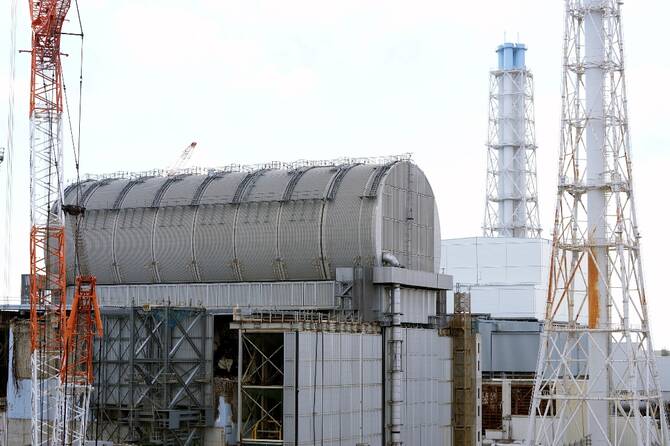
TOKYO: A massive operation to remove hundreds of tons of radioactive debris from Japan’s tsunami-stricken Fukushima nuclear plant has been delayed until at least 2037, the operator said Tuesday.
Around 880 tons of hazardous material remain inside the power station, site of one of history’s worst nuclear accidents after a tsunami triggered by a 9.0-magnitude earthquake in 2011.
Preparation work needed to start the retrieval is expected to take “12 to 15” years from now, Tepco official Akira Ono told reporters.
This means the earliest they can embark on the removal is now 2037, according to a Tepco document, after the company previously said they hoped to start in the early 2030s.
Dangerously high radiation levels mean that removing melted fuel and other debris from the plant is seen as the most daunting challenge in the decades-long decommissioning project.
Tiny samples of material have twice been collected under a trial project using special tools, but full-fledged extractions are yet to take place.
The new schedule throws into doubt previously stated goals by Tepco and the government to declare the Fukushima plant defunct by 2051.
But Tepco insisted Tuesday the deadline was achievable despite acknowledging it would be “tough.”
“There is no need to abandon the target,” Ono said, adding it is the firm’s “responsibility” to “figure out how to meet it.”
Three of Fukushima’s six reactors went into meltdown in 2011 after the huge tsunami swamped the facility.

Fukushima radioactive debris removal delayed until 2037
Short Url
https://arab.news/nvkyv
Fukushima radioactive debris removal delayed until 2037
- Preparation work needed to start the retrieval is expected to take “12 to 15” years from now, Tepco official Akira Ono told reporters
- Dangerously high radiation levels mean that removing melted fuel and other debris from the plant is seen as the most daunting challenge in the decades long decommissioning project
Polls open in Nepal’s first election after last year’s youth-led protests toppled the government
KATMANDU: Polls opened across Nepal on Thursday in the first nationwide election since last year’s violent, youth-led uprising forced the government from power.
Security forces patrolled streets and guarded polling stations across the Himalayan nation of about 30 million people as voters lined up to cast their ballots. Counting of votes will begin later Thursday, with results expected over the weekend.
Authorities banned vehicles from the streets and prohibited political rallies and public gatherings. All forms of campaigning are barred on election day.
Nearly 19 million people are eligible to vote, according to the Election Commission.
Voters are directly electing 165 members to the House of Representatives, the lower chamber of Parliament. The remaining 110 seats in the 275-member body will be allocated through a proportional representation system, under which political parties nominate lawmakers based on their share of the vote.
The election is widely seen as a three-way contest, shaped by voter frustration over widespread corruption and demands for greater government accountability.
The National Independent Party, founded in 2022, is considered the front-runner, posing a strong challenge to two long-dominant parties — the Nepali Congress and the Communist Party of Nepal (Unified Marxist–Leninist).
The new party’s prime ministerial candidate is rapper-turned politician Balendra Shah, who won the 2022 Katmandu mayoral race and emerged as a leading figure in the 2025 uprising that ousted former Prime Minister Khadga Prasad Oli.
Shah, 35, has rode a wave of public anger toward traditional political parties. He highlighted health and education for poor Nepalis as a key focus during his campaign.
The youth-led protests against corruption and poor governance were triggered by a social media ban before snowballing into a popular revolt against the government. Dozens were killed and hundreds injured when protesters attacked government buildings and police opened fire on them.
While the Congress and the Communists retain loyal voter bases, Shah’s party has drawn larger crowds on the campaign trail, highlighting its growing appeal among younger voters seeking an alternative.
The next administration is expected to inherit daunting challenges. It must deliver on changes demanded by last year’s protests, tackle entrenched corruption and carefully manage ties with its powerful neighbors, India and China.
Security forces patrolled streets and guarded polling stations across the Himalayan nation of about 30 million people as voters lined up to cast their ballots. Counting of votes will begin later Thursday, with results expected over the weekend.
Authorities banned vehicles from the streets and prohibited political rallies and public gatherings. All forms of campaigning are barred on election day.
Nearly 19 million people are eligible to vote, according to the Election Commission.
Voters are directly electing 165 members to the House of Representatives, the lower chamber of Parliament. The remaining 110 seats in the 275-member body will be allocated through a proportional representation system, under which political parties nominate lawmakers based on their share of the vote.
The election is widely seen as a three-way contest, shaped by voter frustration over widespread corruption and demands for greater government accountability.
The National Independent Party, founded in 2022, is considered the front-runner, posing a strong challenge to two long-dominant parties — the Nepali Congress and the Communist Party of Nepal (Unified Marxist–Leninist).
The new party’s prime ministerial candidate is rapper-turned politician Balendra Shah, who won the 2022 Katmandu mayoral race and emerged as a leading figure in the 2025 uprising that ousted former Prime Minister Khadga Prasad Oli.
Shah, 35, has rode a wave of public anger toward traditional political parties. He highlighted health and education for poor Nepalis as a key focus during his campaign.
The youth-led protests against corruption and poor governance were triggered by a social media ban before snowballing into a popular revolt against the government. Dozens were killed and hundreds injured when protesters attacked government buildings and police opened fire on them.
While the Congress and the Communists retain loyal voter bases, Shah’s party has drawn larger crowds on the campaign trail, highlighting its growing appeal among younger voters seeking an alternative.
The next administration is expected to inherit daunting challenges. It must deliver on changes demanded by last year’s protests, tackle entrenched corruption and carefully manage ties with its powerful neighbors, India and China.
© 2026 SAUDI RESEARCH & PUBLISHING COMPANY, All Rights Reserved And subject to Terms of Use Agreement.


