

Pakistan welcomes Thailand-Cambodia ceasefire, hopes for peaceful resolution via diplomacy

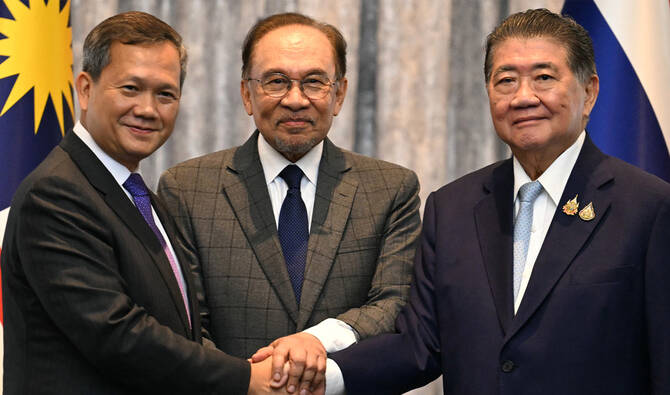
Malaysia's Prime Minister Anwar Ibrahim (center), Cambodia's Prime Minister Hun Manet (left) and Thailand's acting Prime Minister Phumtham Wechayachai (right) pose for photos as they shake hands following a press conference after talks about a ceasefire between Thailand and Cambodia in Putrajaya on July 28, 2025. (AFP)
Short Url
Updated 29 July 2025
Follow

Pakistan welcomes Thailand-Cambodia ceasefire, hopes for peaceful resolution via diplomacy

  • Thailand, Cambodia agreed to ceasefire on Monday after days-long fighting killed at least 35, displaced over 270,000
  • Pakistan’s foreign office hopes for resolution of conflict through regional cooperation between the two neighbors

ISLAMABAD: Pakistan’s foreign office on Tuesday welcomed the Thailand-Cambodia ceasefire after days of fighting, hoping the two sides would resolve their outstanding issues through diplomacy and regional cooperation. 

The foreign office’s statement followed Malaysian Prime Minister Anwar Ibrahim’s announcement of an “unconditional ceasefire” between Thailand and Cambodia on Monday. Talks between the two neighboring countries were held at Ibrahim’s official residence in Malaysia’s administrative capital, Putrajaya. Acting Thai Prime Minister Phumtham Wechayachai and Cambodian Prime Minister Hun Manet both attended the meeting, along with the ambassadors of China and the United States. 

Fighting over a border dispute between Thailand and Cambodia broke out last week, killing at least 35 people and displacing more than 270,000 from both sides of the border. Ibrahim said Cambodia and Thailand agreed to a ceasefire effective at midnight on Monday (17:00 GMT) while a meeting between the military commanders of both nations will follow on Tuesday.

“Pakistan welcomes the successful conclusion of the special meeting hosted by Malaysia on the Cambodia-Thailand situation,” the foreign office said in a statement. “We appreciate the spirit of dialogue and express hope for a peaceful resolution through diplomacy and regional cooperation.”

Thailand and Cambodia have wrangled for decades over border territory and been on a conflict footing since the killing of a Cambodian soldier in a skirmish late in May. The development led to a troop buildup on both sides and a full-blown diplomatic crisis that brought Thailand’s fragile coalition government to the brink of collapse.

Both countries accused each other of starting the fighting last week, that within hours increased from small arms fire to heavy artillery and rockets, and Thailand’s unexpected scrambling of an F-16 fighter jet to carry out airstrikes.

Pakistan had also engaged in a military conflict with its nuclear-armed neighbor India in May. Both countries pounded each other with fighter jets, artillery fire, drones and missiles before that killed over 70 on both sides of the border before agreeing to a ceasefire brokered by Washington on May 10. 


Nearly 25% of Pakistan’s primary schools enrolling girls operate as single-teacher ones— report

Updated 13 sec ago
Follow

Nearly 25% of Pakistan’s primary schools enrolling girls operate as single-teacher ones— report

  • Pakistan needs over 115,000 more teachers in primary schools enrolling girls to meet global benchmark of one teacher per 30 students, says report
  • Sixty percent of Pakistani primary schools enrolling girls are overcrowded, while 32% lack clean drinking water or toilets, says Tabadlab report

ISLAMABAD: Nearly 25% of Pakistan’s primary schools that enrolls girls operate as single-teacher ones, a report by a leading think tank said this week, calling on the government to devolve teacher recruitment powers, upskill underutilized teachers and introduce reforms to hire and promote faculty members. 

Pakistan faces an acute education crisis which is reflected in the fact that it has the world’s second-highest number of out-of-school children, an estimated 22.8 million aged 5-16 who are not in educational institutions, according to UNICEF. 

While poverty remains the biggest factor keeping children out of classrooms, Pakistan’s education crisis is exacerbated by inadequate infrastructure and underqualified teachers, cultural barriers and the impacts of frequently occurring natural disasters. 

According to “The Missing Ustaani,” a report published by Islamabad-based think tank Tabadlab and supported by Malala Fund and the Pakistan Institute of Education (PIE), Pakistan needs over 115,000 more teachers in primary schools with girls’ enrolment to meet the basic international benchmark of ensuring one teacher per 30 children. Currently, the average Student-to-Teacher Ratio (STR) across Pakistan’s primary schools with girls’ enrolment is 39:1, it said. 

“Approximately 60% of these schools are overcrowded, necessitating the recruitment of over 115,000 additional teachers nationwide,” the report said on Monday. “Compounding this, nearly 25% of primary schools with girls’ enrolment operate as single-teacher schools, placing immense pressure on the quality of education.”

It said the situation is more dire in Pakistan’s poverty-stricken southwestern Balochistan province, where nearly 52% of the schools are single-teacher only ones while the percentage decreases slightly in the southern Sindh province to 51 percent. 

The report said while the STR improves to 25:1 at the middle school level, acute shortages of subject specialists emerge as the top-priority concern for quality education in these schools.

“Furthermore, around 32% of primary schools with girls’ enrolment and 18% of middle schools face ‘critical infrastructural shortages’— lacking clean drinking water or toilets in addition to high STRs— which significantly affects girls’ attendance and learning, particularly during adolescence,” the report said. 

The report cited a set of priority recommendations to address Pakistan’s systemic teacher deployment challenges and improve educational equity for girls. 

It urged the government to devolve recruitment authority to school or cluster levels to enable timely, context-specific hiring. It also called upon authorities to reform teacher transfer and promotion policies to introduce school-specific postings with minimum service terms. 

This, it said, would reduce arbitrary transfers and improving continuity in classrooms. The report advised authorities to upskill surplus or underutilized primary teachers to support instruction at the middle school level, helping address subject-specialist shortages.

“Together, these reforms offer a pathway toward a more equitable, efficient, and responsive teaching workforce— one capable of improving learning outcomes and ensuring that every girl in Pakistan has access to a qualified teacher,” the report said. 

To tackle Pakistan’s education crisis, Prime Minister Shehbaz Sharif declared an ‘education emeregency’ in September 2024, stressing the importance of education for all.