

Pakistan welcomes Thailand-Cambodia ceasefire, hopes for peaceful resolution via diplomacy

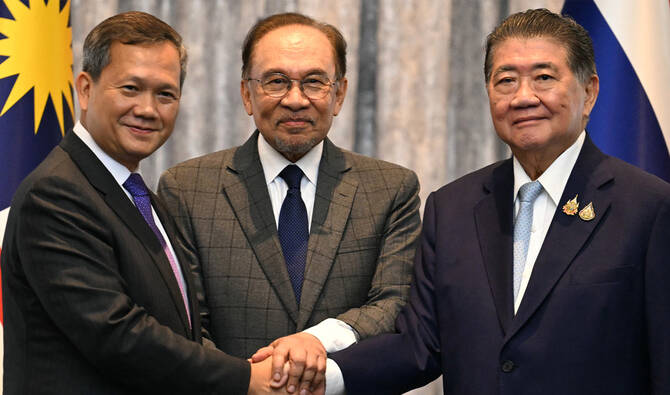
Malaysia's Prime Minister Anwar Ibrahim (center), Cambodia's Prime Minister Hun Manet (left) and Thailand's acting Prime Minister Phumtham Wechayachai (right) pose for photos as they shake hands following a press conference after talks about a ceasefire between Thailand and Cambodia in Putrajaya on July 28, 2025. (AFP)
Short Url
Updated 29 July 2025
Follow

Pakistan welcomes Thailand-Cambodia ceasefire, hopes for peaceful resolution via diplomacy

  • Thailand, Cambodia agreed to ceasefire on Monday after days-long fighting killed at least 35, displaced over 270,000
  • Pakistan’s foreign office hopes for resolution of conflict through regional cooperation between the two neighbors

ISLAMABAD: Pakistan’s foreign office on Tuesday welcomed the Thailand-Cambodia ceasefire after days of fighting, hoping the two sides would resolve their outstanding issues through diplomacy and regional cooperation. 

The foreign office’s statement followed Malaysian Prime Minister Anwar Ibrahim’s announcement of an “unconditional ceasefire” between Thailand and Cambodia on Monday. Talks between the two neighboring countries were held at Ibrahim’s official residence in Malaysia’s administrative capital, Putrajaya. Acting Thai Prime Minister Phumtham Wechayachai and Cambodian Prime Minister Hun Manet both attended the meeting, along with the ambassadors of China and the United States. 

Fighting over a border dispute between Thailand and Cambodia broke out last week, killing at least 35 people and displacing more than 270,000 from both sides of the border. Ibrahim said Cambodia and Thailand agreed to a ceasefire effective at midnight on Monday (17:00 GMT) while a meeting between the military commanders of both nations will follow on Tuesday.

“Pakistan welcomes the successful conclusion of the special meeting hosted by Malaysia on the Cambodia-Thailand situation,” the foreign office said in a statement. “We appreciate the spirit of dialogue and express hope for a peaceful resolution through diplomacy and regional cooperation.”

Thailand and Cambodia have wrangled for decades over border territory and been on a conflict footing since the killing of a Cambodian soldier in a skirmish late in May. The development led to a troop buildup on both sides and a full-blown diplomatic crisis that brought Thailand’s fragile coalition government to the brink of collapse.

Both countries accused each other of starting the fighting last week, that within hours increased from small arms fire to heavy artillery and rockets, and Thailand’s unexpected scrambling of an F-16 fighter jet to carry out airstrikes.

Pakistan had also engaged in a military conflict with its nuclear-armed neighbor India in May. Both countries pounded each other with fighter jets, artillery fire, drones and missiles before that killed over 70 on both sides of the border before agreeing to a ceasefire brokered by Washington on May 10. 


Pakistan eyes collaboration with Saudi Arabia, Indonesia, China for local vaccine production

Updated 5 sec ago
Follow

Pakistan eyes collaboration with Saudi Arabia, Indonesia, China for local vaccine production

  • Pakistan last week held talks with a visiting Saudi delegation on partnering to manufacture vaccines locally
  • Government working on “war footing” to ensure local production of vaccines by 2030, says health minister

ISLAMABAD: Pakistan is eyeing collaboration with Saudi Arabia, Indonesia and China to produce vaccines locally, Health Minister Syed Mustafa Kamal said on Thursday, adding that Islamabad was exploring both government-to-government and business-to-business opportunities in this regard. 

Kamal told Arab News last week that Islamabad was “very close” to an agreement with Saudi Arabia that would enable Pakistan to manufacture vaccines locally. The development took place as a Saudi delegation, led by the Kingdom’s senior adviser to the minister of industry Nizar Al-Hariri, arrived in Pakistan last week and held talks with health officials on a partnership with Pakistan which would enable it to manufacture vaccines locally. 

The efforts take place amid Pakistan’s push to strengthen its health security and industrial capacity. The country of more than 240 million currently imports all vaccines used in its national immunization campaigns, relying heavily on international partners to help cover the costs.

“Mustafa Kamal said Pakistan is exploring collaboration with Saudi Arabia, Indonesia and China for local production of these vaccines,” state broadcaster Radio Pakistan reported. 

Kamal said the government is working on a “war footing” to ensure the local production of vaccines before 2030. 

The health minister reiterated that Pakistan has the potential to locally produce raw materials of the 13 vaccines that it provides free of cost. He added that the government will also export vaccines once it starts producing them at home. 

“Mustafa Kamal said the government is exploring both government-to-government and business-to-business collaboration to achieve our objectives in vaccine production,” Radio Pakistan said. 

Pakistan’s health ministry has said it imports all 13 vaccines that it provides masses for free at an annual cost of about $400 million.

International partners currently cover 49 percent of these costs, with the remainder borne by the Pakistani government. This external support, Kamal has warned, is expected to end after 2030.