

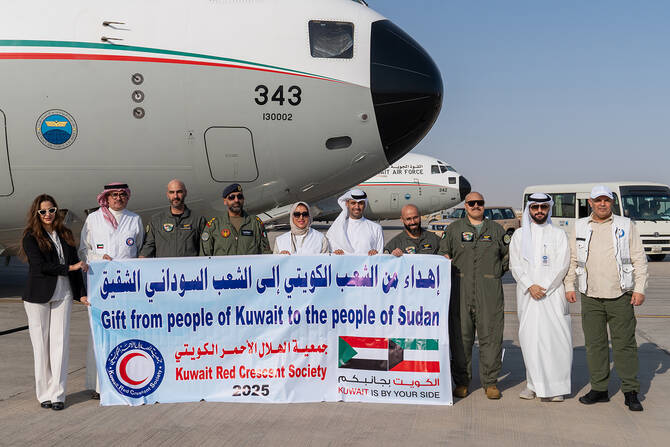
Kuwait’s Red Crescent dispatches relief plane to help Sudanese amid conflict

The Kuwait Red Crescent Society dispatched a relief plane to Sudan in cooperation with the Ministry of Foreign Affairs and Ministry of Defense. (Kuwait News Agency)
Short Url
Updated 28 July 2025
Follow

Kuwait’s Red Crescent dispatches relief plane to help Sudanese amid conflict

  • Khaled Mohammed Al-Magham, chairman of KRCS, said the plane will deliver food, shelter materials, and means of transport
  • He highlighted Kuwait’s commitment to assisting countries in crisis under the leadership of the emir of Kuwait, crown prince

LONDON: Kuwait dispatched a relief plane to Port Sudan on Monday to assist the Sudanese with essential aid, as armed conflict continues to embroil the region.

The Kuwait Red Crescent Society, in cooperation with the Ministry of Foreign Affairs and Ministry of Defense, loaded 40 tons of various aid onto an Kuwait Air Force plane that took off from Abdullah Al-Mubarak Air Base on Monday.

Khaled Mohammed Al-Magham, the chairman of the KRCS, said that the plane will deliver food, shelter materials, and means of transport, including five tons of wheat, to the Sudanese people, among whom 13 million have been displaced, including 8.6 million internally, since April 2023.

“Sending this plane demonstrates the State of Kuwait’s commitment to actively participate in humanitarian efforts to support the people of Sudan due to their suffering,” he told Kuwait News Agency. The KRCS is collaborating with its Sudanese counterpart to provide the aid and oversee its distribution.

Al-Magham expressed gratitude to donors for their significant support of the humanitarian mission, highlighting Kuwait’s dedication to assisting countries in crisis under the leadership of the emir of Kuwait and the crown prince. Al-Magham affirmed that “Kuwait will continue its relief and shelter support to our Sudanese brothers,” KUNA added.


Libya’s Red Castle museum opens for first time since fall of Qaddafi

Updated 3 sec ago
Follow

Libya’s Red Castle museum opens for first time since fall of Qaddafi

Libya’s national museum, formerly known as As-Saraya Al-Hamra or the Red Castle, has reopened in Tripoli, allowing the public access to some of the country’s finest historical treasures for the first time since the revolt that toppled Muammar Qaddafi.
The museum, Libya’s largest, was closed in 2011 during a NATO-backed uprising against longtime ruler Qaddafi, who appeared on the castle’s ramparts to deliver a fiery speech.
Renovations were started in March 2023 by the Tripoli-based Government of National Unity (GNU), which came to power in 2021 in a UN-backed political process.
“The reopening of the National Museum is not just a cultural moment but a live testimony that Libya is building its institutions,” GNU Prime Minister Abdulhamid Al-Dbiebah said at a reopening ceremony on Friday.
Built in the 1980s, the museum’s 10,000 square meters of gallery space features mosaics and murals, sculptures, coins, and artefacts dating back to prehistoric times and stretching through Libya’s Roman, Greek and Islamic periods.
The collection also includes millennia-old mummies from the ancient settlements of Uan Muhuggiag in Libya’s deep south, and Jaghbub near its eastern border with Egypt.
“The current program focuses on enabling schools to visit the museum during this period, until it is officially opened to the public at the beginning of the year,” museum director Fatima Abdullah Ahmed told Reuters.
Libya has since recovered 21 artefacts that were smuggled out of the country after Qaddafi’s fall, notably from France, Switzerland, and the United States, the chairman of the board of directors of the antiquities department Mohamed Farj Shakshoki told Reuters ahead of the opening.
Shakshoki said that talks are ongoing to recover more than two dozen artefacts from Spain and others from Austria.
In 2022, Libya received nine artefacts, including funerary stone heads, urns and pottery from the US
Libya houses five UNESCO World Heritage sites, which it said in 2016 were all endangered due to instability and conflict.
In July, Libya’s delegation to UNESCO said the ancient city of Ghadames, one of the sites, had been removed from the list as the security situation had improved.