UN rights chief warns world inaction on Gaza could amount to war crimes, genocide complicity

1 / 2
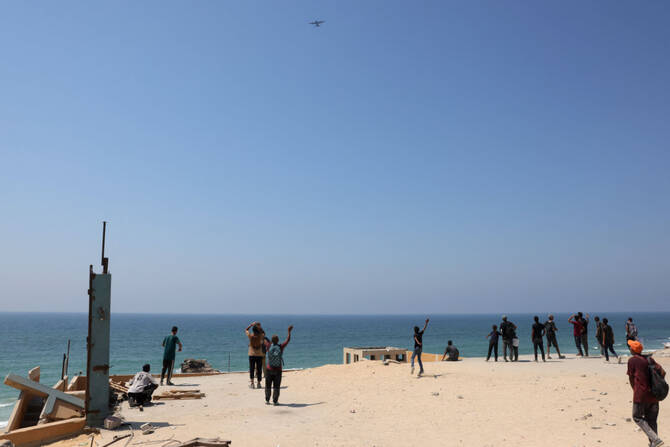
People gather as Jordanian and Emirati plane military transport aircraft drop humanitarian aid on the northern Gaza Strip on July 27, 2025. (AFP)
2 / 2
Short Url
Updated 28 July 2025
Follow

UN rights chief warns world inaction on Gaza could amount to war crimes, genocide complicity

  • Volker Turk tells Israel to end its ‘unlawful’ occupation of Palestine
  • Gaza children ‘wasting away,’ widespread hunger, says UN official

NEW YORK CITY: The UN High Commissioner for Human Rights Volker Turk on Sunday issued a stark appeal ahead of a high-level conference on Palestine, urging governments to exert pressure on the Israeli regime to end its “carnage” in Gaza and warned that inaction could amount to complicity in war crimes and genocide.

In a video statement released from Geneva, Turk called for “immediate steps by Israel to end its unlawful continued presence in the occupied Palestinian territory,” and urged all parties to work toward implementing a two-state solution.


The event, co-chaired by Saudi Arabia and France, the High-Level International Conference for the Peaceful Settlement of the Question of Palestine and the Implementation of the Two-State Solution, is being described as urgent and historic.

UN humanitarian chief Tom Fletcher on Sunday warned that the situation in Gaza was dire, with widespread hunger, children wasting away, and people risking their lives just to access food.

While Israel’s recent move to ease restrictions and allow more aid through was a step forward, Fletcher said it was not enough.

Vast quantities of aid, safe access routes, consistent fuel supplies, protection for civilians, and an immediate ceasefire were urgently needed to prevent further catastrophe.

Turk said: “This conference must deliver concrete action.”

He urged the participating governments to “put all possible pressure on the Israeli government to end the carnage in Gaza — permanently.” Turk cautioned that “countries that fail to use their leverage may be complicit in international crimes.”

Describing the situation in Gaza and the West Bank as an “unspeakable tragedy,” Turk said that daily violence and destruction were fueling the “dehumanization of Palestinians.”

He condemned Israeli plans that he said amounted to consolidating the annexation of the West Bank and forcing Palestinians out of Gaza.

“Every day, we see actions and hear about plans (to) crowd extremely exhausted and hungry people into ever-smaller areas of the territory, after repeated displacement orders by the Israeli military,” he said.

“These steps put the two-state solution even further out of reach.”

“Children are starving and dying in front of our eyes,” Turk said, calling Gaza “a dystopian landscape of deadly attacks and total destruction.”

He criticized what he described as the failure of the Gaza Humanitarian Foundation, supported by the US and Israel, saying its chaotic, militarized distribution centers “are failing utterly to deliver humanitarian aid at the scope and scale needed.”

According to figures from Gaza’s Health Ministry, Turk said, over 200,000 Palestinians have been killed or injured since Oct. 7, about 10 percent of the territory’s population.

He also noted that more than 1,000 people have died since May while trying to access food, and that over 300 humanitarian workers have been killed by Israel.

“All countries have an obligation to take concrete steps to ensure that Israel, the occupying power in Gaza, complies with its obligations to ensure that sufficient food and lifesaving necessities are provided to the population,” he said.

Turning to the occupied West Bank, Turk accused Israeli security forces and settlers of “continuing to kill Palestinians, demolish houses, cut off water supplies, and consolidate systems of oppression and discrimination.”

While condemning the Oct. 7 attacks by Hamas and other Palestinian groups and recognizing the trauma inflicted on Israel, Turk reiterated his long-standing condemnation of the scale of Israel’s military response in Gaza.

He said he has warned repeatedly of war crimes, crimes against humanity, and the need to prevent genocide, echoing concerns raised by the International Court of Justice.

“The people of the world will judge this conference on what it delivers,” he warned.

Turk renewed calls for an “immediate, permanent ceasefire,” the “unconditional release of all hostages and all others arbitrarily detained,” and for “massive” humanitarian aid to be delivered to Palestinians “wherever they are.”

He concluded by expressing the UN human rights office’s readiness to support Palestinian state-building efforts grounded in human rights and the rule of law, and emphasized the importance of victim support and accountability.

The long road to Palestinian statehood
An Arab News Deep Dive Enter

keywords


Pakistan killed over 80 militants in strikes on TTP camps in Afghanistan — official

Updated 59 min ago
Follow

Pakistan killed over 80 militants in strikes on TTP camps in Afghanistan — official

  • Saturday’s airstrikes followed a series of attacks inside Pakistan amid a surge in militancy
  • The Afghan Taliban authorities accuse Pakistani forces of killing civilians in the airstrikes

ISLAMABAD: Pakistan’s airstrikes in Afghanistan destroyed seven Tehreek-e-Taliban Pakistan (TTP) camps and killed over 80 militants, a Pakistani security official said on Sunday, with the Afghan Taliban accusing Pakistani forces of killing civilians in the assault.

Saturday’s airstrikes followed a series of attacks inside Pakistan amid a surge in militancy. Authorities say the attacks, particularly in Khyber Pakhtunkhwa province and the Pakistani capital of Islamabad, were carried out by the TTP and allied groups that Islamabad alleges are operating from sanctuaries in Afghanistan. Kabul denies this.

According to Pakistan’s information ministry, recent incidents included a suicide bombing at a Shiite mosque in Islamabad, separate attacks in Bajaur and Bannu, and another recent incident in Bannu during the holy month of Ramadan, which started earlier this week. The government said it had “conclusive evidence” linking the attacks to militants directed by leadership based in Afghanistan.

“Last night, Pakistan’s intelligence-based air strikes destroyed seven centers of Fitna Al-Khawarij TTP in three provinces of Nangarhar, Paktika and Khost, in which more than eighty Khawarij (TTP militants) have been confirmed killed, while more are expected,” a Pakistani security official, who spoke on condition of anonymity, told Arab News.


An earlier statement from Pakistan’s information ministry said the targets included a camp of a Daesh regional affiliate, the Islamic State Khorasan Province (ISKP), which claimed a suicide bombing at an Islamabad Shiite mosque that killed 32 people this month.

In an X post, Afghan government spokesperson Zabihullah Mujahid said Pakistani forces had violated Afghan territory.

“Pakistani special military circles have once again trespassed into Afghan territory,” Mujahid said. “Last night, they bombed our civilian compatriots in Nangarhar and Paktika provinces, martyring and wounding dozens of people, including women and children.”

 The Afghan Taliban’s claims of civilian casualties could not be independently verified. Pakistan did not immediately comment on the allegation that civilians had been killed in the strikes.

In a post on X, Afghanistan’s foreign ministry said it had summoned Pakistan’s charge d’affaires to Afghanistan Ubaid-ur-Rehman Nizamani and lodged protest through a formal démarche in response to the Pakistani military strikes.

“IEA-MoFA (The Islamic Emirate of Afghanistan’s Ministry of Foreign Affairs) vehemently condemns the violation of Afghanistan’s airspace and the targeting of civilians, describing it as a flagrant breach of Afghanistan’s territorial integrity & a provocative action,” it said in a statement.

“The Pakistani side was also categorically informed that safeguarding Afghanistan’s territorial integrity is the religious responsibility of the Islamic Emirate of Afghanistan; henceforth, the responsibility for any adverse consequences of such actions will rest with the opposing side.”

Tensions between Islamabad and Kabul have escalated since the Afghan Taliban returned to power in 2021. Pakistan says cross-border militant attacks have increased since then and has accused the Taliban of failing to honor commitments under the 2020 Doha Agreement to prevent Afghan soil from being used for attacks against other countries. The Taliban deny allowing such activity and have previously rejected similar accusations.

Saturday’s exchange of accusations marks one of the most direct confrontations between the two neighbors in recent months and risks further straining already fragile ties along the volatile border.