

2 Palestinian families in Jerusalem demolish homes to avoid Israel fines, prison

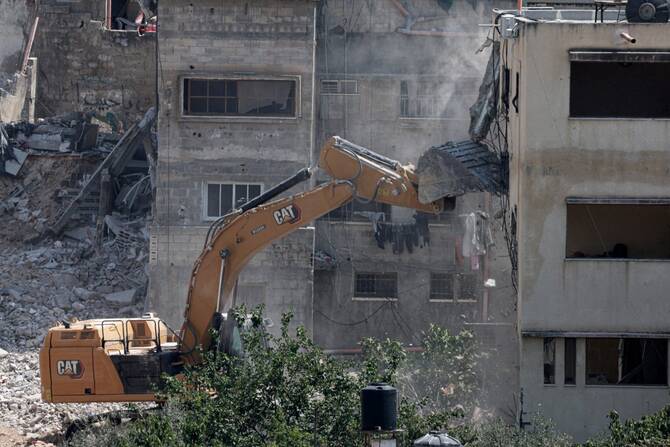
An Israeli military bulldozer demolishes a home at the Nur Shams Palestinian refugee camp, east of Tulkarem, June 23, 2025. (AFP)
Short Url
Updated 28 July 2025
Follow

2 Palestinian families in Jerusalem demolish homes to avoid Israel fines, prison

  • Tel Aviv denies Palestinians permits but expands illegal settlements
  • Families forced because Israeli govt wants payment for demolitions

LONDON: Two Palestinian families in occupied East Jerusalem were forced to demolish their homes on Sunday to avoid steep financial penalties, and possibly imprisonment, that the Israeli regime had threatened for allegedly building without permits.

The Palestinian Authority’s Jerusalem governorate said the Quraan family was forced to demolish their home in the Jabal Al-Mukabbir neighborhood on Sunday.

The Halawani family also demolished their residential building, comprising six housing units, in Beit Hanina, north of Jerusalem. As a result, 30 individuals, including children, have been left homeless.

The families were forced to demolish their homes because they would have had to pay thousands of dollars for the Israeli regime to do so.

Israel regularly denies Palestinians building permits, while illegally expanding Jewish settlements in the city and the occupied West Bank.

From 1991 to 2018, Israeli authorities approved only 16.5 percent of building permits in Palestinian neighborhoods. The others were issued for Israeli neighborhoods in West Jerusalem and settlements, according to the organization Peace Now.

The Jerusalem governorate said Israel has a “systematic policy of displacing” Palestinians from the city.

“Palestinian families in occupied Jerusalem are frequently denied building permits by Israeli authorities, leaving many with no legal option but to build without authorization,” it added.

Human Rights Watch and other groups have criticized Israel’s home demolition policy in Jerusalem as “discriminatory.”

Since Israel attacked Gaza in October 2023, authorities in Jerusalem have demolished 623 houses and other commercial facilities belonging to dozens of Palestinian families.

The Israeli regime faces charges of war crimes and genocide in the Occupied Territories.


Israel’s hostage forum releases AI-generated video of last Gaza captive

Updated 23 December 2025
Follow

Israel’s hostage forum releases AI-generated video of last Gaza captive

  • The Gaza ceasefire, which came into effect in October, remains fragile with both sides alleging violations, and mediators fearing that Israel and Hamas alike are stalling

JERUSALEM: An Israeli group representing the families of Gaza hostages released on Tuesday an AI-generated video of Ran Gvili, the last captive whose body is still being held in the Palestinian territory.
The one-minute clip, created whole cloth using artificial intelligence, purports to depict Gvili as he sits in a Gaza tunnel and appeals to US President Donald Trump to help bring his body back to Israel.
“Mr President, I’m asking you to see this through: Please bring me home. My family deserves this. I deserve the right to be buried with honor in the land I fought for,” says the AI-generated image of Gvili.
Gvili was 24 at the time of Hamas’s October 7, 2023 attack on Israel.
He was an officer in Israel’s Yasam elite police unit and was on medical leave when he learnt of the attack.
He decided to leave his home and brought his gun to counter the Hamas militants.
He was shot in the fighting at the Alumim kibbutz before he was taken to Gaza.
Israeli authorities told Gvili’s parents in January 2024 that he had not survived his injuries.
The AI clip was released by the Hostages and Missing Families Forum, the main group representing those taken captive to Gaza.
The Forum said it was published with the approval of Gvili’s family.
“Seeing and hearing Rani speak in his own voice is both moving and heartbreaking. I would give anything to hear, see and hold him again,” Gvili’s mother Talik said, quoted by the Forum.
“But all I can do now is plead that they don’t move to the next phase of the agreement before bringing Rani home — because we don’t leave heroes behind.”
The Gaza ceasefire, which came into effect in October, remains fragile with both sides alleging violations, and mediators fearing that Israel and Hamas alike are stalling.
In the first stage, Palestinian militants were expected to return all of the remaining 48 living and dead hostages held in Gaza.
Since the ceasefire came into effect on October 10, militants have released 47 hostages.
In the next stages of the truce, Israel is supposed to withdraw from its positions in Gaza, an interim authority is to govern the Palestinian territory instead of Hamas, and an international stabilization force is to be deployed.
Israeli Prime Minister Benjamin Netanyahu is expected to meet Trump in Florida later this month to discuss the second phase of the deal.