

At least five arrested as Pakistan widens crackdown on illegal currency exchange, transfers

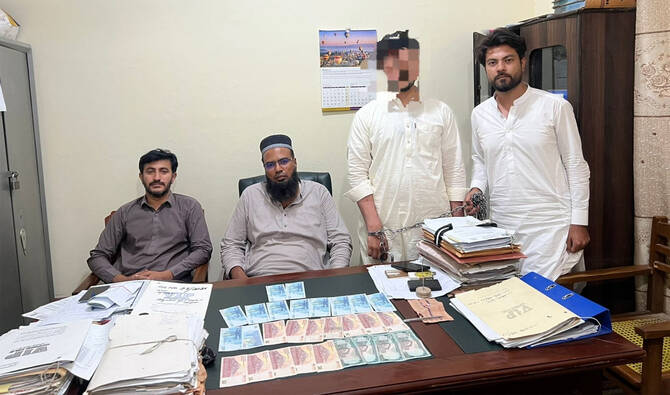
In this handout photo, taken and released by Pakistan’s Federal Investigation Agency on July 27, 2025, officials gesture with a suspect arrested over the charges of illegal money exchange, in Quetta. (FIA)
Short Url
Updated 27 July 2025
Follow

At least five arrested as Pakistan widens crackdown on illegal currency exchange, transfers

  • The development comes days after a senior ISI official met exchange company representatives, amid concern over rupee’s depreciation
  • Pakistan operates a multi-tiered currency market, with rates diverging between official interbank channel, open market and ‘grey market’

ISLAMABAD: Pakistan’s Federal Investigation Agency (FIA) has arrested five suspects involved in illegal currency exchange and transfer of money, the agency said on Sunday, amid a widening crackdown on black market currency traders.

The development comes days after the Inter-Services Intelligence (ISI), Pakistan’s powerful military-run spy agency, held a meeting in Islamabad with senior officials from currency exchange companies, amid growing concern over the rupee’s depreciation, which fell to a 22-month low of Rs284.97 against the US dollar earlier this week.

Maj. Gen. Faisal Naseer, a deputy chief of the ISI, chaired the session, according to Malik Bostan, who attended the discussion and is the chairman of the Exchange Companies Association of Pakistan (ECAP), told Arab News. The FIA had begun raiding informal, unregulated money transfer, or ‘hundi’ and ‘hawala,’ operators and currency smuggling networks.

In a statement on Sunday, the agency said it was tightening the noose around networks involved currency smuggling and had conducted major operations in the southwestern Balochistan province that border Iran and Afghanistan.

“Five suspects involved in hawala, hundi and illegal currency exchange have been arrested,” the FIA said in a statement. “The suspects were arrested in raids in different areas of Quetta and Chaman.”

Pakistan operates a multi-tiered currency market, with rates diverging between the official interbank channel, the open market, and an unregulated “grey market” where many traders and informal hawala dealers operate.

Burdened by over $58 billion in imports in the last fiscal year, Pakistan faces severe inflationary pressure whenever the dollar strengthens. The rupee has lost 2 percent of its value since January, despite Pakistan’s current account recording a surplus of $2.1 billion, according to central bank data.

During the raids in Balochistan, the FIA said, officials seized 684,000 Pakistani rupees, 230.5 million Iranian rials, more than 135,000 Afghanis, 700 US dollars, 200 Saudi riyals and 150 Australian dollars.

“Cheque books, hawala-hundi receipts and bank deposit slips were also recovered from the suspects,” it said.

“The accused were involved in currency exchange without a license. They could not give a satisfactory answer to the authorities regarding the recovered currency.”

The agency said it was further investigating the arrested suspects.


Sindh assembly passes resolution rejecting move to separate Karachi

Updated 21 February 2026
Follow

Sindh assembly passes resolution rejecting move to separate Karachi

  • Chief Minister Shah cites constitutional safeguards against altering provincial boundaries
  • Calls to separate Karachi intensified amid governance concerns after a mall fire last month

ISLAMABAD: The provincial assembly of Pakistan’s southern Sindh province on Saturday passed a resolution rejecting any move to separate Karachi, declaring its territorial integrity “non-negotiable” amid political calls to carve the city out as a separate administrative unit.

The resolution comes after fresh demands by the Muttahida Qaumi Movement (MQM) and other voices to grant Karachi provincial or federal status following governance challenges highlighted by the deadly Gul Plaza fire earlier this year that killed 80 people.

Karachi, Pakistan’s largest and most densely populated city, is the country’s main commercial hub and contributes a significant share to the national economy.

Chief Minister Syed Murad Ali Shah tabled the resolution in the assembly, condemning what he described as “divisive statements” about breaking up Sindh or detaching Karachi.

“The province that played a foundational role in the creation of Pakistan cannot allow the fragmentation of its own historic homeland,” Shah told lawmakers, adding that any attempt to divide Sindh or separate Karachi was contrary to the constitution and democratic norms.

Citing Article 239 of Pakistan’s 1973 Constitution, which requires the consent of not less than two-thirds of a provincial assembly to alter provincial boundaries, Shah said any such move could not proceed without the assembly’s approval.

“If any such move is attempted, it is this Assembly — by a two-thirds majority — that will decide,” he said.

The resolution reaffirmed that Karachi would “forever remain” an integral part of Sindh and directed the provincial government to forward the motion to the president, prime minister and parliamentary leadership for record.

Shah said the resolution was not aimed at anyone but referred to the shifting stance of MQM in the debate while warning that opposing the resolution would amount to supporting the division of Sindh.

The party has been a major political force in Karachi with a significant vote bank in the city and has frequently criticized Shah’s provincial administration over its governance of Pakistan’s largest metropolis.

Taha Ahmed Khan, a senior MQM leader, acknowledged that his party had “presented its demand openly on television channels with clear and logical arguments” to separate Karachi from Sindh.

“It is a purely constitutional debate,” he told Arab News by phone. “We are aware that the Pakistan Peoples Party, which rules the province, holds a two-thirds majority and that a new province cannot be created at this stage. But that does not mean new provinces can never be formed.”

Calls to alter Karachi’s status have periodically surfaced amid longstanding complaints over governance, infrastructure and administrative control in the megacity, though no formal proposal to redraw provincial boundaries has been introduced at the federal level.