

Israel declares Gaza fighting pause amid deepening hunger crisis

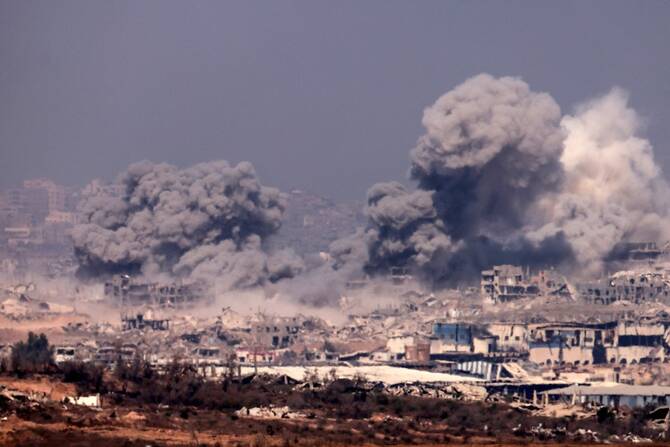
Thick smoke billowing during Israeli strikes on the besieged Palestinian territory on July 27, 2025. (AFP)
Short Url
Updated 27 July 2025
Follow

Israel declares Gaza fighting pause amid deepening hunger crisis

  • The military’s statement did not say when the humanitarian corridors for UN convoys would open, or where
  • It also said the military is prepared to implement humanitarian pauses in densely populated areas

GAZA CITY, Palestinian Territories: Israel declared a “tactical pause” in fighting in parts of Gaza on Sunday and said it would allow the UN and aid agencies to open secure land routes to tackle a deepening hunger crisis.

The military also said it had begun air-dropping food into the territory and angrily rejected allegations it was using starvation as a weapon against Palestinian civilians.

In a statement, the army said it coordinated its decisions with the UN and international organizations to “increase the scale of humanitarian aid entering the Gaza Strip.”

There was no immediate official response from the UN or non-governmental aid agencies operating in Gaza, and privately skeptical humanitarian sources said they were waiting to see the results on the ground of the Israeli announcement.

The pause in fighting would be limited to areas where the military says Israeli troops are not currently operating — Al-Mawasi, Deir El-Balah and Gaza City — and last from 10:00 a.m. (0700 GMT) until 8:00 p.m. every day.

But the Israeli statement added that “designated secure routes” had been opened across all of Gaza to enable the safe passage of UN and humanitarian aid organization convoys delivering and distributing food and medicine.

The Israeli military said these operations, alongside its ongoing campaign against Palestinian armed groups, should disprove “the false claim of deliberate starvation in the Gaza Strip.”

Israel imposed a total blockade on Gaza on March 2 after ceasefire talks broke down. In late May, it began allowing a small trickle of aid to resume, amid warnings of a wave of starvation.

Before Israel announced the airborne delivery of seven pallets of food, the United Arab Emirates had said it would restart aid drops and Britain said it would work with partners including Jordan to assist them.

On Saturday alone, the Palestinian civil defense agency said over 50 more Palestinians had been killed in Israeli strikes and shootings, some as they waited near aid distribution centers.

“We ask God and our Arab brothers to work harder to reach a ceasefire before we all die,” Gaza resident Hossam Sobh said, adding that he had feared death as he recovered a bag of flour under the nose of an Israeli tank.

Also on Saturday, Israeli troops boarded a boat carrying activists from the Freedom Flotilla Coalition as it attempted to approach Gaza from the sea to challenge a naval blockade.

Israeli forces brought the pro-Palestinian activist boat Handala into the port of Ashdod on Sunday, after seizing the vessel in international waters and detaining the crew, an AFP journalist saw.

The humanitarian situation in the Palestinian territory has gravely deteriorated in recent days, with more than 100 NGOs warning this week that “mass starvation” was spreading in Gaza.

On Telegram, the Israeli military announced it “carried out an airdrop of humanitarian aid as part of the ongoing efforts to allow and facilitate the entry of aid into the Gaza Strip.”

Humanitarian chiefs are deeply skeptical that air drops can deliver enough food safely to tackle the deepening hunger crisis facing Gaza’s more than two million inhabitants.

But British Prime Minister Keir Starmer backed the idea, vowing to work with Jordan to restart air drops. The United Arab Emirates said it would resume air drops “immediately.”

A number of Western and Arab governments carried out air drops in Gaza in 2024, when aid deliveries by land also faced Israeli restrictions, but many in the humanitarian community consider them ineffective.

“Air drops will not reverse the deepening starvation,” said Philippe Lazzarini, head of the UN agency for Palestinian refugees, UNRWA. “They are expensive, inefficient and can even kill starving civilians.”

Israel’s military insists it does not limit the number of trucks going into Gaza, and alleges that UN agencies and relief groups are not collecting aid once it is inside the territory.

But humanitarian organizations accuse the army of imposing excessive restrictions, while tightly controlling road access within Gaza.

A separate aid operation is under way through the Israeli- and US-backed Gaza Humanitarian Foundation.

But it has faced fierce international criticism after Israeli fire killed hundreds of Palestinians near distribution points.

On Saturday evening, the live feed on the Handala boat belonging to pro-Palestinian activist group Freedom Flotilla showed Israeli troops boarding the vessel.

The soldiers moved in as the boat approached Gaza and three video live feeds of the scene broadcasting online were cut minutes later.

Media restrictions in Gaza and difficulties in accessing many areas mean AFP is unable to independently verify tolls and details provided by the civil defense agency and other parties.

Israel launched its military campaign in Gaza after Hamas’s October 2023 attack resulted in the deaths of 1,219 people, most of them civilians, according to an AFP tally based on official figures.

The Israeli campaign has killed 59,733 Palestinians, mostly civilians, according to the health ministry in the Hamas-run territory.


Sudan named most neglected crisis of 2025 in aid agency poll

Updated 1 sec ago
Follow

Sudan named most neglected crisis of 2025 in aid agency poll

LONDON: The humanitarian catastrophe engulfing Sudan, unleashing horrific violence on children and uprooting nearly a quarter of the population, is the world’s most neglected crisis of 2025, according to a poll of aid agencies.
Some 30 million Sudanese people – roughly equivalent to Australia’s population — need assistance, but experts warn that warehouses are nearly empty, aid operations face collapse and two cities have tipped into famine.
“The Sudan crisis should be front page news every single day,” said Save the Children humanitarian director Abdurahman Sharif.
“Children are living a nightmare in plain sight, yet the world continues to shamefully look away.”
Sudan was named by a third of respondents in a Thomson Reuters Foundation crisis poll of 22 leading aid organizations.
Democratic Republic of Congo (DRC), widely considered the deadliest conflict since World War Two, ranked second.
Although Sudan has received some media attention, Sharif said the true scale of the catastrophe remained “largely out of sight and out of mind.”
The United Nations has called Sudan the world’s biggest humanitarian crisis, but a $4.16 billion appeal is barely a third funded.
The poll’s respondents highlighted a number of overlooked emergencies, including Myanmar, Afghanistan, Somalia, Africa’s Sahel region and Mozambique.
Many agencies said they were reluctant to single out just one crisis in a year when the United States and other Western donors slashed aid despite soaring humanitarian needs.
“It feels as though the world is turning its back on humanity,” said Oxfam’s humanitarian director Marta Valdes Garcia.

’INDICTMENT OF HUMANITY’
The conflict between the Sudanese army and the paramilitary Rapid Support Forces, which erupted out of a power struggle in April 2023, has created the world’s largest displacement crisis with 12 million people fleeing their homes.
Aid groups cited appalling human rights violations, including child cruelty, rape and conscription.
“What is being done to Sudan’s children is unconscionable, occurring on a massive scale and with apparent impunity,” said World Vision’s humanitarian operations director Moussa Sangara.
Hospitals and schools have been destroyed or occupied, and 21 million people face acute hunger.
The UN World Food Programme (WFP) has warned that without additional funds it will have to cut rations for communities in famine or at risk.
Aid organizations say violence, blockades and bureaucratic obstacles are making it hard to reach civilians in conflict zones.
“What we are witnessing in Sudan is nothing short of an indictment of humanity,” said the UN refugee agency’s regional director Mamadou Dian Balde.
“If the world does not urgently step up — diplomatically, financially, and morally — an already catastrophic situation will deteriorate further with millions of Sudanese and their neighbors paying the price.”

’BREAKING POINT’
South Sudan and Chad, both hosting large numbers of Sudanese refugees, were also flagged in the survey.
Charlotte Slente, head of the Danish Refugee Council, said Chad – a country already dealing with deep poverty and hunger exacerbated by the climate crisis — was being pushed “to breaking point.”
“Chad’s solidarity with the refugees is a lesson for the world’s wealthiest nations. That generosity is being met by global moral failure,” Slente said.
In South Sudan, Oxfam said donors were pulling out, forcing aid agencies to cut crucial support for millions of people.

’HELLSCAPE FOR WOMEN’
Several organizations sounded the alarm over escalating conflict in DRC.
Around 7 million people are displaced and 27 million face hunger in the vast resource-rich country, where rape has been used as a weapon of war through decades of conflict.
“This is the biggest humanitarian emergency that the world isn’t talking about,” said Christian Aid’s chief executive Patrick Watt.
On a recent visit, he said villagers told him how armed groups had stolen livestock, torched homes, recruited boys to fight and subjected women and girls to terrifying sexual violence.
Rwandan-backed M23 rebels seized a swathe of eastern Congo this year in their bid to topple the government in Kinshasa. Fighting has continued despite a US-led peace deal signed this month by DRC and Rwanda.
DRC’s conflict has intensified amid soaring global demand for minerals needed for clean energy technologies, smartphones and more.
Watt said people now face economic disaster due to Kinshasa’s blockade on M23-controlled areas and aid cuts that have hollowed out the humanitarian response.
ActionAid said the violence had “created a hellscape” for women, while the Norwegian Refugee Council (NRC) called Congo “a case study of global neglect.”
“This neglect is not an accident: it is a choice,” said NRC Secretary General Jan Egeland.
UN aid chief Tom Fletcher named Myanmar as the most neglected crisis, describing it as “a billion-dollar emergency running on fumes.”
A $1.1 billion appeal for the southeast Asian country is only 17 percent funded despite mass displacement, rising hunger and rampant violence.
Although donors raced to help after Myanmar’s massive earthquake in March, Fletcher said the world had turned away from the “grinding crisis” underneath.
“Myanmar is becoming invisible,” he said.