Muslim leaders increase security after vandalism reports at Texas and California mosques

1 / 3
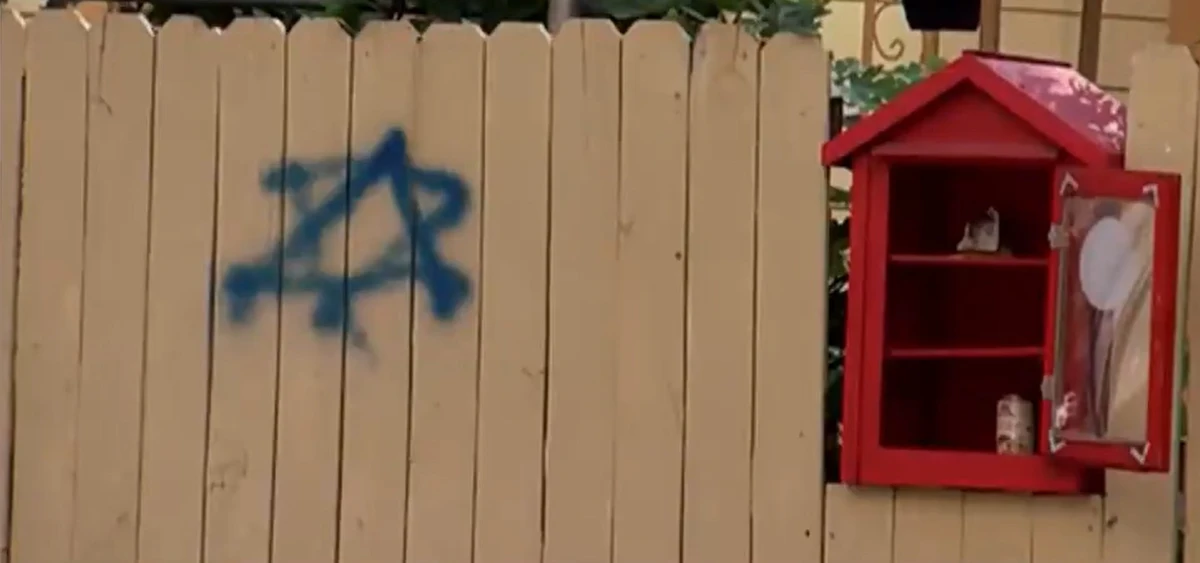
Screengrabs showing acts of vandalism involving graffiti at a few mosques in Texas and California, where Muslim leaders stepped up existing efforts to keep their sacred spaces and community members safe. (X/@CAIRNational)
2 / 3
Screengrabs showing acts of vandalism involving graffiti at a few mosques in Texas and California, where Muslim leaders stepped up existing efforts to keep their sacred spaces and community members safe. (X/@CAIRNational)
3 / 3
Screengrabs showing acts of vandalism involving graffiti at a few mosques in Texas and California, where Muslim leaders stepped up existing efforts to keep their sacred spaces and community members safe. (X/@CAIRNational)
Short Url
Updated 26 July 2025
Follow

Muslim leaders increase security after vandalism reports at Texas and California mosques

  • “The past two years have been extremely difficult for American Muslims,” said Edward Ahmed Mitchell
  • The recent vandalism reports have left some worried and frustrated — but not entirely surprised

TEXAS: After a spate of vandalism reports involving graffiti at a few mosques in Texas and California, Muslim leaders there have stepped up existing efforts to keep their sacred spaces and community members safe.

The incidents and subsequent hypervigilance add to what many American Muslims say has already been a charged climate amid the fallout in the US from the Israel-Hamas war that has killed tens of thousands of Palestinians and devastated Gaza. The war started in October 2023 with a deadly attack by Hamas on Israel.

“The past two years have been extremely difficult for American Muslims,” said Edward Ahmed Mitchell, national deputy director of the Council on American-Islamic Relations, a Muslim civil rights and advocacy organization.

A constant stream of images showing the death, destruction and ongoing starvation in Gaza has taken a toll, said Mitchell, as has a rise in anti-Muslim and anti-Palestinian bigotry in the US

He pointed to one of the most egregious examples of that bigotry: After the war started, an Illinois man killed a 6-year-old Palestinian American Muslim boy and wounded his mother in a hate-crime attack.

Worry and frustration

The recent vandalism reports have left some worried and frustrated — but not entirely surprised.

“Since October 2023, we’ve definitely seen rise in Islamophobia,” said Rawand Abdelghani, who is on the board of directors of Nueces Mosque, one of the affected mosques in Austin, Texas. “Anti-Palestinian, anti-immigrant, all of that rhetoric that’s being said … it has contributed to things like this happening.”

Nueces security footage showed someone, their face partially covered, spray-painting what appears to be Star of David symbols at the property. CAIR Austin said similar incidents were reported at two other Austin mosques.

They all seemingly happened on the same night in May, in what the group described as part of “a disturbing pattern of hate-motivated incidents.” It called for increased security patrols and protective measures.

Shaimaa Zayan, CAIR Austin operations manager, called them an intimidation attempt.

Less than two weeks earlier, someone had spray-painted graffiti at the Islamic Center of Southern California, including the Star of David on an outer wall there, center spokesperson Omar Ricci said.

“In light of what’s going on within Palestine and the genocide in Gaza, it felt like an attack,” said Ricci, who’s also a reserve Los Angeles Police Department officer.

Some specifics remained unresolved. The LAPD said it opened a vandalism/hate crime investigation and added extra patrols, but added it has neither a suspect nor a motive and noted that nonreligious spaces were also targeted.

The Austin Police Department did not respond to Associated Press inquiries.

Nueces had already increased its security camera use following three incidents last year, including someone throwing rocks at the mosque, Abdelghani said. After the May vandalism, it also added overnight security, she added.

Nueces serves many university students and is considered a “home away from home,” Abdelghani said. It’s where they learn about their faith, meet other Muslims and find refuge, including during tense times, like when some students got arrested amid campus protests last year, she added.

CAIR says that in 2024, its offices nationwide received 8,658 complaints, the highest number it has recorded since its first civil rights report in 1996. It listed employment discrimination as the most common in 2024.

The group says last year, US Muslims, along with others of different backgrounds, “were targeted due to their anti-genocide … viewpoints.” Referencing former President Joe Biden, the CAIR report said that for “the second year in a row, the Biden-backed Gaza genocide drove a wave of Islamophobia in the United States.”

Israel has strongly rejected allegations it’s committing genocide in Gaza, where its war with Hamas has killed more than 59,000 Palestinians, according to Gaza health officials. The initial Hamas-led attack on Oct. 7, 2023, killed some 1,200 people, while about 250 were abducted.

Tensions in multiple spaces

The war has fueled tensions in myriad US settings. After it started, Muslim and Jewish civil rights groups reported a surge of harassment, bias and physical assaults reports against their community members. Pew Research Center in February 2024 found that 70 percent of US Muslims and nearly 90 percent of US Jews surveyed say they felt an increase in discrimination against their respective communities since the war began.

More recently, leaders of US Jewish institutions have called for more help with security after a firebomb attack in Colorado on demonstrators showing support for Israeli hostages in Gaza that left one person killed and others injured, as well as a fatal shooting of two Israeli Embassy staffers outside a Jewish museum in Washington, D.C.

Politically, the conflict loomed over last year’s presidential election, leaving many pro-Palestinian US voters feeling ignored by their own government’s support for Israel. It has roiled campuses and sparked debates over free speech and where political rhetoric crosses into harassment and discrimination.

There’ve been bitter disagreements, including among some Jewish Americans, about exactly what the definition of antisemitism should cover, and whether certain criticism of Israeli policies and Zionism should be included. That debate further intensified as President Donald Trump’s administration sought to deport some foreign-born pro-Palestinian campus activists.

The Islamic Center of Southern California has been targeted before, including vandalism in 2023 and separate threats that authorities said in 2016 were made by a man who was found with multiple weapons in his home.

Incidents like the latest one cause concern, Ricci said.

“People see that it’s not going to take very much to spark something in the city,” he said. “There’s a lot of emotion. There’s a lot of passion” on both the pro-Palestinian and pro-Israeli sides.

Salam Al-Marayati, president of the Muslim Public Affairs Council, said “if people think they can get away with graffiti, then the next step is to firebomb a mosque or even go attack worshippers.”

Opening doors and receiving support

Al-Marayati and others praised how many have shown support for the affected Muslim communities.

“The best preparation is what we did in Los Angeles and that’s to stand shoulder-to-shoulder with our allies and be there for one another,” he said.

In Texas, a gathering at Nueces brought together neighbors and others, including Christians and Jews, to paint over the vandalism, clean up the property and garden, Zayan said.

“It was beautiful,” she said.

“It’s really important to open your doors and open your heart and invite people and to rebuild this trust and connection,” she said. “For non-Muslims, it was a great opportunity for them to show their love and support. They really wanted to do something.”

Trump takes unconventional approach to communicating to the public about war in Iran

Updated 03 March 2026
Follow

Trump takes unconventional approach to communicating to the public about war in Iran

  • The communications strategy opened Trump to criticism that he hadn’t done enough to explain the rationale and objectives of the war

Typical of an unconventional presidency, the Trump administration waited more than 48 hours to make any live, public communication to the American people about why it had decided to go to war with Iran.
President Donald Trump discussed why he launched the attack prior to a White House ceremony honoring military heroes on Monday but took no questions from reporters. Earlier in the day, Defense Secretary Pete Hegseth and Joint Chiefs of Staff Chairman Dan Caine briefed journalists at the Pentagon.
The two days previous, Trump delivered two pretaped statements that were released on Truth Social, the social media site owned by the president’s media company, and granted telephone interviews to more than a dozen journalists — several of which produced fragmented responses that, to some, clouded as much as they cleared up.
The communications strategy opened Trump to criticism that he hadn’t done enough to explain the rationale and objectives of the war, even as the American military suffered its first casualties. By contrast, Israeli Prime Minister Benjamin Netanyahu, who has teamed with the US against Iran, delivered two statements the day the war began and addressed reporters Monday at the site of a missile attack that killed nine people. The Israeli military has held multiple press briefings each day.
“The American people need a commander in chief, and he has been absent in that role,” Rahm Emanuel, White House chief of staff under President Barack Obama, said on CNN Monday. Emanuel, a Democrat, is contemplating a run for the presidency in 2028.
An unconventional strategy leads to criticism
Peter Baker, chief White House correspondent for The New York Times, wrote on social media that “after Trump launched a new war on Iran, he did not rush back to the White House to make an Oval Office address to rally the nation as other presidents have done. He stayed at Mar-a-Lago to attend a glitzy political fundraiser.”
That post provoked a response from Steven Cheung, White House communications director. “Imagine being a reporter so consumed with Trump Derangement Syndrome that he wants President Trump to mimic the failed policies of the past. The truth is that President Trump spent the majority of his time monitoring the situation in a secure facility, in constant contact with world leaders, and made multiple addresses to the nation that garnered hundreds of millions of views. He also took dozens of calls with reporters.”
The calls included one with Baker’s colleague at The Times, Zolan Kanno-Youngs. Trump’s mobile phone number is known to many of the reporters who cover him, and the president often takes their calls for on-the-spot interviews. Besides The Times, he spoke in the aftermath of the attack to journalists for ABC, CBS, NBC, CNN, CNBC, Fox News Channel, The Atlantic, The Washington Post, Axios, Politico and an Israeli television station.
Most of the calls were brief and marginally illuminating; Politico’s Dasha Burns said Trump answered but said he was too busy to talk. The public couldn’t hear what Trump said in the interviews and was dependent upon what the journalists chose to report on the conversations.
“I spoke to President Trump today and he told me that the operation in Iran is going to go very fast,” Libby Alon, a reporter for Channel 14 News in Israel, wrote about her interview on X. “It’s doing very well, and (will) make the people of Israel very happy, and the people of the world very happy.”
The Times reported that in its six-minute chat, Trump “offered several seemingly contradictory visions of how power might be transferred to a new government — or even whether the existing Iranian power structure would run that government or be overthrown.”
In one of his two conversations with Trump, ABC News’ Jonathan Karl said when he asked about the death of Iranian Ayatollah Ali Khamenei, the president said: “I got him before he got me. They tried twice. Well I got him first.” CNN’s Jake Tapper went on the air minutes after his conversation Monday, saying Trump told him “the big one is coming soon,” an apparent reference to a future attack.
Asked for comment, White House spokeswoman Anna Kelly said: “President Trump is the most transparent and accessible president in American history. The American people have never had a more direct and authentic relationship with a president of the United States than they have with President Trump.”
Hegseth briefing concentrates on friendly reporters
Pentagon reporters learned late Sunday about Hegseth’s briefing. Reporters from The Associated Press, Reuters, ABC, CBS, NBC, CNN, Fox News Channel and Stars & Stripes were permitted into the briefing room, but Hegseth did not call on them. Instead, he took questions from NewsNation and Trump-friendly outlets like the Daily Caller, Daily Wire, One America News and the Christian Broadcasting Network. Most mainstream news outlets left their regular stations at the Pentagon last fall rather than agree to Hegseth’s rules restricting their work.
Hegseth denounced the “foolishness” of people wanting to know details of the operation in advance, such as whether Americans would commit to more than air power, and said the operation would continue as long as it took to achieve objections. He initially ignored NBC News’ Courtney Kube when she called out a question: “President Trump put a four-week time limit on it. Are you saying he’s wrong?”
Later, Hegseth denounced Kube for asking “the typical NBC sort of gotcha-type question. President Trump has all the latitude in the world to talk about how long it might take — four weeks, two weeks, six weeks, it could move up, it could move back. We’re going to execute at his command the objectives he set out to achieve.”
Unlike Pentagon briefings in past administrations, reporters were given assigned seats, with the Trump-friendly outlets seated in front. Jennifer Griffin, Hegseth’s former colleague at Fox News Channel who left the Pentagon with other reporters after not accepting his new rules, was seated in the last row.