

Pakistan’s top judge pushes for AI integration in courts, stresses need for ethical safeguards

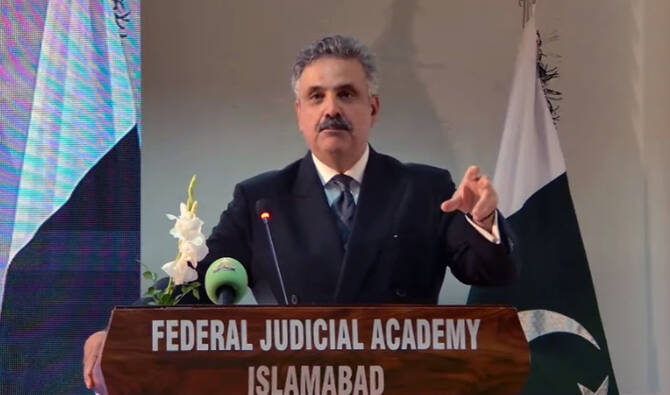
Chief Justice of Pakistan Yahya Afridi speaks during an event at the Federal Judicial Academy in Islamabad on July 25, 2025. (Screengrab/Federal Judicial Academy)
Short Url
Updated 25 July 2025
Follow

Pakistan’s top judge pushes for AI integration in courts, stresses need for ethical safeguards

  • Chief Justice Yahya Afridi says AI can boost efficiency but must not compromise fairness, transparency
  • National Judicial Automation Committee has been tasked with drafting ethical framework for AI use

ISLAMABAD: Chief Justice of Pakistan Yahya Afridi on Friday highlighted his plan to integrate artificial intelligence into the country’s judicial system, saying it could significantly improve the performance of courts while stressing that its adoption must be guided by an ethical framework to ensure responsible use.

Globally, countries are experimenting with AI to improve legal efficiency, with Chinese courts using the technology for evidence analysis and verdict drafting, while the US judiciary deploying it for legal research and risk assessments.

Speaking at a symposium to mark the International Day for Judicial Wellbeing, the chief justice said the judiciary was committed to embracing innovation but not at the cost of fairness or transparency.

Justice Afridi said the National Judicial Automation Committee, chaired by Justice Muhammad Ali Mazhar and comprising judges from the high courts, had been tasked with preparing and recommending ethical guidelines for the use of AI in Pakistan’s judiciary.

“We hope that this initiative, along with the willingness of our judiciary to use AI, will enable us to integrate AI into our processes safely and allow us to make our justice delivery system more efficient, transparent and, above all, citizen-centric,” he said.

While acknowledging the immense potential of AI to improve judicial efficiency, Justice Afridi warned its integration must not be “blind or uncritical,” stressing the need for thoughtful deliberation on the complex ethical concerns it raises.

International experts have also warned that opaque algorithms, AI-generated recommendations and the replacement of human judgment in nuanced cases could undermine judicial impartiality and public trust.

The chief justice’s address also outlined a broader judicial reform agenda focused on improving institutional support, promoting fairness and enhancing the wellbeing of judges, particularly at the district level.

He expressed pride in the district judiciary and pledged to continue reforms that protect their dignity, provide necessary resources and help them deliver justice more effectively.

“It is my firm resolve as the Chief Justice of Pakistan to support you through reforms that protect your wellbeing, affirm your dignity and provide the resources you need to perform your best,” he told the gathering.

He added that a judge who is institutionally supported is better equipped to be “fair, focused and effectively responsive.”


IMF mission begins talks in Islamabad as Pakistan seeks next program review

Updated 5 sec ago
Follow

IMF mission begins talks in Islamabad as Pakistan seeks next program review

  • Finance ministry confirms ‘kick-off meeting’ with visiting IMF delegation
  • Review critical for next tranche under $7 billion bailout program

Karachi: Pakistan began formal talks with a visiting International Monetary Fund (IMF) delegation on Monday as the country prepares for the next review of its $7 billion bailout program.

The IMF team is in Pakistan to conduct a review under the Extended Fund Facility (EFF) approved in September 2024, a multi-year program aimed at stabilizing the economy after a balance-of-payments crisis, high inflation and dwindling foreign exchange reserves.

Pakistan has so far received roughly $3 billion of the EFF. Successful completion of the latest review could pave the way for the release of the next tranche of funds, subject to IMF board approval.

Separately in 2024, Pakistan also secured about $1.3 billion under the IMF’s Resilience and Sustainability Facility, a climate-focused funding window aimed at strengthening the country’s capacity to manage environmental and disaster-related risks.

“Kick-off meeting with IMF Mission held today,” the finance ministry said on Monday as it shared visuals of Finance Minister Muhammad Aurangzeb and senior officials meeting the delegation in Islamabad.

IMF country representative in Pakistan, Mahir Binici, told Arab News in an emailed statement; 

“An IMF mission led by Ms. Iva Petrova has started discussions with the authorities in Karachi and Islamabad on the third review of Pakistan’s Extended Fund Facility (EFF) arrangement and the second review of the Resilience and Sustainability Facility (RSF).”

The discussions are expected to focus on Pakistan’s fiscal performance, revenue collection targets, structural reform implementation and broader macroeconomic stability measures agreed under the program.

The review comes at a sensitive time for Pakistan’s economy, with rising global oil prices and regional instability adding pressure to inflation and external accounts. Analysts say continued IMF engagement remains crucial for maintaining investor confidence and securing external financing.

Pakistan entered the IMF program to restore macroeconomic stability, strengthen public finances and rebuild foreign exchange reserves. Authorities have repeatedly described the reform agenda as necessary to ensure long-term economic resilience.

Further meetings between technical teams are expected over the coming days.